
Free Verification of Competency (Manual Pallet Jack) Template
Download our Free Verification of Competency (Manual Pallet Jack) Template. This structured DOCX and PDF helps assess operator skills and knowledge.
Free Verification of Competency (Manual Pallet Jack) Template
DOCX • 140 KB + PDF
Updated Oct 2026
No signup required
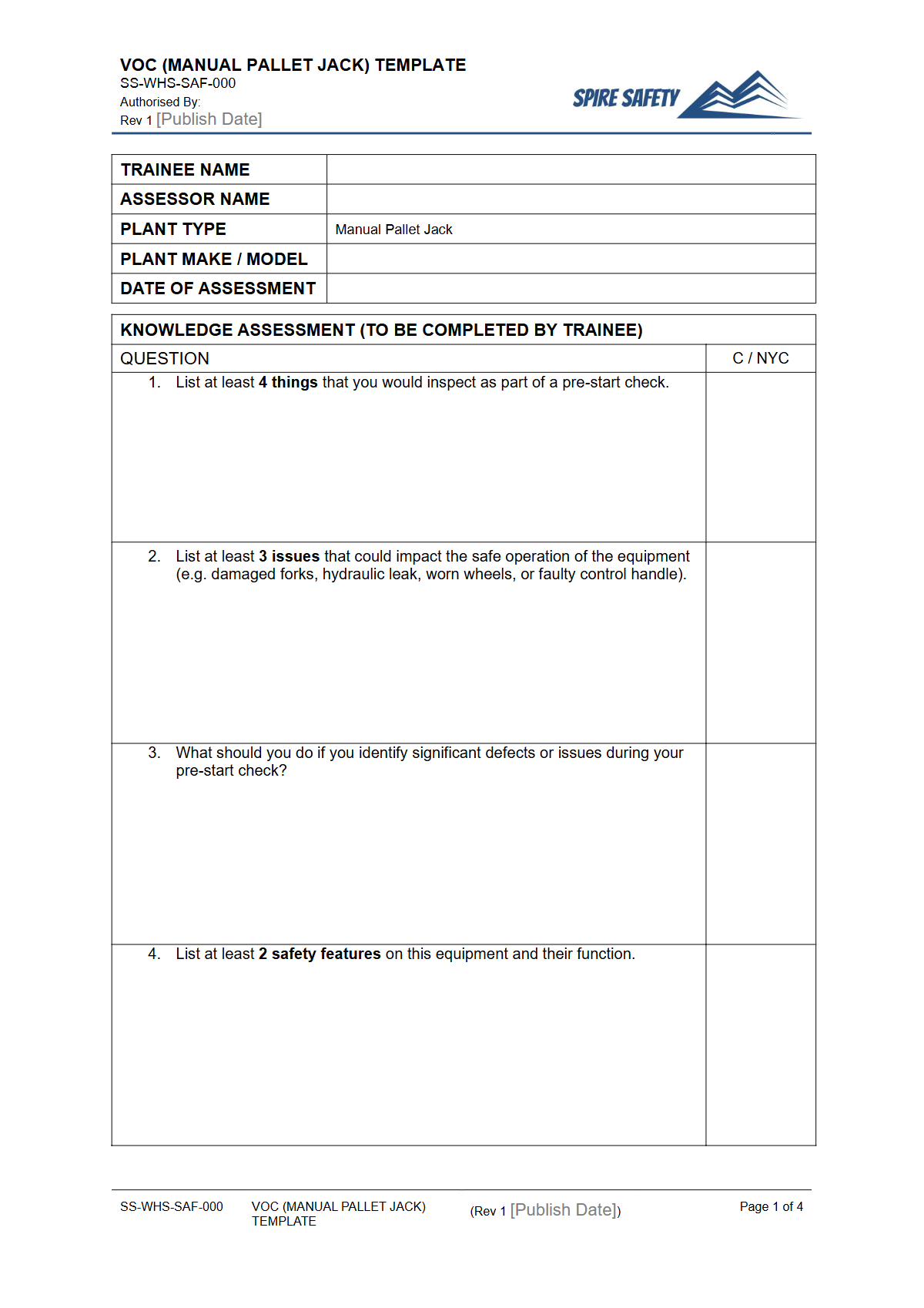
Ensure your workers operate manual pallet jacks safely and competently with our Free Verification of Competency (Manual Pallet Jack) Template. This document provides a structured framework for assessing an operator's skills, knowledge, and ability to handle this common piece of warehouse equipment according to safe work practices. Available for immediate download in both DOCX and PDF formats, this template is designed to be adapted to your specific workplace needs, helping your organisation meet its Work Health and Safety (WHS) obligations.
Video walkthrough
Purpose of the Free Verification of Competency (Manual Pallet Jack) Template
A Verification of Competency (VOC) is a formal process to confirm that a person currently possesses the skills and knowledge required to perform a task safely. It's not a substitute for initial training but rather a way to verify that those skills haven't faded over time.
This template's purpose is to guide a competent assessor in observing and questioning an operator to ensure they can use a manual pallet jack without endangering themselves or others. Properly documented VOCs are a key part of demonstrating due diligence and are often reviewed during a WHS compliance audit.
While manual pallet jacks may seem simple, their incorrect use can lead to serious musculoskeletal injuries or incidents involving dropped loads. Using a structured VOC process demonstrates a commitment to managing these risks. The principles are similar for other types of equipment, whether it's a simple tool or more complex machinery like that covered in our Verification of Competency (Rough Terrain Forklift) template.
How to use the Free Verification of Competency (Manual Pallet Jack) Template
Using this resource involves an assessor—typically a supervisor or other competent person—observing an operator as they perform a series of tasks with a manual pallet jack. The assessor uses the checklist to record whether the operator’s performance meets the required standard for each criterion.
The process generally includes a combination of practical demonstration and theoretical questions to check underpinning knowledge.
Key Components of the Template
- Pre-Operational Checks: Assesses the operator's ability to inspect the pallet jack for faults or damage before use, checking wheels, hydraulic systems, and handles.
- Operational Assessment: Evaluates practical skills such as correct body positioning, manoeuvring in tight spaces, safely lifting and lowering loads, and parking the jack correctly.
- Theory Questions: A set of questions to confirm understanding of load stability, workplace-specific hazards, and emergency procedures.
Important: This document is a template, not a finished procedure. We strongly advise that you customise it to reflect the specific types of pallet jacks, typical loads, and unique environmental conditions of your workplace. Integrating such customised documents is a core part of effective WHS management systems.
When to use it
A VOC for a manual pallet jack is not a one-off event. It should be conducted at several key points to ensure ongoing competence and safety. Consider using this template in the following situations:
- Pre-Employment: To verify the skills of a new hire who claims to have prior experience.
- Post-Incident: As part of an investigation after an incident or near-miss involving a pallet jack.
- Introduction of New Equipment: When a new model of pallet jack with different features is introduced.
- Periodic Re-assessment: On a regular basis (e.g., every one to two years) as part of a general safety program to prevent skill degradation.
This proactive approach helps maintain a consistent standard of safety across your operations. The same logic applies to many other common tools found on a worksite, as seen in resources like our Free Pressure Cleaner VOC (Verification of Competency) Template.
Who should use it
This template is designed for use by individuals responsible for workplace safety and operational supervision. This includes:
- WHS Managers and Advisors: To implement a standardised process for competency verification across the organisation.
- Supervisors and Team Leaders: To conduct on-the-floor assessments of their team members.
- Internal Trainers and Assessors: As a tool for formal competency assessments.
- Human Resources/Recruitment Staff: To integrate into the onboarding process for new employees in operational roles.
If you require assistance in adapting this template or developing a broader competency framework for your business, consider seeking expert guidance through WHS consulting. You can also browse our extensive free WHS resources library for other useful templates and guides.
Common mistakes
Common mistakes to avoid
- Using a generic VOC template without customising it for site-specific equipment and risks.
- Treating the assessment as a training session instead of a verification of existing skills.
- Failing to properly document the VOC outcome and any required corrective actions.
- Appointing an assessor who lacks the experience to judge operator competency effectively.
Legal references
Legal considerations
The following legal requirements may be relevant to this type of work.
- Work Health and Safety Act (Harmonised) — Provides the primary duties for protecting workers and other people from work health and safety risks.
- Work Health and Safety Regulations (Harmonised) — Sets out requirements supporting the management of workplace hazards and risks.
The following codes may be relevant to this type of work.
- Managing WHS Risks Code of Practice — Provides practical guidance on identifying hazards, assessing risks and applying effective controls.
- Work Health and Safety Consultation, Cooperation and Coordination Code of Practice — Provides practical guidance on consulting workers and coordinating with other duty holders.
- Managing the Work Environment and Facilities Code of Practice — Provides practical guidance on safe work environments, workplace facilities and related controls.
Did you know
Musculoskeletal Risks
Incorrect manual pallet jack use is a leading cause of musculoskeletal injuries like sprains and strains, particularly to the back, shoulders, and arms.
No Licence Required
Unlike forklifts, manual pallet jacks do not require a high-risk work licence in Australia, but employers still have a legal duty to ensure operators are competent.
FAQ
Frequently asked questions
01What is the difference between a Verification of Competency and a licence?
02How often should a manual pallet jack VOC be completed?
03Who can conduct a Verification of Competency?
04Is a manual pallet jack considered 'plant' under WHS law?
Share this resource
Free Verification of Competency (Manual Pallet Jack) Template
Browse Categories
How To Use It
- 1Download and open in Word or PDF.
- 2Replace the placeholders with your business details.
- 3Get it reviewed by a WHS specialist before rollout.
Need it customised?
Our WHS consultants can adapt this template to your site, run a gap analysis, or audit what you already have in place.
Book a Free Consultation WHS consulting servicesor call 1300 156 382
Related templates
- Free Verification of Competency (Material Hoist) Template
- Free Verification of Competency (Mobile Crane) Template
- Free Verification of Competency (Mulcher Attachment) Template
- Free Verification of Competency (Order Picker) Template
- Free Verification of Competency (Parts Washer) Template
- Free Verification of Competency (Pedestal Grinder) Template