
Free Verification of Competency (Pedestal Grinder) Template
Download our free Verification of Competency (Pedestal Grinder) Template. This DOCX & PDF resource helps you assess operator skills and safety knowledge.
Free Verification of Competency (Pedestal Grinder) Template
DOCX • 138 KB + PDF
Updated Oct 2026
No signup required
Purpose of the Free Verification of Competency (Pedestal Grinder) Template
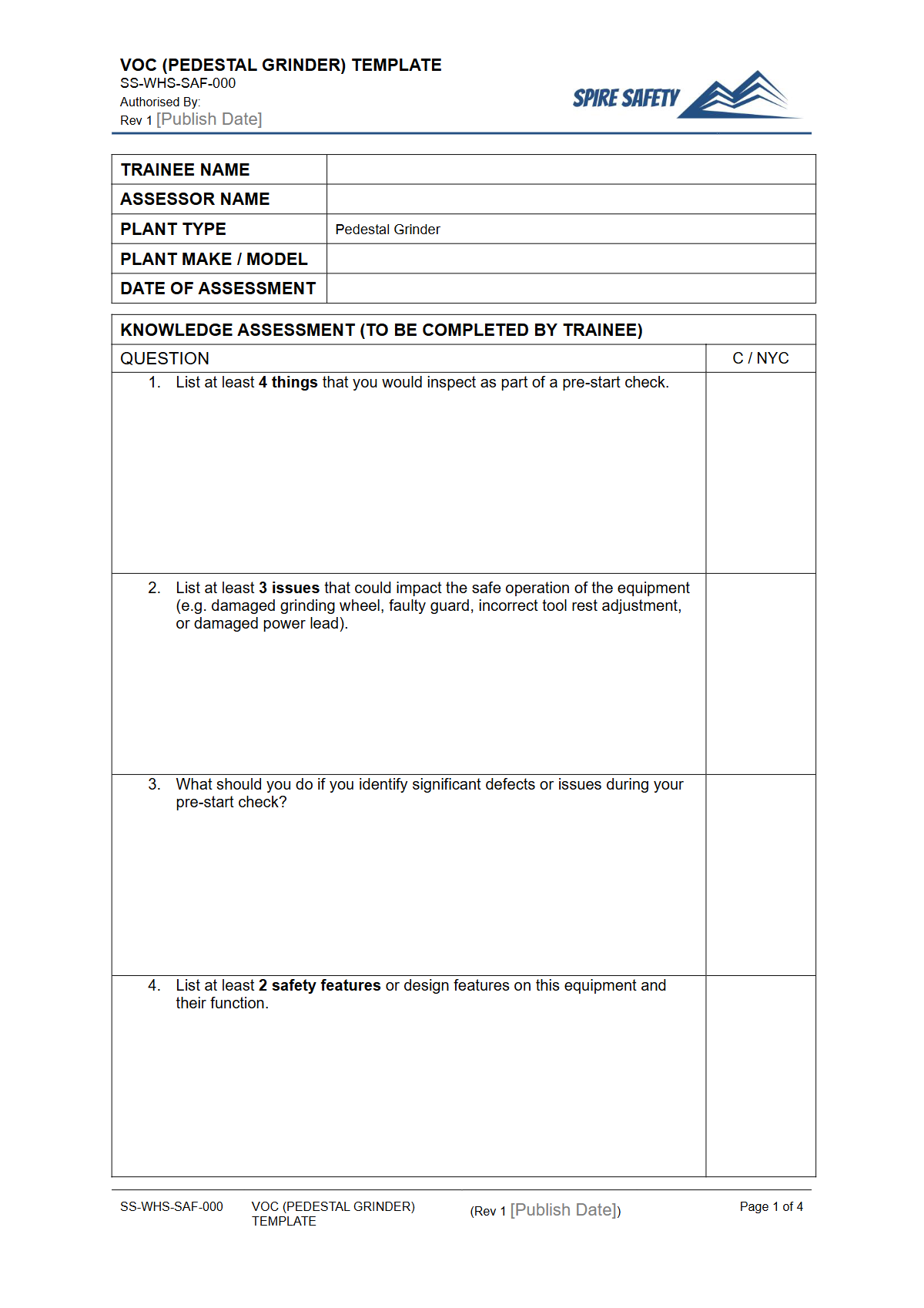
This Free Verification of Competency (Pedestal Grinder) Template provides a structured framework for assessing and confirming a worker’s ability to operate a pedestal grinder safely. It is designed to help a Person Conducting a Business or Undertaking (PCBU) meet their primary duty of care by ensuring workers are competent for the tasks they perform.
Using this document helps formalise the assessment process, creating a clear record that an individual possesses the necessary skills and safety awareness for the specific equipment used in your workplace.
A documented VOC process demonstrates a commitment to safety and is a crucial element of proactive risk management. Integrating such checks is a key function of effective WHS management systems, moving beyond initial training to confirm ongoing competence.
This template is aligned with Australian WHS principles, providing a solid starting point for organisations in any industry where pedestal grinders are used, from manufacturing workshops to maintenance facilities.
Video walkthrough
How to use the Free Verification of Competency (Pedestal Grinder) Template
This template is designed for practical, on-the-job assessment. The process involves a combination of theoretical questions and direct observation of a worker operating the equipment.
The assessor uses the checklist to verify knowledge of pre-start checks, safe operating techniques, hazard identification (e.g., wheel condition, guard adjustment), and correct shutdown procedures.
To effectively use this resource:
- Download the template in your preferred format (DOCX for easy editing or PDF).
- Customise the checklist to align with your specific machinery and internal safety rules.
- Have a competent person (like a supervisor or trainer) conduct the assessment.
- Observe the operator performing tasks with the pedestal grinder in a typical work scenario.
- Ask the operator the provided knowledge-based questions to confirm their understanding.
- Document the results, provide feedback, and outline any corrective actions if competency gaps are identified.
Please note: This is a template only. We have provided a comprehensive starting point, but you must customise this document to reflect your specific site, the make and model of your pedestal grinder, your safe work procedures, and the unique risks in your workplace.
When to conduct a VOC
A Verification of Competency is not a one-time event. It should be conducted at key points in a worker's employment lifecycle to ensure skills remain current and relevant to the work environment.
For assessing competence on similar workshop equipment, you may also find our Free Drill Press VOC (Verification of Competency) Template useful.
Key Triggers for Assessment
- Pre-Employment or Pre-Task: Before a new employee begins work, or when an existing employee is assigned to use a pedestal grinder for the first time.
- Post-Training: To verify that skills and knowledge learned during a training course have been successfully transferred to the workplace.
- Post-Incident: Following a near miss or incident involving a pedestal grinder to identify and rectify any competency-related contributing factors.
- Periodic Refreshers: At regular intervals (e.g., every 1-3 years) as part of an ongoing competency maintenance program.
While this document focuses on fixed grinders, other types of grinding equipment require their own specific assessments. You might also need our Free Angle Grinder VOC (Verification of Competency) Template for portable units.
Who should conduct the assessment?
The person conducting the VOC must be competent and qualified to do so. This means they should not only be an expert in operating the pedestal grinder but also have a thorough understanding of the relevant safety procedures, risks, and controls.
They must be able to make an objective and informed judgement about the worker's abilities. The assessor could be a supervisor, a leading hand, an internal WHS advisor, or an external specialist.
Keeping detailed and accurate VOC records is essential for demonstrating due diligence. These documents provide tangible evidence that your organisation is actively verifying worker skills, a critical point often examined during a WHS compliance audit. Clear records protect both the business and its workers by ensuring only competent individuals operate potentially hazardous machinery.
The principles of competency verification apply to a wide range of plant and equipment. While this document covers pedestal grinders, assessing competence on other machinery, like that covered in our Verification of Competency (Floor Grinder) Template, requires its own tailored approach and a specifically designed assessment tool.
Common mistakes
Common mistakes to avoid
- Using a generic template without customising it for the specific make/model of the grinder and site-specific procedures.
- The assessor lacking sufficient expertise on the pedestal grinder, leading to an inaccurate or incomplete assessment.
- Treating the VOC as a 'tick and flick' exercise instead of a thorough observation of practical skills and knowledge.
- Failing to document and implement corrective actions, such as further training, when an operator is found 'not yet competent'.
Legal references
Legal considerations
The following legal requirements may be relevant to this type of work.
- Work Health and Safety Act (Harmonised) — Provides the primary duties for protecting workers and other people from work health and safety risks.
- Work Health and Safety Regulations (Harmonised) — Sets out requirements supporting the management of workplace hazards and risks.
The following codes may be relevant to this type of work.
- Managing WHS Risks Code of Practice — Provides practical guidance on identifying hazards, assessing risks and applying effective controls.
- Work Health and Safety Consultation, Cooperation and Coordination Code of Practice — Provides practical guidance on consulting workers and coordinating with other duty holders.
- Managing the Work Environment and Facilities Code of Practice — Provides practical guidance on safe work environments, workplace facilities and related controls.
Did you know
Wheel Speed Matters
The RPM rating on a grinding wheel must be equal to or greater than the maximum speed of the grinder. Mounting a wheel with a lower RPM rating than the grinder can cause it to shatter during operation.
The 'Ring Test'
Before mounting a new vitrified grinding wheel, a 'ring test' should be performed by tapping it gently. A clear metallic tone indicates the wheel is free from cracks or damage that could cause it to fail.
FAQ
Frequently asked questions
01What is a Verification of Competency (VOC) for a pedestal grinder?
02Is a VOC the same as a qualification or licence?
03How often should a pedestal grinder VOC be conducted?
04Who is qualified to conduct a VOC on a pedestal grinder?
Share this resource
Free Verification of Competency (Pedestal Grinder) Template
Browse Categories
How To Use It
- 1Download and open in Word or PDF.
- 2Replace the placeholders with your business details.
- 3Get it reviewed by a WHS specialist before rollout.
Need it customised?
Our WHS consultants can adapt this template to your site, run a gap analysis, or audit what you already have in place.
Book a Free Consultation WHS consulting servicesor call 1300 156 382
Related templates
- Free Verification of Competency (Pick and Carry Crane) Template
- Free Verification of Competency (Pipe Bender) Template
- Free Verification of Competency (Plasma Cutter) Template
- Free Verification of Competency (Pole Hedge Trimmer) Template
- Free Verification of Competency (Pole Saw) Template
- Free Verification of Competency (Pop Rivet Gun) Template