
Free Verification of Competency (Plasma Cutter) Template
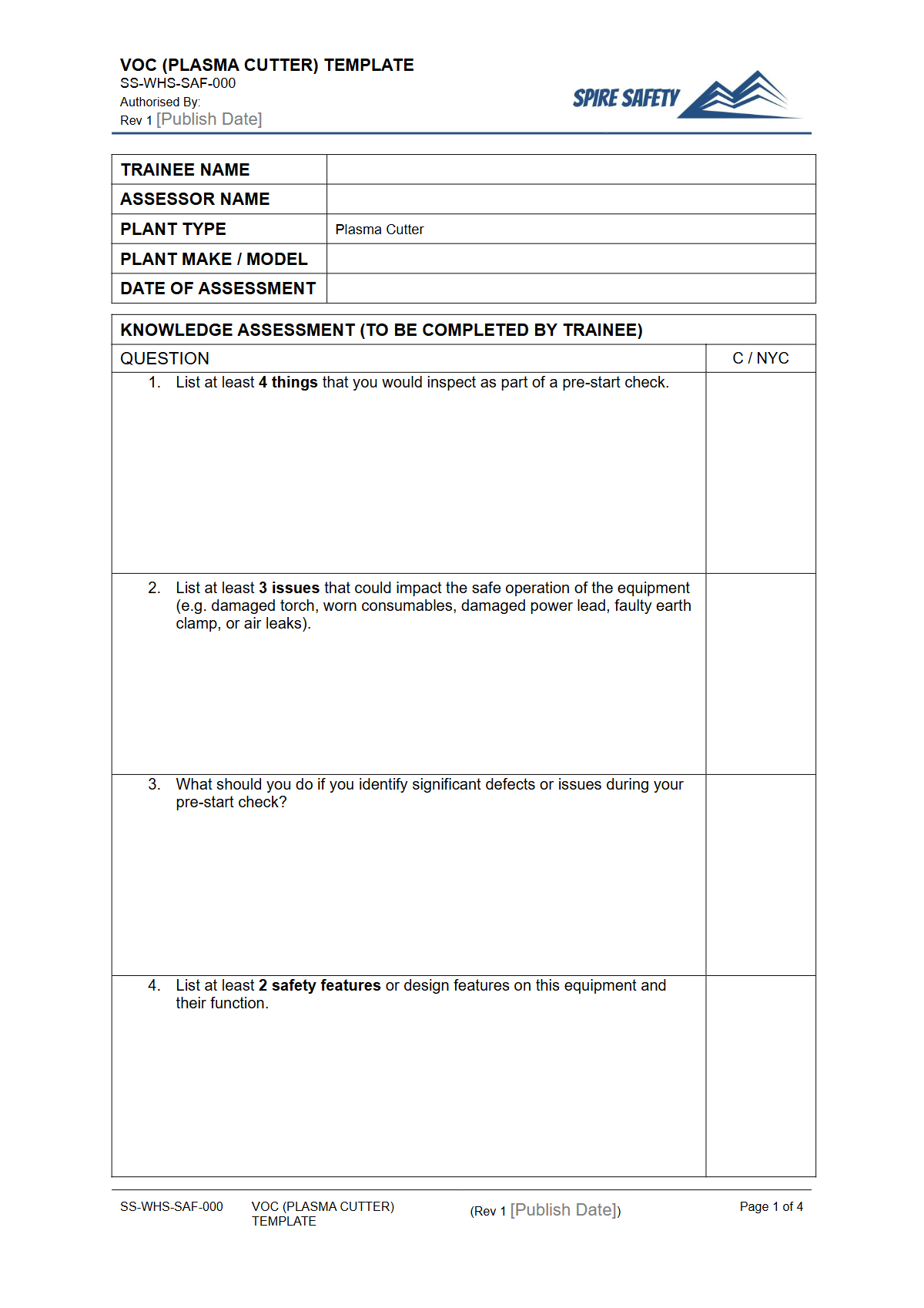
Assess plasma cutter operator skills with our free Verification of Competency (Plasma Cutter) Template.
Free Verification of Competency (Plasma Cutter) Template
DOCX • 138 KB + PDF
Updated Oct 2026
No signup required
Purpose of the Free Verification of Competency (Plasma Cutter) Template
Ensuring workers can safely operate high-risk equipment is a critical part of a PCBU’s duty of care. Our Free Verification of Competency (Plasma Cutter) Template provides a structured framework for assessing and documenting that an operator has the required skills, knowledge, and safe work behaviours.
This process goes beyond initial training, verifying that competence is maintained over time. Plasma cutters introduce significant hazards, including severe burns from molten metal, electric shock, intense ultraviolet (UV) radiation, and exposure to toxic fumes. Using this VOC template helps formalise the assessment process, creating a clear record of competence that forms a vital part of your overall WHS management systems.
Video walkthrough
How to use the Free Verification of Competency (Plasma Cutter) Template
This template is designed for practical, on-the-job assessment by a competent individual. It guides the assessor through observing the operator perform key tasks, from pre-start checks to safe shutdown procedures, while adhering to required safety protocols.
Steps for Implementation:
- Download the template in your preferred format (DOCX for easy editing or PDF).
- Customise the checklist to match the specific make and model of the plasma cutter used in your workplace, the types of materials being cut, and your site-specific Safe Work Method Statement (SWMS).
- Provide the customised checklist to a person who is competent and experienced in both the operation of the equipment and in conducting assessments.
- The assessor observes the operator performing the tasks outlined in the checklist in a controlled, real-world or simulated environment.
- The assessor completes the form, making detailed notes on observed behaviours and asking clarifying questions to test the operator’s underpinning knowledge.
- The results are reviewed with the operator, highlighting areas of strength and identifying any gaps where further training or supervision is needed.
- The completed VOC form is signed by both parties and filed as a permanent training record. This process is similar for other workshop tools, as shown in our Free Drill Press VOC (Verification of Competency) Template.
Important: This document is a template designed as a starting point. We have provided a structured foundation aligned with Australian WHS practice, but you must customise it to fit the unique requirements and risks of your organisation and the specific equipment in use.
When to Conduct a Plasma Cutter VOC
Verification of Competency is not a one-off event. It should be integrated into your safety procedures and conducted at several key points to ensure ongoing safety and skill retention. Consider using this template in the following situations:
- Pre-Employment: To verify the claimed experience of new hires before they are authorised to operate equipment unsupervised.
- Post-Training: To confirm that skills learned during a training course have been successfully transferred to the workplace.
- Introduction of New Equipment: When a new or different model of plasma cutter is introduced to the workplace.
- Post-Incident: Following any incident, accident, or near-miss involving a plasma cutter to identify and correct any unsafe behaviours or knowledge gaps.
- Periodic Re-assessment: On a regular basis (e.g., annually or biennially) as part of a skills maintenance program, a key activity often reviewed during WHS compliance audits.
- Identified Performance Issues: If a supervisor or co-worker raises concerns about an operator's safety practices or skill level.
The consistent use of VOCs for various equipment, such as that detailed in our Free Pressure Cleaner VOC (Verification of Competency) Template, helps build a robust safety culture.
Who Should Conduct the Assessment
The credibility and effectiveness of a VOC depend entirely on the person conducting it. The assessor must be a subject matter expert with the authority and knowledge to make a valid judgement on another person's competence. Suitable individuals typically include:
- Experienced Supervisors or Foremen: Individuals with extensive, hands-on experience with the specific plasma cutter and a deep understanding of the associated risks and safe work procedures.
- Internal Trainers/Assessors: Designated personnel within the organisation who have formal qualifications in training and assessment (such as a TAE40116 Certificate IV) in addition to their technical expertise.
- WHS Managers and Advisors: Provided they possess the practical skills and technical knowledge of plasma cutting operations, not just theoretical safety knowledge.
- External Specialists: Third-party experts or consultants can be engaged to provide an independent and objective assessment, which can be particularly useful for complex or high-risk operations. For guidance on finding the right expert, our WHS consulting services can assist.
Ultimately, the assessor must be deemed competent themselves and be confident in their ability to evaluate others against the established criteria for a range of machinery, including those covered by our Verification of Competency (Wrecker or Impact Wrench) template.
Common mistakes
Common mistakes to avoid
- Failing to clear the work area of flammable or combustible materials before starting to cut.
- Neglecting to inspect the torch, consumables (electrode, nozzle), and earth clamp for damage before use.
- Using the equipment in a poorly ventilated area, leading to the inhalation of hazardous fumes and metal oxides.
- Setting incorrect parameters (e.g., amperage, air pressure) for the material thickness, resulting in poor cut quality and increased dross.
Legal references
Legal considerations
The following legal requirements may be relevant to this type of work.
- Work Health and Safety Act (Harmonised) — Provides the primary duties for protecting workers and other people from work health and safety risks.
- Work Health and Safety Regulations (Harmonised) — Sets out requirements supporting the management of workplace hazards and risks.
The following codes may be relevant to this type of work.
- Managing WHS Risks Code of Practice — Provides practical guidance on identifying hazards, assessing risks and applying effective controls.
- Work Health and Safety Consultation, Cooperation and Coordination Code of Practice — Provides practical guidance on consulting workers and coordinating with other duty holders.
- Managing the Work Environment and Facilities Code of Practice — Provides practical guidance on safe work environments, workplace facilities and related controls.
Did you know
Extreme Temperatures
The plasma arc generated by a cutter can reach temperatures exceeding 22,000°C. This extreme heat can instantly vaporise metal, requiring strict controls to manage fire, burn, and fume hazards.
UV Radiation Hazard
A plasma arc produces intense ultraviolet (UV) and infrared (IR) radiation, similar to arc welding. Unprotected exposure can cause severe skin burns and 'arc eye' (photokeratitis), a painful eye condition, necessitating full-coverage PPE including rated face shields and gloves.
FAQ
Frequently asked questions
01What is a Verification of Competency for a plasma cutter?
02Is a plasma cutter ticket or licence required in Australia?
03How often should a plasma cutter VOC be conducted?
04Who can conduct a Verification of Competency for a plasma cutter?
Share this resource
Free Verification of Competency (Plasma Cutter) Template
Browse Categories
How To Use It
- 1Download and open in Word or PDF.
- 2Replace the placeholders with your business details.
- 3Get it reviewed by a WHS specialist before rollout.
Need it customised?
Our WHS consultants can adapt this template to your site, run a gap analysis, or audit what you already have in place.
Book a Free Consultation WHS consulting servicesor call 1300 156 382
Related templates
- Free Verification of Competency (Pole Hedge Trimmer) Template
- Free Verification of Competency (Pole Saw) Template
- Free Verification of Competency (Pop Rivet Gun) Template
- Free Verification of Competency (Portable Water Pump) Template
- Free Verification of Competency (Portable Welding Machine) Template
- Free Verification of Competency (Post Hole Digger or Auger) Template