
Free Verification of Competency (Portable Welding Machine) Template
Verify operator competence for portable welding machines with our structured template. Aligned with Australian WHS practice. Download your free Word doc today.
Free Verification of Competency (Portable Welding Machine) Template
DOCX • 138 KB + PDF
Updated Oct 2026
No signup required
Purpose of the Free Verification of Competency (Portable Welding Machine) Template
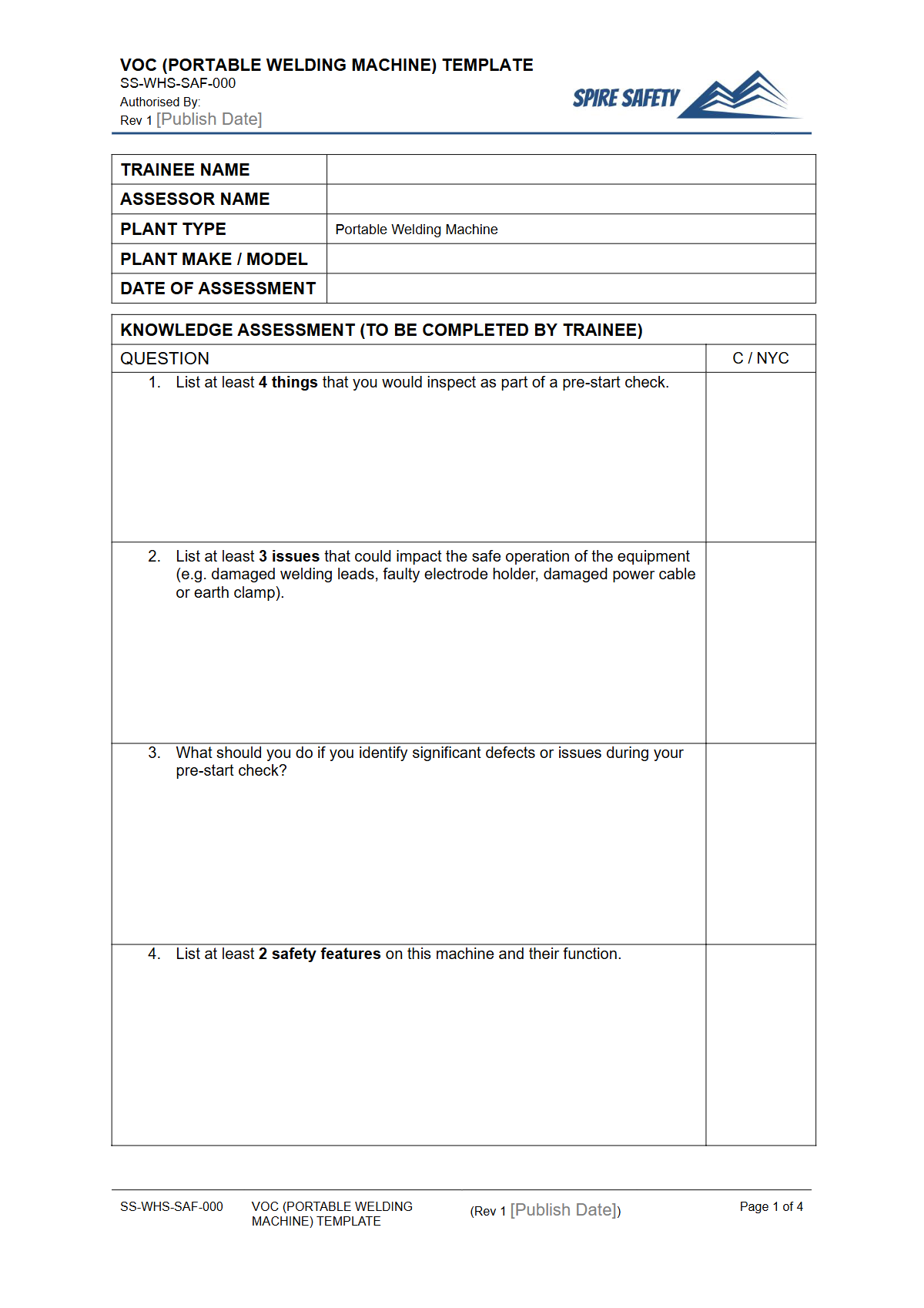
This free Verification of Competency (Portable Welding Machine) Template provides a structured starting point for organisations to confirm that their workers have the necessary skills and knowledge to operate portable welding equipment safely and effectively. Using a portable welder involves significant risks, including electric shock, burns, exposure to harmful fumes, and fire.
A formal VOC process helps a Person Conducting a Business or Undertaking (PCBU) meet their primary duty of care by ensuring operators are competent, not just trained. It serves as a critical record demonstrating that you have taken reasonably practicable steps to manage risks associated with welding tasks.
This process is a key component of building and maintaining effective WHS management systems, reinforcing a culture of safety and operational excellence.
Video walkthrough
How to use the Free Verification of Competency (Portable Welding Machine) Template
Our template is provided in an editable DOCX format, allowing for full customisation. Before use, it is essential to adapt the document to your specific workplace environment, the exact models of portable welders in use, and the unique tasks your operators will perform.
This includes adding your company branding and modifying the criteria to reflect your Safe Work Method Statements (SWMS) and operational procedures. The process should involve a competent assessor observing the operator performing tasks, supplemented by theoretical questions to gauge their understanding of WHS principles, equipment manuals, and emergency procedures.
The outcome should be clearly documented, with any identified gaps in competency addressed through further training. Regular reviews of your VOC process are beneficial and often form part of comprehensive WHS compliance audits.
A Note on Customisation
This document is a template only. It must be customised to suit the specific needs of your business, the equipment being used, and the environment it is used in.
We are not responsible for any incidents or compliance breaches that may arise from the use of this template.
When to Use a VOC
A Verification of Competency for a portable welding machine should be conducted at several key points. It is crucial during the pre-employment or onboarding process to validate a new hire's claimed skills.
It should also be performed when a worker is required to use a new or different model of portable welder, after a significant period of not using the equipment, or following an incident or near-miss involving welding operations. Periodic reassessments (e.g., every one to two years) are also a standard practice to ensure skills and safety knowledge remain current.
The VOC is not a substitute for initial training but a confirmation of ongoing competence. For other portable tools, you might find our free Drill Press VOC template useful for establishing a similar process.
Who Should Use This Template
This template is designed for use by individuals responsible for workplace safety and operational supervision. This typically includes Safety Managers, WHS Advisors, Site Supervisors, and qualified trainers and assessors.
The person conducting the VOC must be competent themselves—they should possess in-depth knowledge of the specific portable welder, extensive practical experience, and a thorough understanding of the relevant Australian WHS regulations and codes of practice for welding. They must be able to make a sound judgement about another person's competency in a fair and structured manner.
This structured approach is applicable across various high-risk equipment, as seen in our Verification of Competency (Mini Excavator) Template which follows a similar assessment philosophy.
By implementing a robust VOC program, your organisation can minimise risks and improve safety outcomes. This template provides the framework, but its effectiveness relies on diligent customisation and implementation.
While this document covers welding equipment, similar principles apply to other site-based machinery. For instance, our free Pressure Cleaner VOC template can help you assess competency for high-pressure water jetting tasks.
You can explore our complete free WHS resources library for more templates to support your safety management system.
Common mistakes
Common mistakes to avoid
- Treating the VOC as a simple 'tick and flick' paperwork exercise without meaningful observation.
- Using a generic assessor who is not familiar with the specific make and model of the portable welder.
- Failing to document and follow up on corrective actions when an operator is found 'Not Yet Competent'.
- Overlooking site-specific hazards like welding in confined spaces, near flammable materials, or in wet conditions during the assessment.
Legal references
Legal considerations
The following legal requirements may be relevant to this type of work.
- Work Health and Safety Act (Harmonised) — Provides the primary duties for protecting workers and other people from work health and safety risks.
- Work Health and Safety Regulations (Harmonised) — Sets out requirements supporting the management of workplace hazards and risks.
The following codes may be relevant to this type of work.
- Managing WHS Risks Code of Practice — Provides practical guidance on identifying hazards, assessing risks and applying effective controls.
- Work Health and Safety Consultation, Cooperation and Coordination Code of Practice — Provides practical guidance on consulting workers and coordinating with other duty holders.
- Managing the Work Environment and Facilities Code of Practice — Provides practical guidance on safe work environments, workplace facilities and related controls.
Did you know
A Carcinogenic Risk
In 2018, the International Agency for Research on Cancer (IARC) reclassified welding fumes from 'possibly carcinogenic' to Group 1 'carcinogenic to humans', placing them in the same category as asbestos.
Engine-Driven Hazards
Portable engine-driven welders present unique hazards not found in electric models, including the risk of carbon monoxide poisoning in poorly ventilated areas, manual handling injuries from refuelling, and increased noise exposure.
FAQ
Frequently asked questions
01What should a portable welding machine VOC cover?
02Is a welding qualification or ticket the same as a VOC?
03How often should I conduct a VOC for a portable welder?
04Can any experienced welder conduct a VOC assessment?
Share this resource
Free Verification of Competency (Portable Welding Machine) Template
Browse Categories
How To Use It
- 1Download and open in Word or PDF.
- 2Replace the placeholders with your business details.
- 3Get it reviewed by a WHS specialist before rollout.
Need it customised?
Our WHS consultants can adapt this template to your site, run a gap analysis, or audit what you already have in place.
Book a Free Consultation WHS consulting servicesor call 1300 156 382
Related templates
- Free Verification of Competency (Post Hole Digger or Auger) Template
- Free Verification of Competency (Power Trowel) Template
- Free Verification of Competency (Random Orbital Sander) Template
- Free Verification of Competency (Reach Forklift) Template
- Free Verification of Competency (Reach Stacker) Template
- Free Verification of Competency (Rebar Bender) Template