
Free Verification of Competency (Reach Stacker) Template
Download our free Verification of Competency (Reach Stacker) template to assess operator skills and support safe operations. Customisable DOCX & PDF.
Free Verification of Competency (Reach Stacker) Template
DOCX • 138 KB + PDF
Updated Oct 2026
No signup required
Purpose of the Free Verification of Competency (Reach Stacker) Template
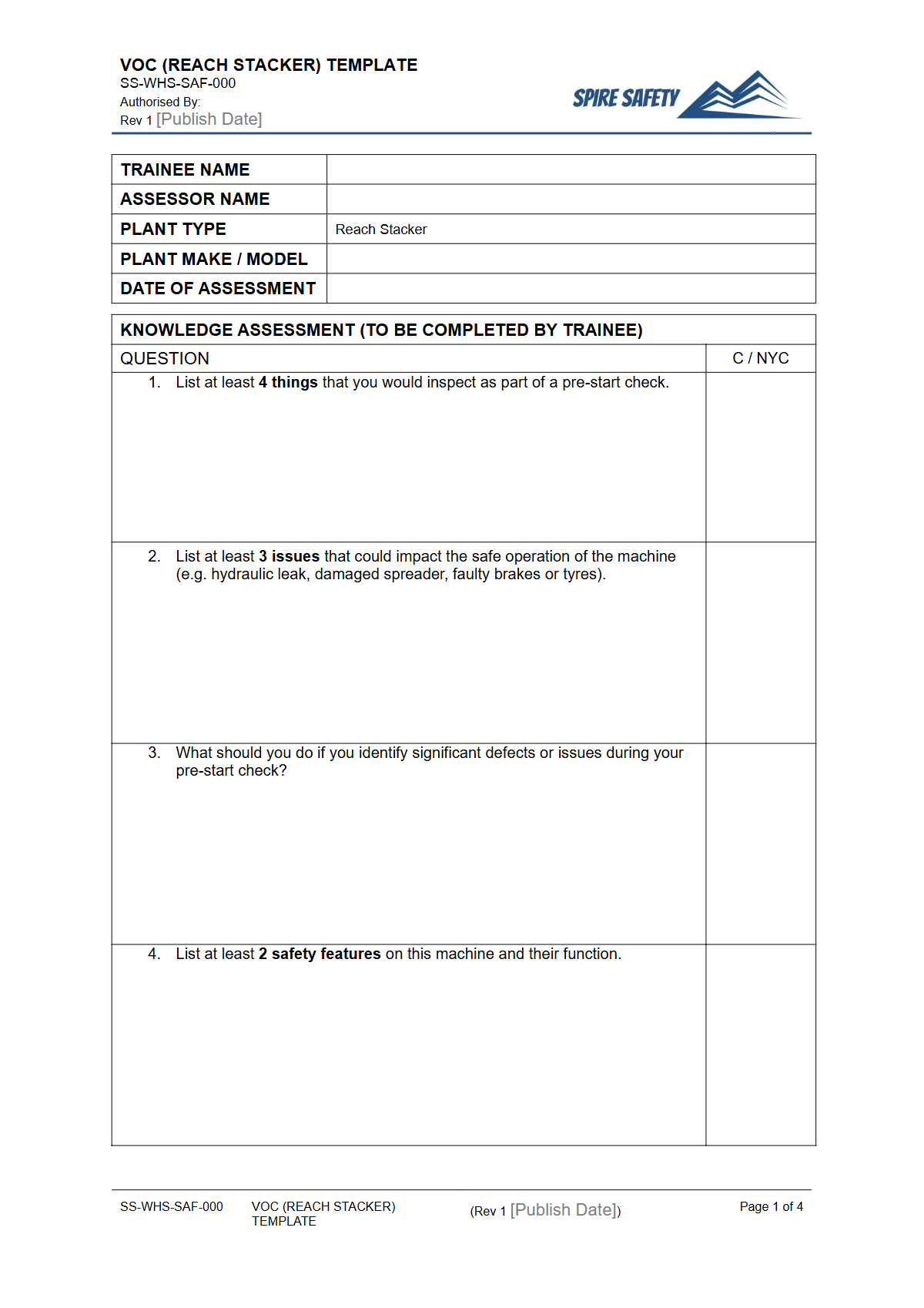
Operating a reach stacker is a high-risk activity that requires significant skill and safety awareness. This Free Verification of Competency (Reach Stacker) Template provides a structured framework for Persons Conducting a Business or Undertaking (PCBUs) to assess and confirm that an operator has the current skills and knowledge to operate the equipment safely.
It goes beyond basic licensing to verify competence in the context of your specific workplace, including its unique layout, procedures, and hazards.
Using a standardised template helps ensure that assessments are conducted consistently and thoroughly for all operators. It provides documented evidence that you have taken steps to verify worker competence, a key part of your primary duty of care under WHS legislation.
The document is designed as a practical tool to integrate into your broader WHS management systems, helping you manage risks associated with mobile plant and materials handling.
What this template covers
This verification of competency tool is structured to assess both theoretical knowledge and practical operational skills. Key areas covered include:
- Pre-operational checks and shutdown procedures.
- Knowledge of the reach stacker's functions, controls, and safety features.
- Hazard identification and risk control measures relevant to the task and environment.
- Safe operating techniques for travelling, lifting, stacking, and destacking containers.
- Understanding of load charts, stability principles, and communication protocols.
- Emergency procedures.
Video walkthrough
How to use the Free Verification of Competency (Reach Stacker) Template
After downloading the template, you should familiarise yourself with its structure. The document is divided into sections for theoretical questions and a practical observation checklist.
The assessor should use these sections to guide their evaluation of the operator. A section is also included to record the assessment outcome, identify any competency gaps, and outline required actions, such as further training or supervision.
Important: This document is a template, not a finished procedure. To be effective, you must customise it to reflect your specific operational environment.
We recommend a competent person reviews and adapts the checklist to include site-specific hazards, policies, procedures, and the specific make and model of the reach stackers used at your workplace. This ensures the verification is relevant and robust.
The process is often more detailed than for smaller equipment, but the principles of assessment are similar to those used in our Verification of Competency (Rough Terrain Forklift) template. The goal is always to create a record that accurately reflects the operator's ability to perform their duties safely on your site.
When to use it
A Verification of Competency is not a one-time event. It should be conducted at various points during an operator's employment to ensure their skills remain current and aligned with site requirements. Common triggers for conducting a VOC include:
- Pre-employment or prior to starting work: To verify the skills and claims of a new operator, even if they hold a valid High Risk Work Licence.
- Introduction of new equipment: When a new model of reach stacker with different controls or features is introduced.
- Post-incident: Following an incident or near-miss involving a reach stacker to identify any gaps in competence that may have contributed.
- Change in operating conditions: If the work environment changes significantly, such as a new yard layout or different types of loads.
- Periodic reassessment: As part of a regular schedule (e.g., every 2-3 years) to ensure skills have not degraded over time. This can be integrated into a program of regular WHS compliance auditing.
Who should use it
This template is designed for use by individuals responsible for workplace health and safety and operational management. This typically includes:
- WHS Managers and Safety Officers
- Operations and Logistics Managers
- Site Supervisors and Team Leaders
- Internal Trainers and Assessors
- External WHS Consultants
The person conducting the VOC must be competent themselves. This means they should have the necessary knowledge, skills, and experience with the specific reach stacker being assessed, as well as an understanding of the assessment process.
This principle applies across all materials handling equipment, from large container handlers to smaller warehouse machines covered in resources like our Verification of Competency (Walkie Stacker) template. If you lack this internal expertise, engaging external specialists through services like WHS consulting can provide the necessary support. Find more helpful documents for a range of plant and equipment in our free WHS resources library.
Common mistakes
Common mistakes to avoid
- Using a generic, non-customised template that doesn't reflect site-specific hazards or equipment.
- Treating the VOC as a paperwork exercise without meaningful, direct observation of the operator.
- Failing to properly document assessment outcomes, corrective actions, and any required retraining.
- Assigning an assessor who is not familiar with or competent on the specific model of reach stacker being assessed.
Legal references
Legal considerations
The following legal requirements may be relevant to this type of work.
- Work Health and Safety Act (Harmonised) — Provides the primary duties for protecting workers and other people from work health and safety risks.
- Work Health and Safety Regulations (Harmonised) — Sets out requirements supporting the management of workplace hazards and risks.
The following codes may be relevant to this type of work.
- Managing WHS Risks Code of Practice — Provides practical guidance on identifying hazards, assessing risks and applying effective controls.
- Work Health and Safety Consultation, Cooperation and Coordination Code of Practice — Provides practical guidance on consulting workers and coordinating with other duty holders.
- Managing the Work Environment and Facilities Code of Practice — Provides practical guidance on safe work environments, workplace facilities and related controls.
Did you know
Lifting Capacity
Modern reach stackers can lift loads exceeding 45 tonnes in the first row. This immense power highlights the critical need for verified operator competence to prevent catastrophic failures.
Complex Manoeuvring
The 'reach' capability allows operators to stack containers up to six high and three rows deep, requiring exceptional spatial awareness and a deep understanding of the machine's stability.
FAQ
Frequently asked questions
01What is the difference between a High Risk Work Licence and a VOC for a reach stacker?
02How often should a reach stacker VOC be conducted?
03Can an internal employee conduct a reach stacker VOC?
04Does this template cover all models of reach stackers?
Share this resource
Free Verification of Competency (Reach Stacker) Template
Browse Categories
How To Use It
- 1Download and open in Word or PDF.
- 2Replace the placeholders with your business details.
- 3Get it reviewed by a WHS specialist before rollout.
Need it customised?
Our WHS consultants can adapt this template to your site, run a gap analysis, or audit what you already have in place.
Book a Free Consultation WHS consulting servicesor call 1300 156 382
Related templates
- Free Verification of Competency (Rebar Bender) Template
- Free Verification of Competency (Rebar Cutter) Template
- Free Verification of Competency (Rebar Tying Gun) Template
- Free Verification of Competency (Ride-On Sweeper) Template
- Free Verification of Competency (Rivet Gun) Template
- Free Verification of Competency (Road Saw or Diamond Blade Saw) Template