
Free Verification of Competency (Ride-On Sweeper) Template
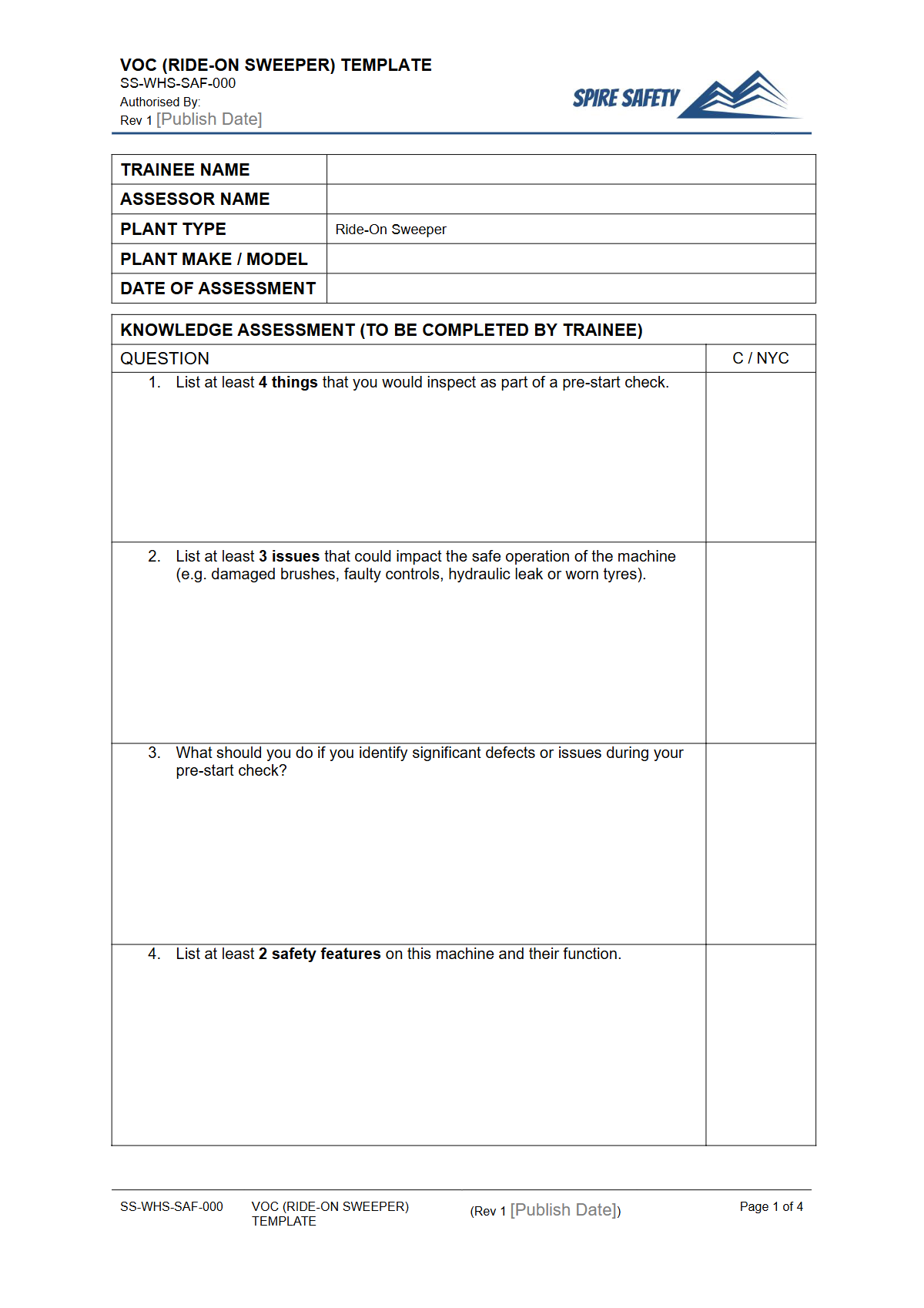
Download our Free Verification of Competency (Ride-On Sweeper) Template in DOCX and PDF. A structured starting point to help assess operator skills and safety.
Free Verification of Competency (Ride-On Sweeper) Template
DOCX • 138 KB + PDF
Updated Oct 2026
No signup required
Purpose of the Free Verification of Competency (Ride-On Sweeper) Template
Ensuring operators can use workplace equipment safely and effectively is a core responsibility for any person conducting a business or undertaking (PCBU). This Free Verification of Competency (Ride-On Sweeper) Template provides a structured starting point for assessing an operator’s ability to use this equipment according to your site’s specific procedures and safety requirements.
A Verification of Competency (VOC) is not a substitute for formal training or licensing; rather, it is a method to verify that the skills learned are being applied correctly in the work environment.
Regularly assessing competence helps manage risks associated with mobile plant, reduces the likelihood of incidents, and demonstrates a commitment to workplace health and safety. The assessment criteria within this template are based on standard Australian WHS practice for mobile plant operation.
Much like using a pressure cleaner VOC template for high-pressure water jetting, this resource is tailored to the unique hazards of sweepers, such as dust exposure, pedestrian interaction, and manoeuvring in confined or busy areas.
Video walkthrough
How to use the Free Verification of Competency (Ride-On Sweeper) Template
Using this template effectively involves more than just a simple download. The process should be integrated into your organisation's safety management framework.
Start by downloading the DOCX file and adapting it to your specific operational context. This is a critical step, as every worksite has unique layouts, traffic rules, and potential hazards.
You must customise the checklist to include site-specific rules, the make and model of the ride-on sweeper being used, and any particular environmental challenges (e.g., slopes, blind corners, hazardous materials). The assessment should then be conducted by a person who is not only competent in operating the ride-on sweeper but also has the skills and knowledge to assess others effectively.
If you are unsure how to tailor this document or implement a VOC program, seeking specialist WHS consulting can provide clarity and direction. Finally, document the assessment outcome and store the record securely.
A Note on Customisation
This document is a template, not a finished product. We have provided it in DOCX format so you can easily modify it.
You must review and amend the contents to ensure it fully addresses the specific equipment, personnel, and risks present in your workplace before use.
When to use it
A VOC for a ride-on sweeper should be performed at several key points to ensure ongoing competence and safety. It is not a one-time event. Consider conducting an assessment:
- Before a worker starts work: To verify the skills and claims made during recruitment.
- When introducing new equipment: If a new make or model of ride-on sweeper is brought to site, operators should be assessed on it.
- Following an incident or near miss: To identify any gaps in skill or knowledge that may have contributed to the event.
- If a performance issue is observed: When a supervisor notices unsafe or incorrect operation.
- As part of a scheduled periodic review: Many organisations schedule VOCs every 2-3 years to ensure skills have not degraded over time.
These assessments form a crucial part of proactive WHS management systems, helping to maintain a consistent standard of safety across the workforce.
Who should use it
This template is designed for use by individuals responsible for workplace safety and operational supervision. This typically includes:
- Work Health and Safety (WHS) Managers and Advisors
- Site Supervisors or Foremen
- Team Leaders
- Internal Trainers and Assessors
The person conducting the assessment must be deemed competent to do so. This means they should have significant experience operating the specific ride-on sweeper, a deep understanding of the associated risks and controls, and the ability to observe, question, and provide constructive feedback to the person being assessed.
The principles are similar whether assessing an operator on a sweeper or conducting a Verification of Competency for a water cart; the assessor's own expertise is paramount.
Documenting these assessments provides tangible evidence of your organisation's efforts to meet its duty of care. Records should be clear, signed, dated, and stored as part of the worker's training file.
These records are often reviewed during WHS compliance audits. Just as you might use a specific VOC template for a mini excavator to address its unique functions, this document focuses on the specific tasks and hazards of ride-on sweepers.
By implementing a robust VOC program, you actively reinforce safe work behaviours and strengthen your safety culture. You can find more templates and checklists to support your WHS framework in our free WHS resources library.
Common mistakes
Common mistakes to avoid
- Using the template 'as is' without customising it for site-specific hazards and machine models.
- Assigning an inexperienced or unqualified person to conduct the assessment.
- Treating the VOC as a 'tick-and-flick' compliance exercise rather than a genuine skills evaluation.
- Failing to keep clear, dated, and signed records of the assessment for each worker.
Legal references
Legal considerations
The following legal requirements may be relevant to this type of work.
- Work Health and Safety Act (Harmonised) — Provides the primary duties for protecting workers and other people from work health and safety risks.
- Work Health and Safety Regulations (Harmonised) — Sets out requirements supporting the management of workplace hazards and risks.
The following codes may be relevant to this type of work.
- Managing WHS Risks Code of Practice — Provides practical guidance on identifying hazards, assessing risks and applying effective controls.
- Work Health and Safety Consultation, Cooperation and Coordination Code of Practice — Provides practical guidance on consulting workers and coordinating with other duty holders.
- Managing the Work Environment and Facilities Code of Practice — Provides practical guidance on safe work environments, workplace facilities and related controls.
Did you know
Dust Control is Critical
Many modern ride-on sweepers feature advanced dust suppression systems, such as water misters. These are vital for controlling airborne contaminants like respirable crystalline silica, a significant workplace health hazard in construction and manufacturing.
FAQ
Frequently asked questions
01Is a Verification of Competency the same as a licence?
02How often should we conduct a VOC for a ride-on sweeper?
03Who is a 'competent person' to conduct this assessment?
04Can this template be used for any brand of ride-on sweeper?
Share this resource
Free Verification of Competency (Ride-On Sweeper) Template
Browse Categories
How To Use It
- 1Download and open in Word or PDF.
- 2Replace the placeholders with your business details.
- 3Get it reviewed by a WHS specialist before rollout.
Need it customised?
Our WHS consultants can adapt this template to your site, run a gap analysis, or audit what you already have in place.
Book a Free Consultation WHS consulting servicesor call 1300 156 382
Related templates
- Free Verification of Competency (Rivet Gun) Template
- Free Verification of Competency (Road Saw or Diamond Blade Saw) Template
- Free Verification of Competency (Rock Grab Attachment) Template
- Free Verification of Competency (Rock Saw Attachment) Template
- Free Verification of Competency (Rotary Hammer) Template
- Free Verification of Competency (Rotary Hoe) Template