
Free Verification of Competency (Rivet Gun) Template
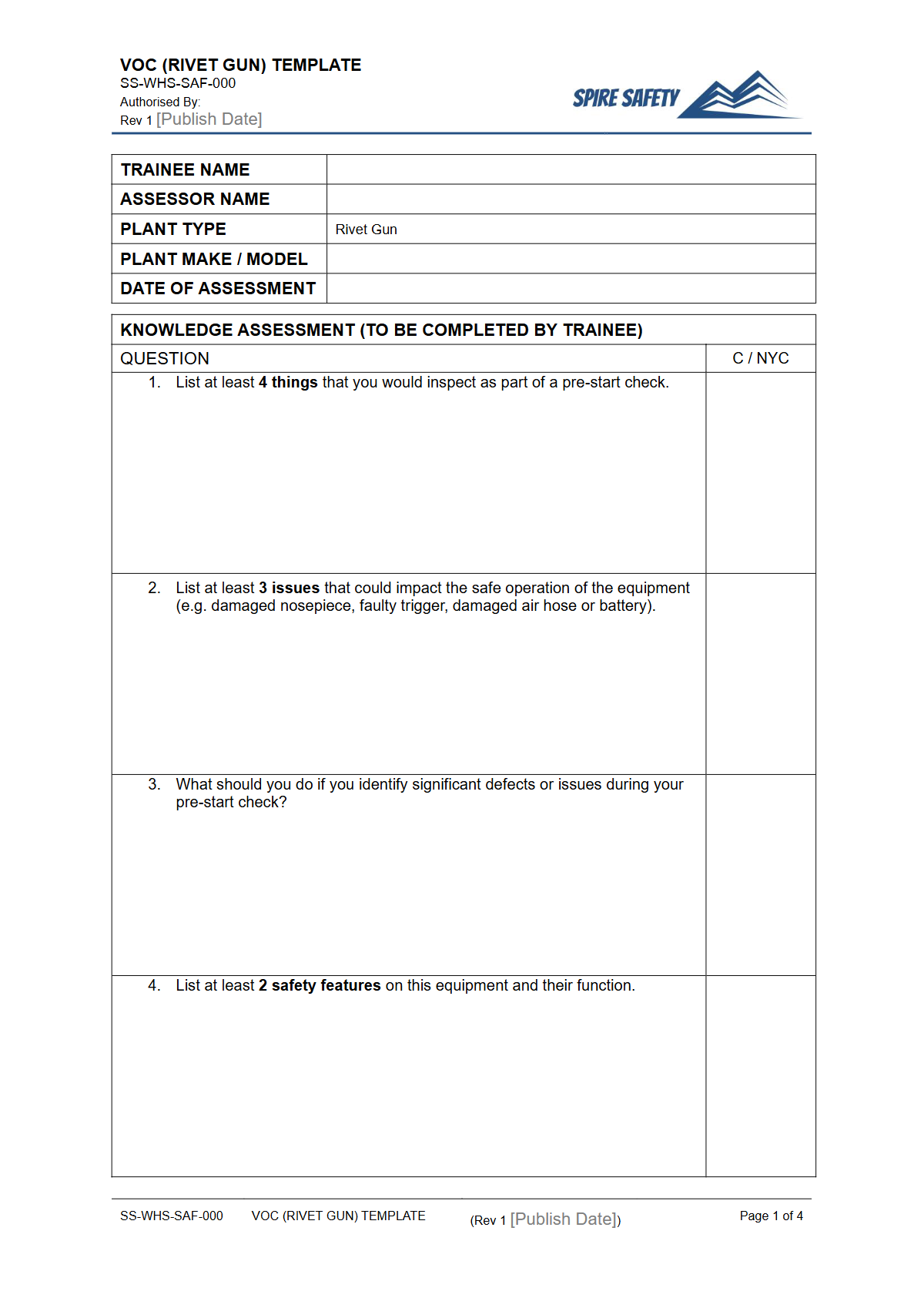
Download our free Verification of Competency (Rivet Gun) template. This structured DOCX & PDF resource helps assess operator skill and safety knowledge.
Free Verification of Competency (Rivet Gun) Template
DOCX • 138 KB + PDF
Updated Oct 2026
No signup required
Purpose of the Free Verification of Competency (Rivet Gun) Template
This free Verification of Competency (Rivet Gun) template is designed to help Australian businesses formally assess an individual's skill and knowledge in operating a rivet gun safely. It serves as documented evidence that a worker can not only perform the task but also understands the associated hazards and control measures.
Using a structured VOC process is a practical way for a Person Conducting a Business or Undertaking (PCBU) to meet their primary duty of care under WHS legislation, which includes ensuring workers are competent for the work they carry out.
A VOC is not a substitute for initial training or licensing but a confirmation of current competence. It verifies that skills learned during training have been retained and can be applied safely in the specific context of your workplace.
Integrating these assessments into your broader WHS management systems helps create a proactive safety culture, identifying knowledge gaps or unsafe behaviours before they lead to an incident. This template provides a solid starting point, aligned with Australian WHS best practices, for assessing operators of various rivet guns, from pneumatic to battery-powered models.
Video walkthrough
How to use the Free Verification of Competency (Rivet Gun) Template
Using this template involves more than just a tick-and-flick exercise. A competent person, who has extensive experience with the specific type of rivet gun being assessed, should conduct the verification.
The process generally involves a combination of theoretical questions and practical observation.
- Step 1: Customise the Template. Review and modify the checklist to reflect the specific makes and models of rivet guns used at your site, the types of rivets and materials involved, and your organisation's safe work procedures. This is a critical step to ensure the assessment is relevant and thorough.
- Step 2: Conduct the Assessment. The assessor should ask the operator questions to gauge their theoretical knowledge of safety features, pre-start checks, PPE requirements, and emergency procedures. This is followed by direct observation of the operator performing tasks, from setting up the tool to completing a job and performing post-operational checks.
- Step 3: Document the Outcome. Record the results directly on the form. If the operator is deemed competent, the signed form should be filed as a training record. If gaps are identified, document the required actions, such as refresher training or a period of supervision, and schedule a future reassessment.
Note: We have developed this resource as a template. It is essential that you customise it to suit the unique circumstances of your workplace, including the specific equipment, environment, and procedures in place. This approach is necessary for other equipment assessments, too, such as our VOC for a wrecker or hydraulic impact wrench.
When to use it
A Verification of Competency for a rivet gun should be conducted at several key points to ensure ongoing safety. It is not a one-time event. Consider using this template in the following situations:
- Pre-employment or pre-start: To verify the skills and claims of new employees or contractors before they begin work.
- Introduction of new equipment: When a new make or model of rivet gun with different features or operating procedures is introduced.
- Post-incident: After an incident or near-miss involving a rivet gun to identify and correct any unsafe practices or knowledge gaps.
- Observed unsafe behaviour: If a supervisor or co-worker observes an operator using the tool in a manner that creates risk.
- Periodic refreshers: As part of a scheduled reassessment program, the frequency of which should be determined by a risk assessment.
Proactively scheduling VOCs is a key component of due diligence and can be reviewed during a formal WHS compliance auditing process to demonstrate robust safety practices.
Who should use it
This template is designed for use by individuals responsible for workplace safety and operational supervision. This typically includes:
- Supervisors and Team Leaders: As the people overseeing daily work, they are ideally positioned to assess the practical skills of their team members.
- WHS Advisors and Officers: To ensure a consistent and documented approach to competency assessment across the organisation.
- Internal Trainers and Assessors: As a formal tool to conclude a training program and verify that learning has been successfully applied.
Crucially, the person conducting the VOC must be competent themselves. This means they must possess the necessary knowledge, skills, and experience in operating the specific rivet gun to be able to make a valid judgement on the operator's competence. This principle applies to all equipment assessments, including for workshop tools like those covered in our Drill Press VOC (Verification of Competency) Template. Find other specific templates like our Verification of Competency (Pipe Cutter) Template by browsing our complete free WHS resources library.
Common mistakes
Common mistakes to avoid
- Using a generic checklist without adding site-specific risks and controls.
- Having an assessor who isn't familiar with the specific make and model of the rivet gun.
- Focusing only on a theoretical quiz and not observing practical use of the tool.
- Failing to document the outcome and any required retraining or supervision plans.
Legal references
Legal considerations
The following legal requirements may be relevant to this type of work.
- Work Health and Safety Act (Harmonised) — Provides the primary duties for protecting workers and other people from work health and safety risks.
- Work Health and Safety Regulations (Harmonised) — Sets out requirements supporting the management of workplace hazards and risks.
The following codes may be relevant to this type of work.
- Managing WHS Risks Code of Practice — Provides practical guidance on identifying hazards, assessing risks and applying effective controls.
- Work Health and Safety Consultation, Cooperation and Coordination Code of Practice — Provides practical guidance on consulting workers and coordinating with other duty holders.
- Managing the Work Environment and Facilities Code of Practice — Provides practical guidance on safe work environments, workplace facilities and related controls.
Did you know
Projectile Risk
The mandrel (the pin that is pulled and snapped off) can become a high-velocity projectile if the rivet gun is not used correctly or if the wrong nosepiece is fitted.
Noise and Vibration
Pneumatic rivet guns can generate significant noise levels and hand-arm vibration, both of which are cumulative hazards requiring specific risk controls like hearing protection and job rotation.
FAQ
Frequently asked questions
01What is a Verification of Competency (VOC) for a rivet gun?
02Is a rivet gun VOC a legal requirement in Australia?
03How often should a rivet gun VOC be conducted?
04Can this template be used for all types of rivet guns?
Share this resource
Free Verification of Competency (Rivet Gun) Template
Browse Categories
How To Use It
- 1Download and open in Word or PDF.
- 2Replace the placeholders with your business details.
- 3Get it reviewed by a WHS specialist before rollout.
Need it customised?
Our WHS consultants can adapt this template to your site, run a gap analysis, or audit what you already have in place.
Book a Free Consultation WHS consulting servicesor call 1300 156 382
Related templates
- Free Verification of Competency (Road Saw or Diamond Blade Saw) Template
- Free Verification of Competency (Rock Grab Attachment) Template
- Free Verification of Competency (Rock Saw Attachment) Template
- Free Verification of Competency (Rotary Hammer) Template
- Free Verification of Competency (Rotary Hoe) Template
- Free Verification of Competency (Rough Terrain Forklift) Template