
Free Verification of Competency (Rotary Hammer) Template
Download our free Verification of Competency (Rotary Hammer) Template in DOCX and PDF. A structured starting point for assessing operator skills and safety.
Free Verification of Competency (Rotary Hammer) Template
DOCX • 138 KB + PDF
Updated Oct 2026
No signup required
Purpose of the Free Verification of Competency (Rotary Hammer) Template
Operating a rotary hammer, like any powerful plant, introduces significant workplace hazards including vibration, noise, and dust exposure. This free Verification of Competency (Rotary Hammer) Template provides a structured starting point for Persons Conducting a Business or Undertaking (PCBUs) to assess an operator's ability to use the equipment safely and proficiently.
A VOC goes beyond a simple licence or ticket, confirming that an individual's skills are current, relevant to the specific equipment on site, and align with your established procedures. Using this template helps formalise the assessment process, creating a clear record that demonstrates due diligence in managing risks associated with plant operation. It forms a crucial part of your overall safety framework and integrates directly into robust WHS management systems.
Video walkthrough
How to use the Free Verification of Competency (Rotary Hammer) Template
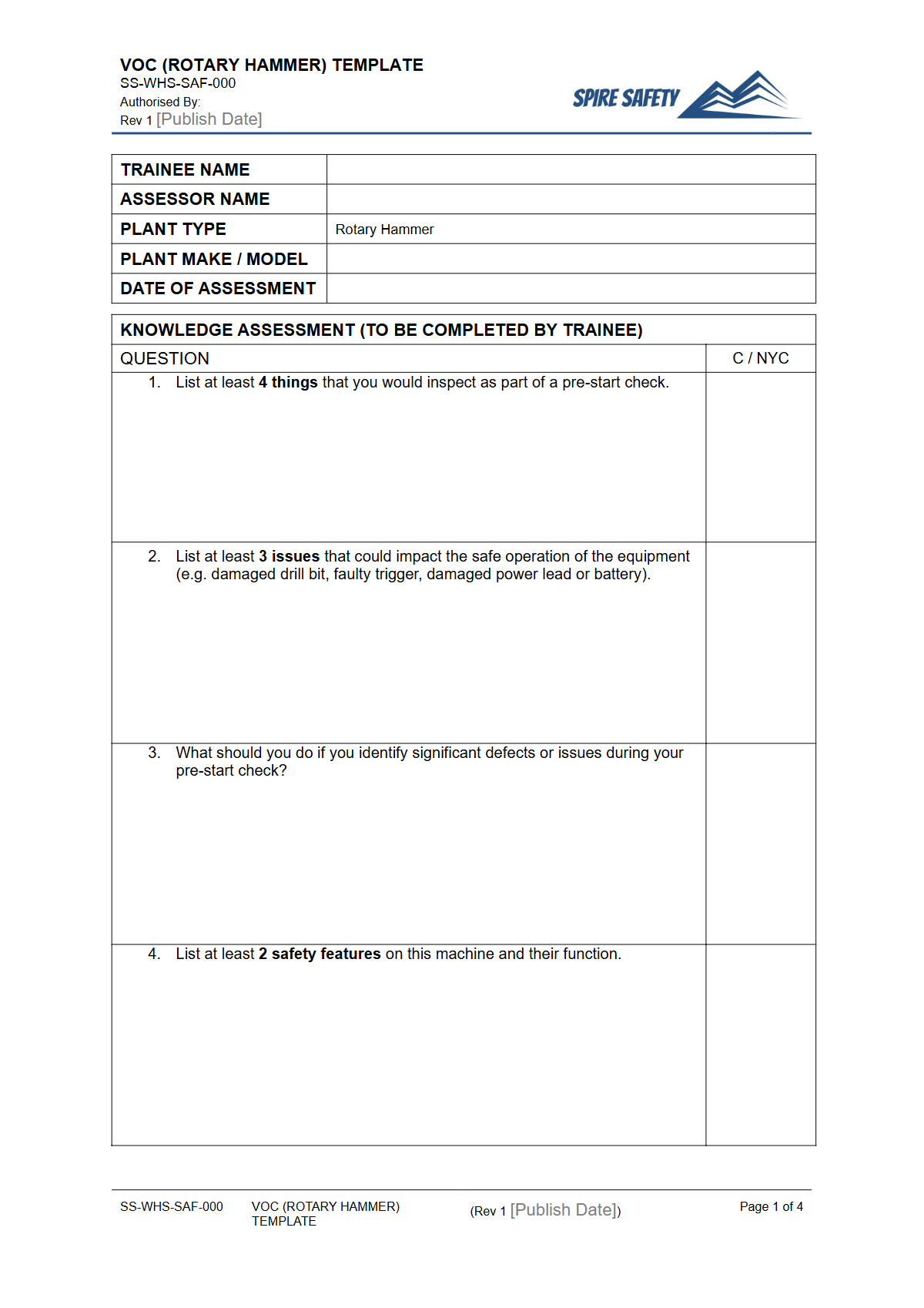
This template is designed for ease of use and customisation. It combines theoretical questions with a practical observation checklist to provide a holistic view of an operator's competence.
The process typically involves an assessor observing the worker through all stages of operation, from pre-start checks to safe shutdown. The document guides the assessor through key performance criteria, ensuring a consistent and fair evaluation.
It's a critical tool for identifying any gaps in knowledge or skill that may require further training. Periodically reviewing these completed assessments is also a valuable input for WHS compliance auditing to ensure processes are being followed correctly.
Important Customisation Note
This document provides a general framework aligned with Australian WHS principles. Before implementation, we stress that you must customise this template to suit the specific context of your workplace.
This includes referencing the exact make and model of the rotary hammer being used, incorporating your site-specific safety rules, Safe Work Method Statements (SWMS), and emergency procedures. A generic checklist cannot account for the unique risks and operational nuances of your site.
When to Use This VOC Template
A Verification of Competency is not a one-time event. It should be conducted at several key points to ensure ongoing safety and skill maintenance. Consider using this template in the following situations:
- Pre-employment: To verify the skills claimed by a potential new hire.
- New Equipment Introduction: When a new model of rotary hammer is introduced to the workplace, even for experienced operators.
- Post-incident: Following an incident or near-miss involving a rotary hammer to identify and correct any unsafe behaviours or knowledge gaps.
- Identified Skill Gaps: When a supervisor observes an operator not following correct procedures.
- Regular Intervals: As part of a scheduled competency review program (e.g., every 2 years) to ensure skills have not diminished over time.
The principles outlined here apply to a range of similar equipment. If your workplace uses smaller, specific models, you may find our Verification of Competency for SDS Plus rotary hammers a more tailored starting point.
Who Should Conduct the Assessment
The effectiveness of a VOC depends entirely on the person conducting it. The assessor must be competent and confident in several areas.
They should not only be skilled in assessment techniques but must also possess extensive, current experience in the safe operation of the specific rotary hammer being assessed. The assessor could be a supervisor, a leading hand, a dedicated trainer, or a WHS advisor, provided they have the required technical expertise and are familiar with your organisation's procedures.
Simply being a manager is not sufficient qualification to assess a high-risk task. This principle is consistent across all plant assessments, whether for a small tool or when using a mini excavator VOC template on a construction site.
Key Assessment Areas
A thorough assessment should cover the entire operational cycle. This template prompts the assessor to evaluate an operator's ability to:
- Locate and understand manufacturer's instructions and relevant safety documentation.
- Conduct comprehensive pre-start checks, identifying any faults or damage.
- Select and correctly fit the appropriate bit for the task and material.
- Demonstrate correct manual handling techniques when moving the equipment.
- Use the rotary hammer with proper technique, applying appropriate pressure and maintaining a stable stance.
- Effectively use safety features, such as dust extraction systems and anti-vibration technology.
- Follow shutdown, cleaning, and storage procedures.
Similar detailed checks are vital for other common construction equipment, as seen in our Verification of Competency for a cement mixer, which also focuses on procedural safety from start to finish. If competency gaps are found, a documented action plan for retraining and reassessment must be put in place. For related workshop equipment, you can also download our free Drill Press VOC template. This resource and many others are available in our comprehensive free WHS resources library.
Common mistakes
Common mistakes to avoid
- Using the template without customising it for the specific equipment and workplace rules.
- Assigning an assessor who is not technically competent in operating a rotary hammer.
- Treating the VOC as a 'tick and flick' exercise without genuine observation and questioning.
- Failing to implement a corrective action plan when competency gaps are identified.
Legal references
Legal considerations
The following legal requirements may be relevant to this type of work.
- Work Health and Safety Act (Harmonised) — Provides the primary duties for protecting workers and other people from work health and safety risks.
- Work Health and Safety Regulations (Harmonised) — Sets out requirements supporting the management of workplace hazards and risks.
The following codes may be relevant to this type of work.
- Managing WHS Risks Code of Practice — Provides practical guidance on identifying hazards, assessing risks and applying effective controls.
- Work Health and Safety Consultation, Cooperation and Coordination Code of Practice — Provides practical guidance on consulting workers and coordinating with other duty holders.
- Managing the Work Environment and Facilities Code of Practice — Provides practical guidance on safe work environments, workplace facilities and related controls.
Did you know
Vibration Risk
Prolonged use of rotary hammers can lead to Hand-Arm Vibration Syndrome (HAVS), a painful and disabling condition. Modern rotary hammers often include anti-vibration technology, and job rotation is a key administrative control.
Dust Control is Critical
Drilling into concrete, brick, or rock can generate high levels of respirable crystalline silica (RCS) dust, a serious health hazard. On-tool dust extraction systems are a primary engineering control to capture this dust at the source.
FAQ
Frequently asked questions
01What is a Verification of Competency (VOC) for a rotary hammer?
02Is a VOC a legal requirement for operating a rotary hammer in Australia?
03How often should a rotary hammer VOC be conducted?
04Can this template be used for all types of rotary hammers?
Share this resource
Free Verification of Competency (Rotary Hammer) Template
Browse Categories
How To Use It
- 1Download and open in Word or PDF.
- 2Replace the placeholders with your business details.
- 3Get it reviewed by a WHS specialist before rollout.
Need it customised?
Our WHS consultants can adapt this template to your site, run a gap analysis, or audit what you already have in place.
Book a Free Consultation WHS consulting servicesor call 1300 156 382
Related templates
- Free Verification of Competency (Rotary Hoe) Template
- Free Verification of Competency (Rough Terrain Forklift) Template
- Free Verification of Competency (Sand Blaster) Template
- Free Verification of Competency (SDS Max Rotary Hammer) Template
- Free Verification of Competency (SDS Plus Rotary Hammer) Template
- Free Verification of Competency (Semi-Trailer or Prime Mover) Template