
Free Verification of Competency (Sand Blaster) Template
Assess sand blaster operator skills with our free Verification of Competency template.
Free Verification of Competency (Sand Blaster) Template
DOCX • 138 KB + PDF
Updated Oct 2026
No signup required
Purpose of the Free Verification of Competency (Sand Blaster) Template
Operating a sand blaster, or any abrasive blasting equipment, involves significant risks, including exposure to hazardous dust like silica, high-pressure system failures, and noise. This Free Verification of Competency (Sand Blaster) Template provides a structured method for a Person Conducting a Business or Undertaking (PCBU) to confirm that an operator has the necessary skills and knowledge to perform the task safely.
It serves as a practical tool to help meet the primary duty of care under WHS legislation, ensuring workers are competent for their assigned tasks. Using this VOC helps document that you have taken steps to verify skills beyond just holding a licence or ticket.
A Verification of Competency is a critical component within broader robust WHS management systems. It formally records the assessment process, creating an auditable trail of an operator's proven competence at a specific point in time. This is essential not only for internal safety management but also for demonstrating due diligence to regulators and principal contractors.
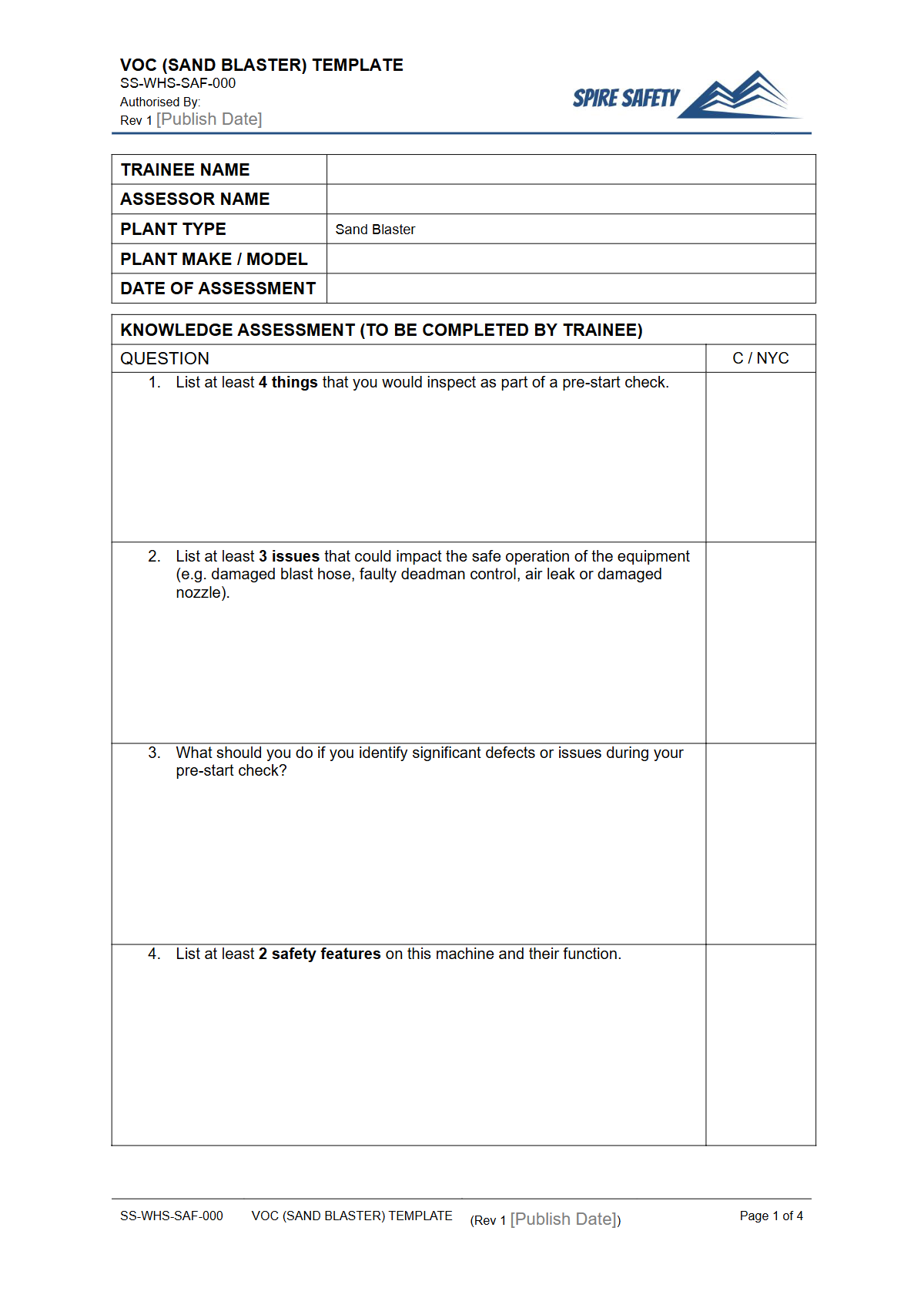
The template guides an assessor through key checks, from pre-start inspections to safe shutdown procedures, ensuring a thorough evaluation.
Video walkthrough
How to use the Free Verification of Competency (Sand Blaster) Template
To effectively use this document, download it in your preferred format (DOCX for easy editing or PDF). The assessment should be conducted by a person who is themselves competent and experienced with the specific type of sand blasting equipment being used.
The assessor will observe the operator completing the tasks outlined in the template, marking each criterion as satisfactory or not yet satisfactory.
The process involves both a 'theory' or knowledge-based assessment and a practical demonstration of skills. The operator should be able to explain the risks associated with the task, including the hazards of the abrasive media, and demonstrate correct pre-operational checks, safe operation, and shutdown protocols.
Any identified gaps in competence should be addressed through further training, with the VOC process repeated once training is complete. A completed VOC document should be signed by both the assessor and the operator and retained as a training record.
Important: This is a template, not a finished document. We have designed it as a comprehensive starting point, but it must be customised to your specific operational context.
You need to review and adapt it to reflect your site's specific hazards, the make and model of your equipment, the abrasive media in use, and your established safe work procedures.
When to use it
A Verification of Competency for a sand blaster is not a one-time event. It should be conducted at several key moments to ensure ongoing safety and competence. Consider using this template in the following situations:
- Pre-employment or prior to commencement: Before allowing a new worker to operate sand blasting equipment independently.
- Post-training: After a worker has completed initial training or obtained a relevant ticket, to verify they can apply the knowledge practically.
- Introduction of new equipment: When a new make or model of sand blaster is introduced to the workplace.
- Incident or near-miss investigation: If an operator is involved in a safety incident, a VOC can help determine if a lack of competence was a contributing factor.
- Periodic reassessment: As part of a regular schedule (e.g., annually or biennially) to ensure skills have not degraded over time.
Who should use it
This template is designed for use by individuals responsible for workplace safety and operator competence. This typically includes:
- Workplace Health and Safety (WHS) Managers and Advisors
- Site Supervisors and Forepersons
- Team Leaders
- Internal Trainers and Assessors
The person conducting the assessment (the assessor) holds a critical role. They must have a high level of technical knowledge and practical experience in sand blasting operations.
They need to be familiar with the specific equipment, the associated hazards (especially respiratory risks), and the control measures documented in the relevant Safe Work Method Statement (SWMS). An assessor without this expertise cannot make a valid judgement on an operator's competence. For tasks with different high-risk equipment, you might need a separate document, like a Verification of Competency for a rough terrain forklift.
Ultimately, this document is a tool to support the PCBU's responsibility to provide a safe work environment. This can be verified through processes like regular WHS compliance auditing, which often review how an organisation manages and documents worker competency.
If your team requires broader safety support, consider engaging expert WHS consulting to help integrate processes like VOCs into your overall safety framework. You can find other useful documents in our free WHS resources library to support your systems.
Common mistakes
Common mistakes to avoid
- Using a generic template without customising it for the specific equipment, task, and abrasive media.
- Assigning an assessor who is not themselves experienced and competent in sand blasting operations.
- Treating the VOC as a simple paperwork exercise rather than a genuine observation and assessment of practical skill.
- Failing to document the outcome and any required corrective actions, such as refresher training.
Legal references
Legal considerations
The following legal requirements may be relevant to this type of work.
- Work Health and Safety Act (Harmonised) — Provides the primary duties for protecting workers and other people from work health and safety risks.
- Work Health and Safety Regulations (Harmonised) — Sets out requirements supporting the management of workplace hazards and risks.
The following codes may be relevant to this type of work.
- Managing WHS Risks Code of Practice — Provides practical guidance on identifying hazards, assessing risks and applying effective controls.
- Work Health and Safety Consultation, Cooperation and Coordination Code of Practice — Provides practical guidance on consulting workers and coordinating with other duty holders.
- Managing the Work Environment and Facilities Code of Practice — Provides practical guidance on safe work environments, workplace facilities and related controls.
Did you know
Modern Abrasives
Due to the severe health risks of silicosis, sand is rarely used in modern abrasive blasting. Common, safer alternatives now include steel grit, glass beads, plastic media, and sodium bicarbonate (baking soda).
FAQ
Frequently asked questions
01What is the difference between a VOC and a licence for sand blasting?
02How often should a sand blaster VOC be conducted?
03Who is a competent person to assess a sand blaster operator?
04Does this template cover crystalline silica dust hazards?
Share this resource
Free Verification of Competency (Sand Blaster) Template
Browse Categories
How To Use It
- 1Download and open in Word or PDF.
- 2Replace the placeholders with your business details.
- 3Get it reviewed by a WHS specialist before rollout.
Need it customised?
Our WHS consultants can adapt this template to your site, run a gap analysis, or audit what you already have in place.
Book a Free Consultation WHS consulting servicesor call 1300 156 382
Related templates
- Free Verification of Competency (SDS Max Rotary Hammer) Template
- Free Verification of Competency (SDS Plus Rotary Hammer) Template
- Free Verification of Competency (Semi-Trailer or Prime Mover) Template
- Free Verification of Competency (Side Tipper Truck) Template
- Free Verification of Competency (Skid Steer Auger Attachment) Template
- Free Verification of Competency (Spider Lift) Template