
Free Verification of Competency (Skid Steer Auger Attachment) Template
Assess operator competence for skid steer auger attachments with our VOC template. Aligned with Australian WHS practice and available in DOCX and PDF formats.
Free Verification of Competency (Skid Steer Auger Attachment) Template
DOCX • 138 KB + PDF
Updated Oct 2026
No signup required
Purpose of the Free Verification of Competency (Skid Steer Auger Attachment) Template
Using this Free Verification of Competency (Skid Steer Auger Attachment) Template is a practical step for Persons Conducting a Business or Undertaking (PCBUs) to ensure workers can safely operate this high-risk attachment. While an operator may be competent on the base machine, an auger introduces unique and significant hazards, including striking underground services, entanglement, machine instability, and soil collapse.
This template provides a structured framework for assessing an operator’s knowledge and practical skills, helping you meet your primary duty of care under WHS legislation.
This document is designed to complement, not replace, competency assessments for the base machine. For a comprehensive approach, it should be used in conjunction with a free Skid-Steer Loader VOC (Verification of Competency) Template to ensure all aspects of operation are covered.
This process creates a formal record demonstrating that you have taken steps to verify that operators are competent for the specific tasks they are assigned.
Video walkthrough
How to Use the Free Verification of Competency (Skid Steer Auger Attachment) Template
This template is provided as a user-friendly DOCX file, allowing for easy customisation to your specific operational needs. A PDF version is also available for straightforward printing and use.
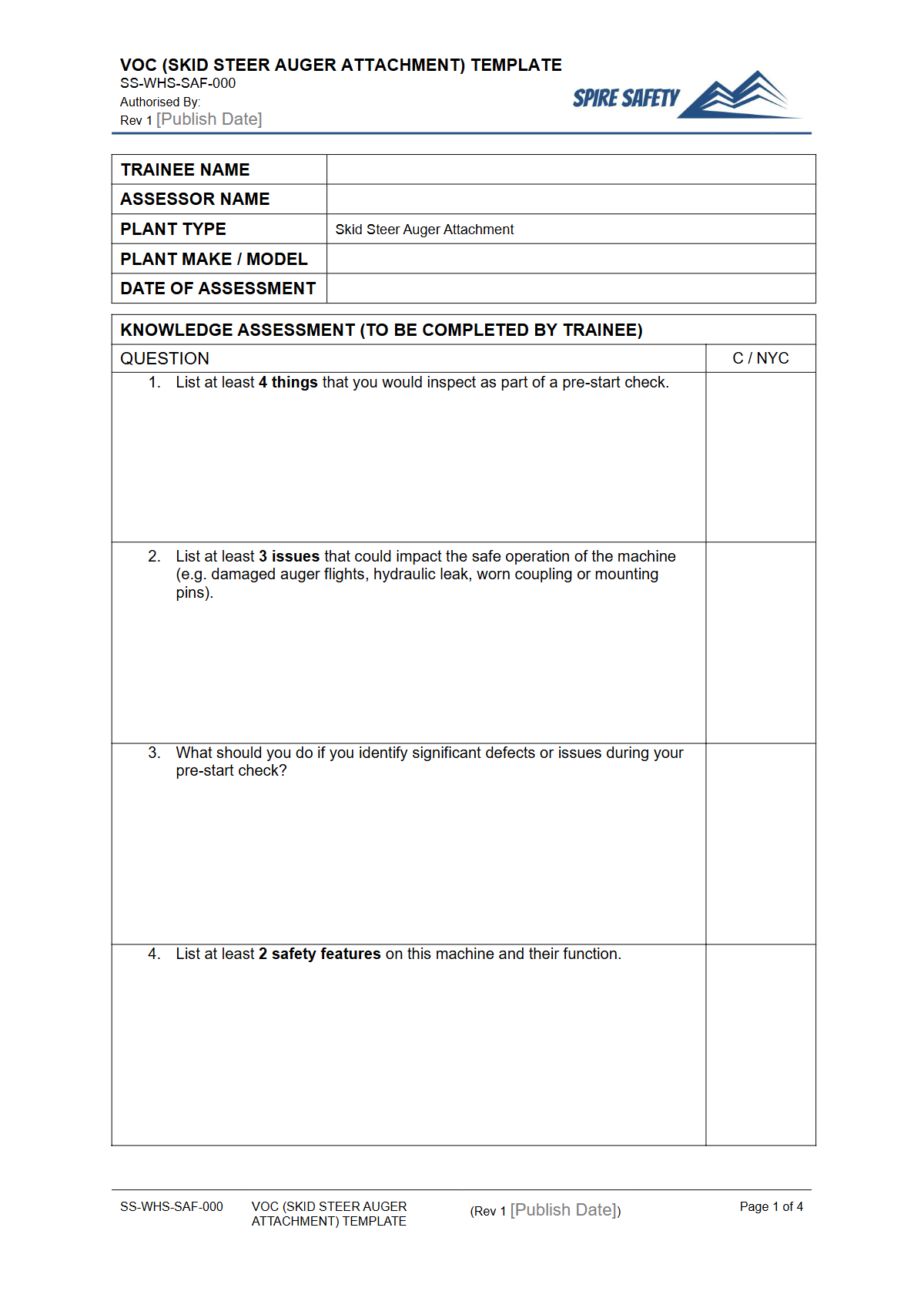
The process involves a competent assessor observing an operator performing tasks with the skid steer and auger in a typical work environment. The assessor uses the checklist to evaluate the operator against critical criteria, including pre-start checks, operational safety, hazard identification (like checking for underground assets), and shutdown procedures.
Important: This document is a template and must be customised. We have designed it as a structured starting point, but you must adapt it to reflect your specific workplace, the models of skid steer and auger you use, your site-specific risks, and your existing Safe Work Method Statements (SWMS).
Integrating this process into a robust WHS management system ensures it becomes a consistent part of your safety practices.
What a Skid Steer Auger VOC Covers
A thorough Verification of Competency for an auger attachment should assess an operator's ability across several key domains. This template prompts evaluation of:
- Pre-Operational Checks: Verifying the condition of the auger flighting, teeth, hydraulic hoses, and attachment locking mechanisms.
- Planning and Hazard Identification: Confirming the operator follows procedures like 'Dial Before You Dig', assesses ground conditions, and establishes exclusion zones.
- Operational Skills: Safely attaching the auger, positioning the machine, controlling the auger's speed and depth, and monitoring for instability or obstructions.
- Emergency Procedures: Demonstrating correct responses to situations like a hydraulic failure or striking an unknown object.
- Shutdown and Detachment: Correctly shutting down the machine, de-pressurising hydraulics, and safely detaching and storing the auger.
The principles of assessing specific, high-risk plant attachments apply across various equipment. Similar detailed assessments are required for other earthmoving tools, as outlined in resources like our Verification of Competency (Mini Excavator) Template.
When to Use This Verification of Competency
A VOC is not a one-time event. It should be conducted at several key points to ensure ongoing safety and competence. Consider using this template:
- Before first use: For any operator, even experienced ones, before they use a skid steer with an auger attachment for the first time at your workplace.
- As part of new worker onboarding: To verify the skills claimed by a new employee or contractor.
- After an incident or near-miss: To identify and correct any gaps in knowledge or performance that may have contributed to the event.
- Following a lengthy absence from the task: If an operator has not used the equipment for an extended period.
- As part of periodic refresher assessments: As a proactive measure to ensure skills have not diminished over time.
This proactive approach helps identify competency drift before it leads to an incident. A scheduled program of verification for all high-risk plant, including equipment like trenchers, is a hallmark of a mature safety system.
You can adapt our Verification of Competency (Trencher) for this purpose.
Who Should Conduct the Assessment
The person conducting the Verification of Competency must be a competent person themselves. This means they must have the requisite knowledge, skills, and experience to operate the skid steer and auger attachment safely and to a high standard.
They should also have experience in training and assessment to be able to fairly judge the operator's performance and provide constructive feedback. This role is often filled by a site supervisor, an experienced operator designated as a trainer, or an external WHS consultant.
The assessor must be confident in their ability to identify both safe and unsafe behaviours. Regular WHS compliance auditing can help identify if your internal verification processes are robust and being carried out by suitably qualified personnel.
Common mistakes
Common mistakes to avoid
- Treating the VOC as a 'tick and flick' exercise without genuine, thorough observation of the task.
- Using an assessor who is not competent or experienced themselves on the specific skid steer and auger combination.
- Failing to customise the template to match the site's specific hazards, ground conditions, and safe work procedures.
- Not retaining the completed VOC form as a formal record of worker competency and training.
Legal references
Legal considerations
The following legal requirements may be relevant to this type of work.
- Work Health and Safety Act (Harmonised) — Provides the primary duties for protecting workers and other people from work health and safety risks.
- Work Health and Safety Regulations (Harmonised) — Sets out requirements supporting the management of workplace hazards and risks.
The following codes may be relevant to this type of work.
- Managing WHS Risks Code of Practice — Provides practical guidance on identifying hazards, assessing risks and applying effective controls.
- Work Health and Safety Consultation, Cooperation and Coordination Code of Practice — Provides practical guidance on consulting workers and coordinating with other duty holders.
- Managing the Work Environment and Facilities Code of Practice — Provides practical guidance on safe work environments, workplace facilities and related controls.
Did you know
Dial Before You Dig
Striking underground services like gas, water, or electrical lines is a primary risk when using augers. In Australia, it is essential to use the free Dial Before You Dig service to obtain plans and locate assets before breaking ground.
Attachment-Specific Risks
The stability and centre of gravity of a skid steer are significantly altered by the weight, position, and movement of an auger attachment, especially when extended or loaded with soil. This requires specific operator awareness beyond basic driving skills.
FAQ
Frequently asked questions
01Is a Verification of Competency for an auger attachment mandatory in Australia?
02What is the difference between a VOC and a training certificate?
03How often should we re-verify competency for a skid steer auger?
04Can I use this template for other skid steer attachments like a trencher or breaker?
Share this resource
Free Verification of Competency (Skid Steer Auger Attachment) Template
Browse Categories
How To Use It
- 1Download and open in Word or PDF.
- 2Replace the placeholders with your business details.
- 3Get it reviewed by a WHS specialist before rollout.
Need it customised?
Our WHS consultants can adapt this template to your site, run a gap analysis, or audit what you already have in place.
Book a Free Consultation WHS consulting servicesor call 1300 156 382
Related templates
- Free Verification of Competency (Spider Lift) Template
- Free Verification of Competency (Steam Cleaner) Template
- Free Verification of Competency (Stick Welder) Template
- Free Verification of Competency (Stump Grinder) Template
- Free Verification of Competency (Submersible Pump) Template
- Free Verification of Competency (TIG Welder) Template