
Free Verification of Competency (Spider Lift) Template
Download our Free Verification of Competency (Spider Lift) Template to assess operator skills. This DOCX and PDF resource is a structured starting point.
Free Verification of Competency (Spider Lift) Template
DOCX • 139 KB + PDF
Updated Oct 2026
No signup required
Purpose of the Free Verification of Competency (Spider Lift) Template
Operating a spider lift (or tracked boom lift) requires more than just a high-risk work licence. This Free Verification of Competency (Spider Lift) Template provides a structured framework for employers to confirm that operators have the current skills and knowledge to use this specialised equipment safely in their specific work environment.
It goes beyond ticking a box for a licence, assessing practical ability, understanding of machine-specific controls, and awareness of site-specific hazards. Using a formal VOC process helps a Person Conducting a Business or Undertaking (PCBU) meet their primary duty of care under Australian WHS legislation.
A documented competency assessment demonstrates due diligence and is a critical component of any safety management plan. It ensures that theoretical knowledge is matched by practical, safe application on the job. Integrating VOCs into your operational procedures is a key part of a comprehensive WHS management system.
Video walkthrough
How to use the Free Verification of Competency (Spider Lift) Template
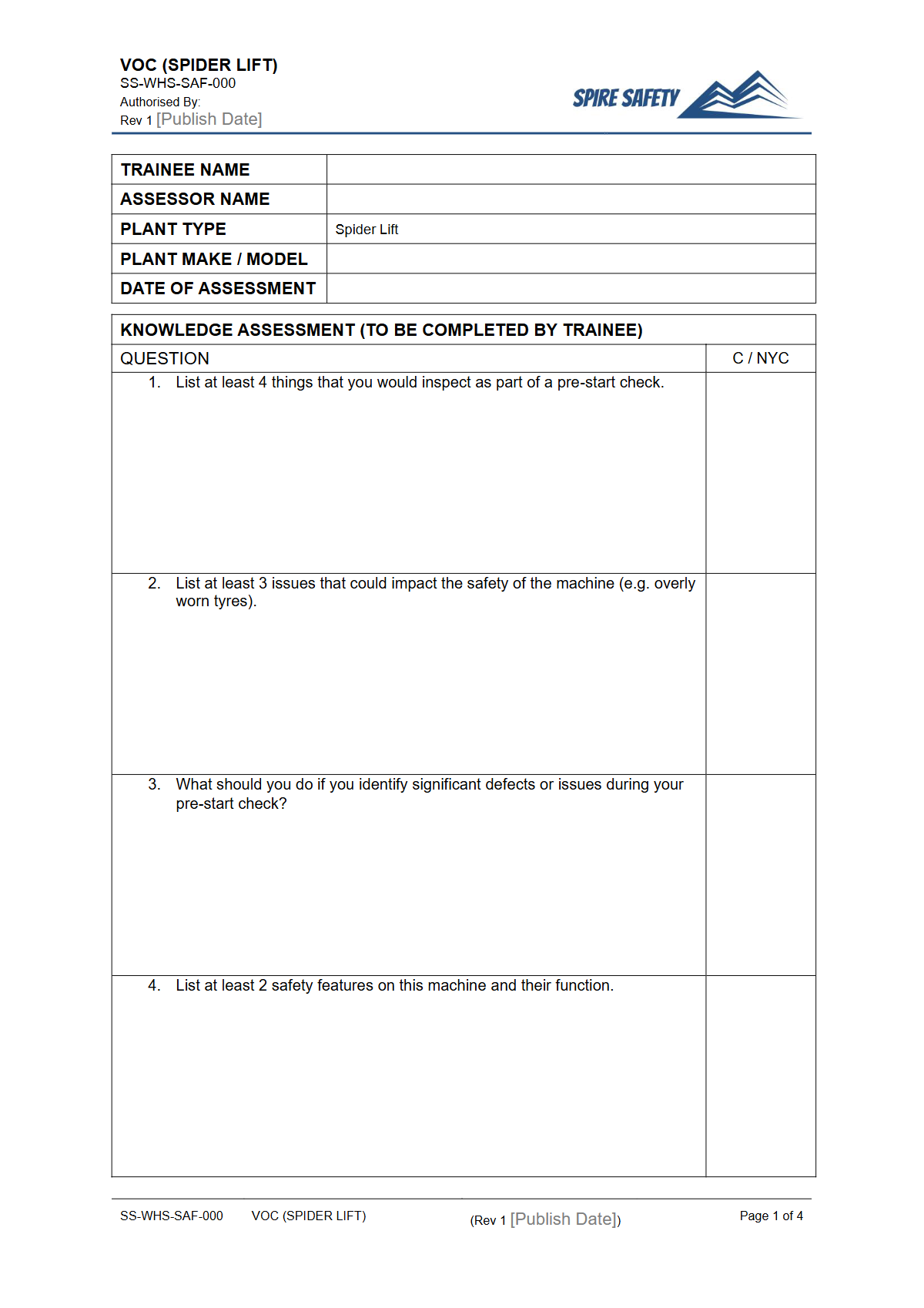
This template is designed for practical application by a competent assessor. It combines a knowledge assessment with a detailed practical observation checklist, covering pre-start checks, setup, travel, elevation, and shutdown procedures. The process for using the Free Verification of Competency (Spider Lift) Template is straightforward:
- Customise: Adapt the checklist to reflect the specific models of spider lifts used on your site, the tasks they perform, and the unique environmental hazards operators may face.
- Assess Knowledge: Use the included questions to gauge the operator's theoretical understanding of spider lift operations, risk controls, and emergency procedures.
- Observe Practical Skills: Have the operator perform a range of tasks under direct observation, using the checklist to record their performance against established safety criteria.
- Document Outcomes: Finalise the record, noting whether the operator is deemed competent or 'not yet competent'. If further training is required, document the specific areas and create an action plan.
Please note: This document is a template designed as a starting point. We have created it to be aligned with good WHS practice, but it must be customised by a competent person to suit the specific equipment and conditions of your workplace.
The process is similar for other mobile plant, such as that covered by our Verification of Competency (Rough Terrain Forklift) template.
When to use it
A VOC for a spider lift is not a one-time event. It should be integrated into your safety procedures and conducted at key moments to ensure ongoing competency. Consider using this verification process in the following situations:
- Pre-employment or Mobilisation: Before a new worker starts operating a spider lift on your site for the first time.
- Post-Incident: Following an accident or near-miss involving a spider lift to identify any competency gaps.
- Introduction of New Equipment: When a new make or model of spider lift is introduced to the workplace.
- Change in Work Environment: If an operator is moving to a new site with different terrain, hazards, or operating conditions.
- Periodic Re-assessment: At regular intervals (e.g., every one to three years) as part of a scheduled competency maintenance program.
This structured approach is also valuable for other high-risk equipment; you can see a similar framework in our Verification of Competency (Mini Excavator) Template.
Who should use it
This template should be used by individuals responsible for overseeing workplace safety and operational performance. This includes:
- Supervisors and Site Foremen
- WHS/OHS Managers and Advisors
- Project Managers
- Equipment Trainers and Assessors
Crucially, the person conducting the verification must be competent themselves. This means they must possess deep technical knowledge and extensive practical experience with the specific spider lift model being assessed, as well as a strong understanding of relevant WHS duties and risk management principles.
This requirement is consistent for assessments on any plant, including those covered by our Verification of Competency (Water Cart) template.
Benefits of a Structured VOC Process
Implementing a formal VOC program using a standardised template delivers significant benefits beyond just paperwork. It actively reduces the risk of incidents by ensuring operators are truly capable of handling the machine in real-world scenarios.
A robust verification process strengthens your organisation's safety culture by demonstrating a commitment to high standards and worker well-being. Furthermore, maintaining detailed VOC records provides tangible evidence of your safety management activities, which can be invaluable during a WHS compliance audit or in the event of a regulatory investigation.
If you require assistance in developing a broader competency framework, expert WHS consulting can provide tailored guidance for your organisation.
Download this template to get started, and explore our complete free WHS resources library for more tools to support your safety management systems.
Common mistakes
Common mistakes to avoid
- Using a generic EWP checklist that doesn't cover the unique functions and risks of a specific spider lift model.
- Treating the assessment as a 'tick and flick' paper exercise without practical, hands-on observation.
- Failing to document and implement corrective actions for operators who are found 'not yet competent'.
- Having an assessor who is not themselves competent and experienced with the specific spider lift being assessed.
Legal references
Legal considerations
The following legal requirements may be relevant to this type of work.
- Work Health and Safety Act (Harmonised) — Provides the primary duties for protecting workers and other people from work health and safety risks.
- Work Health and Safety Regulations (Harmonised) — Sets out requirements supporting the management of workplace hazards and risks.
The following codes may be relevant to this type of work.
- Managing WHS Risks Code of Practice — Provides practical guidance on identifying hazards, assessing risks and applying effective controls.
- Work Health and Safety Consultation, Cooperation and Coordination Code of Practice — Provides practical guidance on consulting workers and coordinating with other duty holders.
- Managing the Work Environment and Facilities Code of Practice — Provides practical guidance on safe work environments, workplace facilities and related controls.
Did you know
Why 'Spider'?
Spider lifts get their name from their distinctive, multi-legged outrigger system that allows them to stabilise on uneven terrain, resembling a spider's legs.
Duty of Care
Conducting VOCs helps a Person Conducting a Business or Undertaking (PCBU) demonstrate they are taking reasonably practicable steps to ensure worker safety, a key part of their primary duty of care.
FAQ
Frequently asked questions
01What is a spider lift VOC?
02Is a high-risk work licence enough to operate a spider lift?
03How often should spider lift VOCs be conducted?
04Who is a competent person to conduct a spider lift VOC?
Share this resource
Free Verification of Competency (Spider Lift) Template
Browse Categories
How To Use It
- 1Download and open in Word or PDF.
- 2Replace the placeholders with your business details.
- 3Get it reviewed by a WHS specialist before rollout.
Need it customised?
Our WHS consultants can adapt this template to your site, run a gap analysis, or audit what you already have in place.
Book a Free Consultation WHS consulting servicesor call 1300 156 382
Related templates
- Free Verification of Competency (Steam Cleaner) Template
- Free Verification of Competency (Stick Welder) Template
- Free Verification of Competency (Stump Grinder) Template
- Free Verification of Competency (Submersible Pump) Template
- Free Verification of Competency (TIG Welder) Template
- Free Verification of Competency (Tile Saw or Wet Saw) Template