
Free Verification of Competency (Stick Welder) Template
Assess stick welder competence and safety with our free Verification of Competency (Stick Welder) Template. Aligned with AU WHS practices. Download today.
Free Verification of Competency (Stick Welder) Template
DOCX • 138 KB + PDF
Updated Oct 2026
No signup required
Purpose of the Free Verification of Competency (Stick Welder) Template
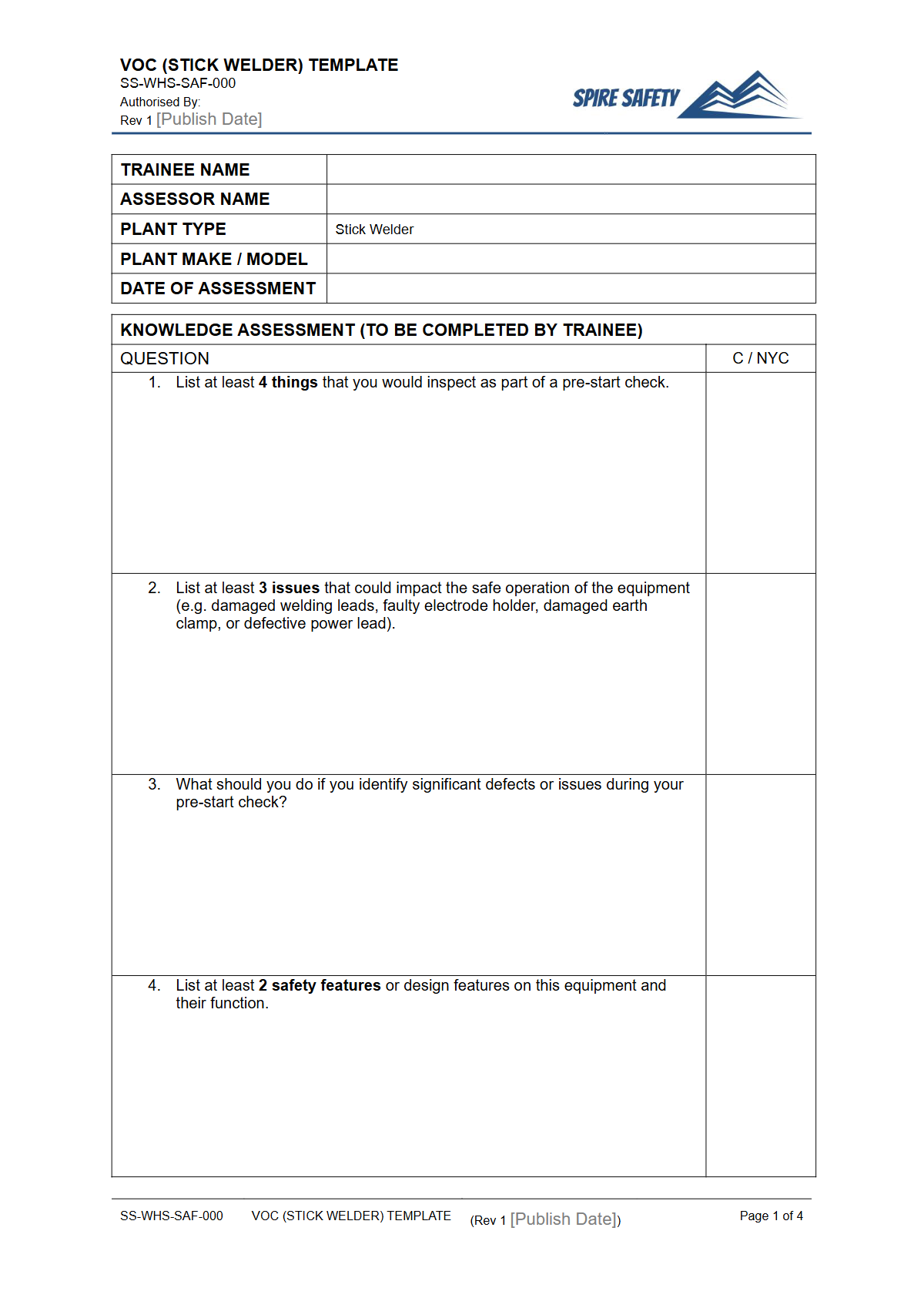
This Free Verification of Competency (Stick Welder) Template provides a structured starting point for employers to confirm that an operator possesses the necessary skills and knowledge for the safe use of manual metal arc welding (MMAW) equipment. Verifying competency is a practical step an organisation can take to meet its primary duty of care under WHS legislation.
It goes beyond formal qualifications by assessing a worker's current ability to perform a task safely in their specific work environment. Using a standardised form ensures that assessments are conducted fairly, consistently, and are properly documented.
A documented VOC process demonstrates WHS due diligence and helps identify any gaps in training before they lead to an incident. While this template focuses on stick welding, the principles of competency verification apply to a wide range of equipment. For example, a similar process should be followed for different welding types, as detailed in our Verification of Competency (MIG Welder) Template.
Video walkthrough
How to use the Free Verification of Competency (Stick Welder) Template
Using this Verification of Competency template is a straightforward process designed to be adapted to your operational needs. First, download the document in your preferred format (DOCX for easy editing or PDF).
The next critical step is customisation. The template includes sections for theory, pre-operational checks, operation, and shutdown procedures, which must be tailored to the specific make and model of the stick welder used at your site and the unique environmental risks of your workplace.
Once customised, a competent person—such as a supervisor or experienced welder—uses the document to observe the operator and ask relevant questions. They will record their observations and make a final judgement on the operator's competence.
Any identified gaps should lead to further training, with a reassessment conducted afterwards. Integrating these documented procedures is a key feature of robust WHS management systems.
Important Note: This document is a template and not a complete, out-of-the-box solution. We have developed it as a strong starting point, but you are responsible for customising it to accurately reflect the specific machinery, tasks, risks, and control measures relevant to your business operations.
Generic assessments may not adequately manage your specific WHS risks.
When to use it
A Verification of Competency should be conducted at several key points to ensure ongoing safety and skill retention. It is not a one-time event. Consider using this VOC process in the following situations:
- Pre-employment: To verify the claimed skills and experience of a new hire before they begin work.
- Introduction of New Equipment: When a new type or model of stick welder is introduced to the workplace.
- Post-Incident: As part of an investigation following a near miss or an incident involving welding equipment to identify and correct behavioural or knowledge gaps. A formal review by WHS compliance auditing specialists can also help pinpoint systemic issues.
- Change in Work Environment: If the conditions or location of welding tasks change significantly, introducing new hazards (e.g., working in a confined space or at height).
- Periodic Reassessment: As part of a regular schedule (e.g., annually or every two years) to ensure skills have not diminished over time.
Who should use it
This template is designed for use by individuals responsible for workplace safety and operator supervision. This typically includes:
- Supervisors and Team Leaders
- WHS Managers and Advisors
- Trainers and Assessors
- Experienced operators tasked with mentoring junior staff
Crucially, the person conducting the assessment must be competent themselves. This means they must have the technical knowledge and practical experience with stick welding to accurately judge another person's skill, identify unsafe practices, and provide constructive feedback.
If this expertise is not available in-house, consider engaging external help through WHS consulting services to ensure your VOC process is valid and reliable.
Key Assessment Areas for Stick Welders
A thorough stick welder VOC should cover the entire work cycle. The template guides the assessor through several critical areas:
- Theory and Knowledge: Understanding of welding principles, electrical safety, electrode selection, and hazard identification (e.g., fumes, radiation, fire). The skills needed can differ significantly from other processes, such as those assessed in a Verification of Competency (TIG Welder).
- Pre-operational Checks: Systematically inspecting the power source, welding leads, electrode holder, and work clamp for damage. The operator must also ensure the work area is free of combustible materials and that appropriate fire-fighting equipment is on hand.
- Safe Operation: Correctly setting welding parameters (amperage), demonstrating secure work clamping, and using appropriate PPE (helmet with correct shade, gloves, leathers). The assessor observes the operator's technique, including arc striking, maintaining arc length, travel speed, and producing a quality bead.
- Shutdown and Housekeeping: Following correct shutdown procedures, safely storing the electrode holder, and cleaning the work area. Competency with other common workshop tools can also be verified using resources like our Free Drill Press VOC (Verification of Competency) Template.
Common mistakes
Common mistakes to avoid
- Using the template without customising it for the specific welder model and workplace hazards.
- Treating the VOC as a paperwork exercise rather than a genuine practical assessment of skill.
- Assigning an assessor who is not themselves competent or experienced in stick welding.
- Failing to document the outcome and any corrective actions, such as required retraining.
Legal references
Legal considerations
The following legal requirements may be relevant to this type of work.
- Work Health and Safety Act (Harmonised) — Provides the primary duties for protecting workers and other people from work health and safety risks.
- Work Health and Safety Regulations (Harmonised) — Sets out requirements supporting the management of workplace hazards and risks.
The following codes may be relevant to this type of work.
- Managing WHS Risks Code of Practice — Provides practical guidance on identifying hazards, assessing risks and applying effective controls.
- Work Health and Safety Consultation, Cooperation and Coordination Code of Practice — Provides practical guidance on consulting workers and coordinating with other duty holders.
- Managing the Work Environment and Facilities Code of Practice — Provides practical guidance on safe work environments, workplace facilities and related controls.
Did you know
Welding Fume is a Carcinogen
Welding fume is internationally classified as a Group 1 carcinogen, meaning it is known to cause cancer in humans. Effective local exhaust ventilation and respiratory protection are essential safety controls.
Electrical Risk
Stick welding can use currents over 100 amps. Even brief contact with the live electrode and the workpiece simultaneously can cause severe electric shock, which may be fatal.
FAQ
Frequently asked questions
01What is a Verification of Competency (VOC)?
02Is a welding ticket the same as a VOC?
03How often should I conduct a stick welder VOC?
04Who can conduct a stick welder VOC assessment?
Share this resource
Free Verification of Competency (Stick Welder) Template
Browse Categories
How To Use It
- 1Download and open in Word or PDF.
- 2Replace the placeholders with your business details.
- 3Get it reviewed by a WHS specialist before rollout.
Need it customised?
Our WHS consultants can adapt this template to your site, run a gap analysis, or audit what you already have in place.
Book a Free Consultation WHS consulting servicesor call 1300 156 382
Related templates
- Free Verification of Competency (Stump Grinder) Template
- Free Verification of Competency (Submersible Pump) Template
- Free Verification of Competency (TIG Welder) Template
- Free Verification of Competency (Tile Saw or Wet Saw) Template
- Free Verification of Competency (Tilting Bucket) Template
- Free Verification of Competency (Torque Wrench) Template