
Free Verification of Competency (Submersible Pump) Template
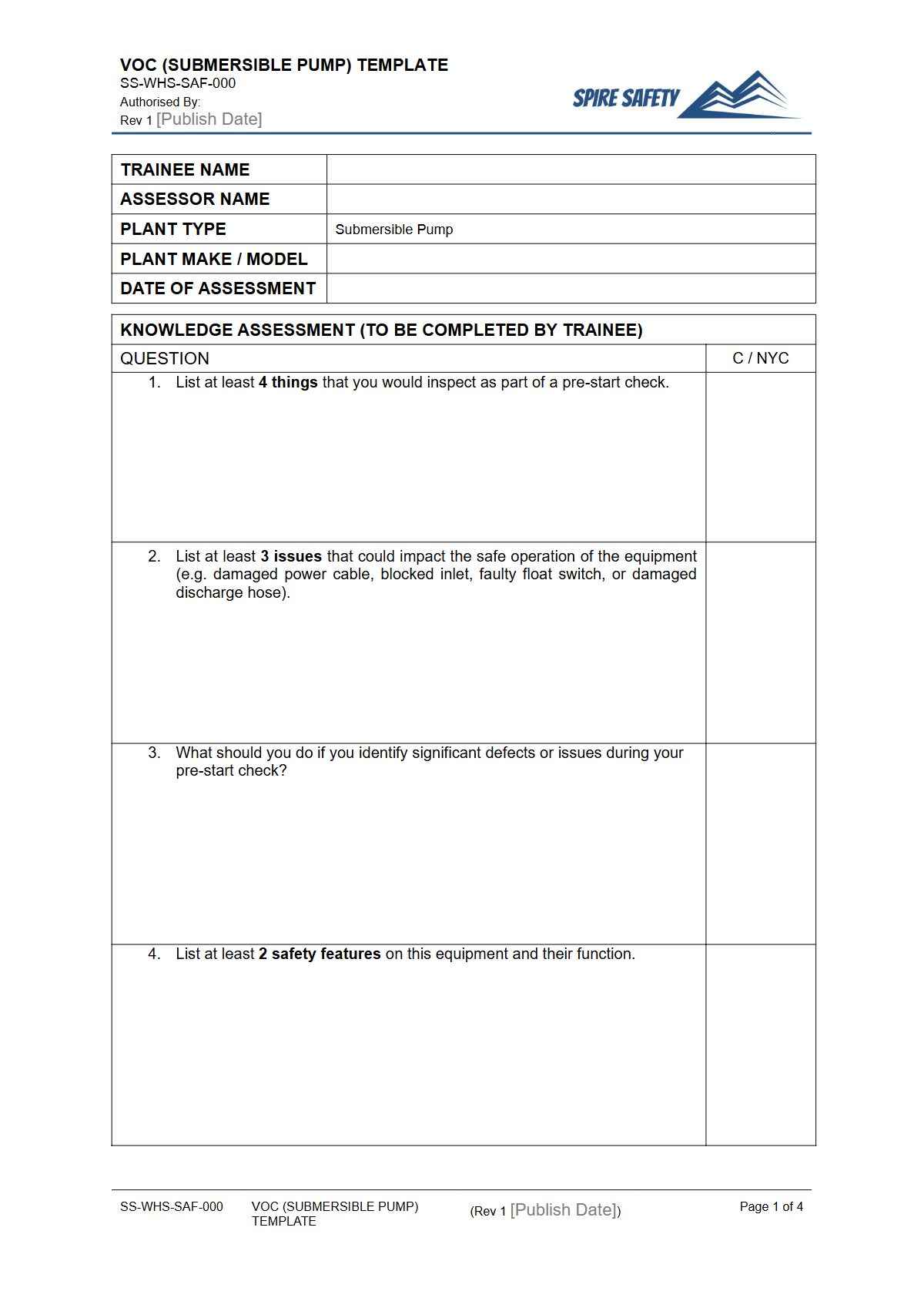
Download our free Verification of Competency (Submersible Pump) Template. This structured DOCX & PDF helps assess operator skills and safety knowledge.
Free Verification of Competency (Submersible Pump) Template
DOCX • 140 KB + PDF
Updated Oct 2026
No signup required
Purpose of the Free Verification of Competency (Submersible Pump) Template
This Free Verification of Competency (Submersible Pump) Template provides a structured framework for Persons Conducting a Business or Undertaking (PCBUs) to assess and confirm an operator's ability to use a submersible pump safely and effectively. Its purpose is to go beyond a simple licence or ticket, verifying that an individual has the current skills, knowledge, and practical competence required for the specific tasks at your workplace.
Using a submersible pump involves significant risks, including electrical hazards, manual handling, and potential exposure to contaminants, making it crucial to ensure operators are truly competent.
Implementing a formal assessment process helps fulfill your primary duty of care under WHS legislation. It creates a clear record that you have taken steps to verify worker skills, which is a key component of effective safety management.
This process is particularly important for high-risk activities or when introducing new types of equipment to the worksite. For other water-related plant, you might also find our Verification of Competency (Water Cart) template a useful resource.
Video walkthrough
How to use the Free Verification of Competency (Submersible Pump) Template
This template is provided as a starting point in both DOCX and PDF formats. It is designed to be customised to reflect the specific submersible pump models, site conditions, and operational procedures unique to your organisation.
A generic approach is not sufficient for ensuring safety and compliance. Effective use involves a competent person (like a supervisor or experienced operator) observing the individual as they perform the required tasks from start to finish.
Follow these general steps:
- Download and Customise: Add your company branding and, most importantly, modify the checklist to include site-specific hazards, pump models, safe work procedures, and emergency protocols. We cannot stress this enough: you must adapt this template to your specific operational context.
- Brief the Operator: Explain the purpose of the VOC and the tasks they will be asked to perform. Ensure they have access to the pump's operating manual and any relevant Safe Work Method Statements (SWMS).
- Observe and Assess: Watch the operator perform each step, from pre-start checks and setup to operation and shutdown. Record your observations against the criteria in the template.
- Provide Feedback: Discuss the results with the operator. Acknowledge areas of strength and identify any gaps in knowledge or skill that require further training or supervision.
- Keep Records: File the completed VOC form as part of the worker's training and competency records. These documents are vital during any WHS compliance auditing activities.
What a Submersible Pump VOC Should Cover
A thorough VOC for a submersible pump should assess the operator's competence across three key phases: pre-operation, operation, and post-operation. The assessor should confirm the operator’s ability to not only perform the physical tasks but also to identify and control associated hazards effectively.
Pre-Operational Checks
Before starting the pump, the operator should demonstrate their ability to conduct thorough pre-start inspections. This includes checking the pump casing for damage, inspecting the suction inlet for blockages, and most critically, examining the full length of the electrical cord and plug for any cuts, abrasions, or defects.
They should also verify that the power source is protected by a Residual Current Device (RCD). This is similar to the checks required for other site equipment, such as those detailed in our Verification of Competency (Cement Mixer) template.
Safe Operation
During operation, the assessment should focus on the operator's ability to position the pump correctly and securely, ensuring it cannot tip over or become clogged. It also includes managing hoses to prevent trip hazards, understanding the pump's capacity and limitations, and monitoring its performance.
For pumps used in trenching or excavation work, the operator must show an awareness of how dewatering can affect ground stability. This practical skill verification is a cornerstone of robust WHS management systems.
Shutdown and Pack-up
The VOC should conclude with an assessment of shutdown procedures. This includes safely disconnecting the power, depressurising hoses, and cleaning the pump if necessary.
The operator must also demonstrate safe manual handling techniques when lifting and transporting the pump, which can often be heavy and awkward. If pump use is related to plumbing or pipework, consider also using a Verification of Competency (Pipe Cutter) Template to assess related tasks.
When to Conduct a Verification of Competency
A VOC is not a one-time event. It should be integrated into your safety procedures and conducted at several key points. Consider using this submersible pump VOC template for:
- Pre-employment or pre-project checks for new workers or subcontractors.
- Introduction of new equipment, even if the operator has used similar models before.
- Post-incident investigations to check if a lack of skill or knowledge contributed to an event.
- Identified performance issues or 'near miss' reports involving the equipment.
- As part of a scheduled refresher program (e.g., annually or biennially) to ensure skills remain current.
Regularly verifying skills helps maintain a high standard of safety and operational discipline on site. You can find more templates for various plant and equipment in our extensive free WHS resources library.
Common mistakes
Common mistakes to avoid
- Using a generic VOC checklist without customising it for site-specific pump models, tasks, and hazards.
- Failing to inspect electrical cords, plugs, and connections for damage before powering on the pump.
- Neglecting manual handling risks when moving and positioning heavy or awkward pumps.
- Not verifying the operator's understanding of emergency shutdown procedures.
Legal references
Legal considerations
The following legal requirements may be relevant to this type of work.
- Work Health and Safety Act (Harmonised) — Provides the primary duties for protecting workers and other people from work health and safety risks.
- Work Health and Safety Regulations (Harmonised) — Sets out requirements supporting the management of workplace hazards and risks.
The following codes may be relevant to this type of work.
- Managing WHS Risks Code of Practice — Provides practical guidance on identifying hazards, assessing risks and applying effective controls.
- Work Health and Safety Consultation, Cooperation and Coordination Code of Practice — Provides practical guidance on consulting workers and coordinating with other duty holders.
- Managing the Work Environment and Facilities Code of Practice — Provides practical guidance on safe work environments, workplace facilities and related controls.
Did you know
Electrical Safety First
A significant portion of incidents involving submersible pumps relate to electrical faults. Always use a residual current device (RCD) and inspect cords and plugs before every use.
Dewatering Dangers
Submersible pumps are often used for dewatering excavations. This process can change soil stability, creating a risk of collapse if not managed correctly.
FAQ
Frequently asked questions
01What is a Verification of Competency for a submersible pump?
02Is a VOC a substitute for formal training or a licence?
03How often should a submersible pump VOC be conducted?
04What specific risks are associated with submersible pumps?
Share this resource
Free Verification of Competency (Submersible Pump) Template
Browse Categories
How To Use It
- 1Download and open in Word or PDF.
- 2Replace the placeholders with your business details.
- 3Get it reviewed by a WHS specialist before rollout.
Need it customised?
Our WHS consultants can adapt this template to your site, run a gap analysis, or audit what you already have in place.
Book a Free Consultation WHS consulting servicesor call 1300 156 382
Related templates
- Free Verification of Competency (TIG Welder) Template
- Free Verification of Competency (Tile Saw or Wet Saw) Template
- Free Verification of Competency (Tilting Bucket) Template
- Free Verification of Competency (Torque Wrench) Template
- Free Verification of Competency (Tower Crane) Template
- Free Verification of Competency (Trailer-Mounted Generator) Template