
Free Verification of Competency (Trailer-Mounted Generator) Template
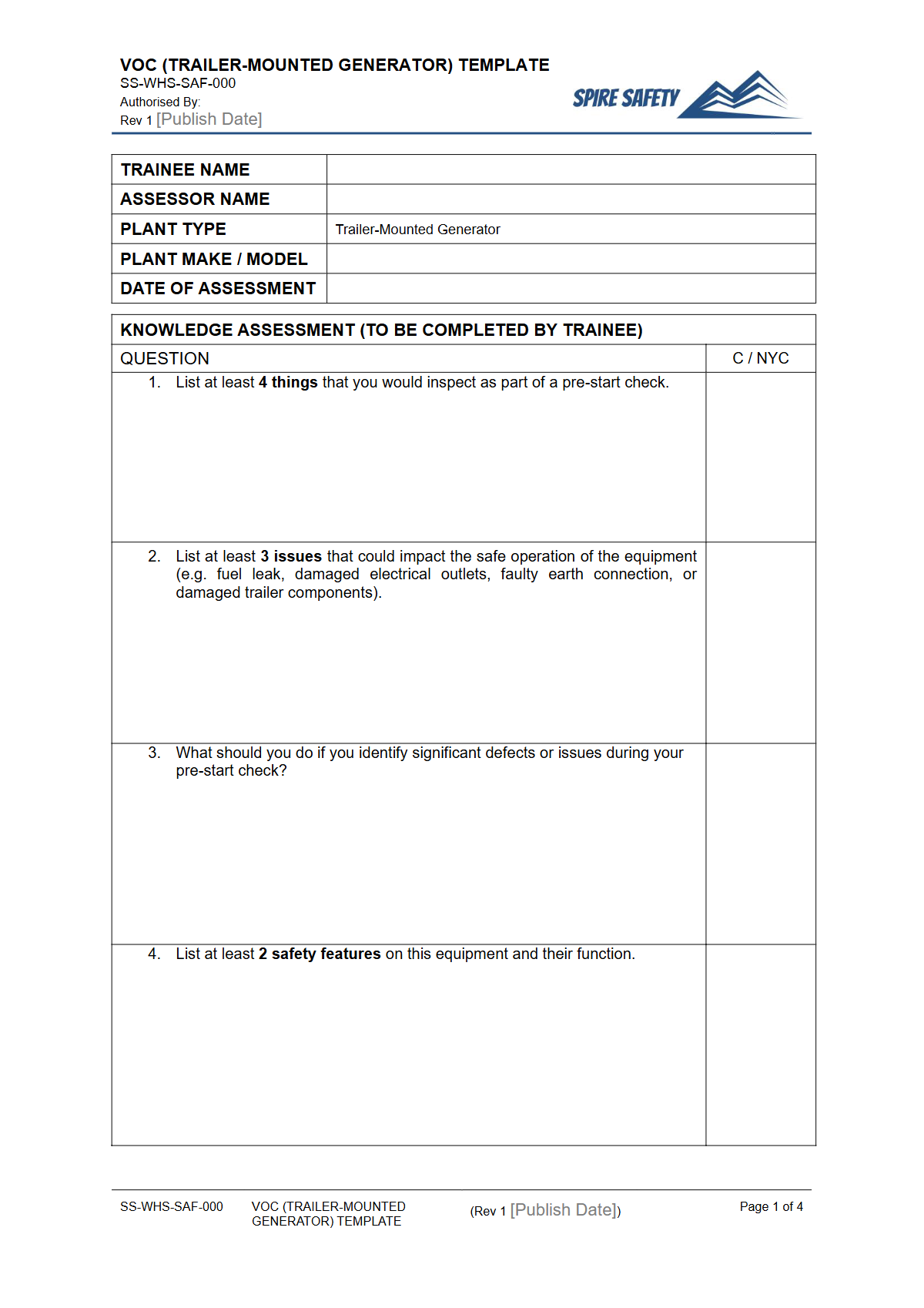
Download our Free Verification of Competency (Trailer-Mounted Generator) Template. This structured Word & PDF resource helps assess operator skills.
Free Verification of Competency (Trailer-Mounted Generator) Template
DOCX • 141 KB + PDF
Updated Oct 2026
No signup required
Purpose of the Free Verification of Competency (Trailer-Mounted Generator) Template
A Verification of Competency (VOC) is a crucial process for any person conducting a business or undertaking (PCBU) to confirm that their workers have the current skills and knowledge to operate equipment safely. This Free Verification of Competency (Trailer-Mounted Generator) Template provides a structured framework for assessing an individual’s ability to safely use, move, and maintain a trailer-mounted generator.
Using such a template helps demonstrate due diligence and ensures that operators understand the specific risks associated with this type of mobile plant, including electrical hazards, towing and manual handling, noise, and exhaust fumes.
Implementing a robust VOC process is a fundamental part of an organisation's safety obligations. It fits within the broader framework of your site's safety procedures, which should be managed systematically.
A well-documented safety program ensures that training, assessment, and operational processes are consistent and effective, with services for WHS management systems able to provide structure and support for these activities.
Video walkthrough
How to Use the Free Verification of Competency (Trailer-Mounted Generator) Template
This template is designed to be a practical tool for supervisors and safety officers. The process is straightforward:
- Download the resource in your preferred format (DOCX for easy editing or PDF).
- Customise the checklist to reflect the specific make and model of the generator used at your workplace, along with your site's unique environmental conditions and safe work procedures.
- Have a competent assessor (a person with the requisite knowledge and experience) observe the worker performing the tasks listed.
- The assessor uses the template to record their observations and make a final determination of competence.
- Sign and file the completed document as a formal record.
Important: Our templates provide a solid foundation aligned with Australian WHS practice. However, we have designed them to be customised.
You must adapt this document to the specific equipment, environment, and risks present in your workplace to ensure it is fit for purpose. Relying on a generic template without customisation may not adequately address your specific safety duties.
This is a key consideration in any formal compliance review, where a WHS compliance auditing process will examine the suitability of your safety documentation.
When to Use It
A VOC for a trailer-mounted generator should be conducted at several key points to ensure ongoing safety and competence. Triggers for conducting a VOC include:
- Pre-employment: To verify the skills and experience claimed by a new hire.
- New Equipment: When a new type or model of trailer-mounted generator is introduced to the site.
- Post-incident: Following an incident or near-miss involving the equipment to identify any competency gaps.
- Identified Performance Issues: If a supervisor observes unsafe or inefficient operation.
- Periodic Re-verification: As part of a regular schedule (e.g., every 2-3 years) to ensure skills have not diminished over time.
This process is distinct from assessing competence on a stationary unit, which is addressed by our Verification of Competency (Diesel Generator) Template.
Who Should Use It
This template is intended for use by individuals responsible for workplace safety and operational supervision. This typically includes:
- Site Supervisors and Foremen
- Work Health and Safety (WHS) Officers or Advisors
- Project Managers
- Training and Assessment Coordinators
Crucially, the person conducting the assessment must be deemed competent themselves. This means they must possess deep technical knowledge of trailer-mounted generators, understand the relevant hazards and control measures, and have experience in conducting assessments.
If your organisation lacks this internal expertise, engaging external specialists through WHS consulting services can provide the necessary third-party assurance.
Key Assessment Criteria
A thorough VOC should cover all phases of operation. Key areas to assess include:
Pre-start Checks
The operator should demonstrate the ability to conduct a comprehensive pre-start inspection, including checking fuel and oil levels, inspecting for leaks, ensuring guards are in place, checking battery condition, and verifying the trailer's roadworthiness (tyres, coupling, lights).
Safe Operation and Positioning
This involves observing the operator's ability to safely tow and position the generator on site, considering ground stability, ventilation, and proximity to combustibles. The assessment should also cover correct start-up and shutdown procedures, load management, electrical connection safety (cable management, RCDs), and proper earthing techniques.
Emergency Procedures
The operator must be able to articulate and, if simulated, demonstrate the correct response to emergencies. This includes emergency shutdown, procedures for fuel spills, response to fire, and understanding the first aid requirements for electric shock.
Mobile Plant Competency
As trailer-mounted generators are mobile, their use often intersects with the operation of other machinery. Ensuring operators are aware of site traffic rules and interaction protocols is vital.
The assessment can be complemented by checks for other mobile equipment, such as our Verification of Competency (Water Cart) template, to build a holistic view of operator skill.
You can find this and many other helpful tools in our free WHS resources library, designed to support Australian businesses in managing their safety obligations.
Common mistakes
Common mistakes to avoid
- Using a generic checklist without customising it for the specific generator model and worksite risks.
- Assigning an assessor who lacks sufficient technical expertise or assessment experience.
- Treating the VOC as a 'tick-and-flick' exercise rather than a genuine observation of practical skill.
- Failing to document and file the completed VOC, leaving no record of due diligence.
Legal references
Legal considerations
The following legal requirements may be relevant to this type of work.
- Work Health and Safety Act (Harmonised) — Provides the primary duties for protecting workers and other people from work health and safety risks.
- Work Health and Safety Regulations (Harmonised) — Sets out requirements supporting the management of workplace hazards and risks.
The following codes may be relevant to this type of work.
- Managing WHS Risks Code of Practice — Provides practical guidance on identifying hazards, assessing risks and applying effective controls.
- Work Health and Safety Consultation, Cooperation and Coordination Code of Practice — Provides practical guidance on consulting workers and coordinating with other duty holders.
- Managing the Work Environment and Facilities Code of Practice — Provides practical guidance on safe work environments, workplace facilities and related controls.
Did you know
Noise Hazard
Many portable generators operate at levels above 85 decibels (dB(A)), the Australian exposure standard for noise. Prolonged exposure without appropriate hearing protection can lead to permanent hearing loss.
Carbon Monoxide Risk
A generator's exhaust contains toxic carbon monoxide (CO), which is colourless and odourless. They must never be used indoors or in poorly ventilated spaces, as CO buildup can be fatal.
FAQ
Frequently asked questions
01What is the difference between a VOC and a license?
02How often should a VOC for a trailer-mounted generator be conducted?
03Can anyone in my company conduct a Verification of Competency?
04Is using this VOC template enough for WHS compliance?
Share this resource
Free Verification of Competency (Trailer-Mounted Generator) Template
Browse Categories
How To Use It
- 1Download and open in Word or PDF.
- 2Replace the placeholders with your business details.
- 3Get it reviewed by a WHS specialist before rollout.
Need it customised?
Our WHS consultants can adapt this template to your site, run a gap analysis, or audit what you already have in place.
Book a Free Consultation WHS consulting servicesor call 1300 156 382
Related templates
- Free Verification of Competency (Transmission Jack) Template
- Free Verification of Competency (Trencher) Template
- Free Verification of Competency (Truck-Mounted Crane or Franna) Template
- Free Verification of Competency (Tyre Changer) Template
- Free Verification of Competency (Vehicle Hoist) Template
- Free Verification of Competency (Vehicle Loading Crane) Template