
Free Verification of Competency (Tyre Changer) Template
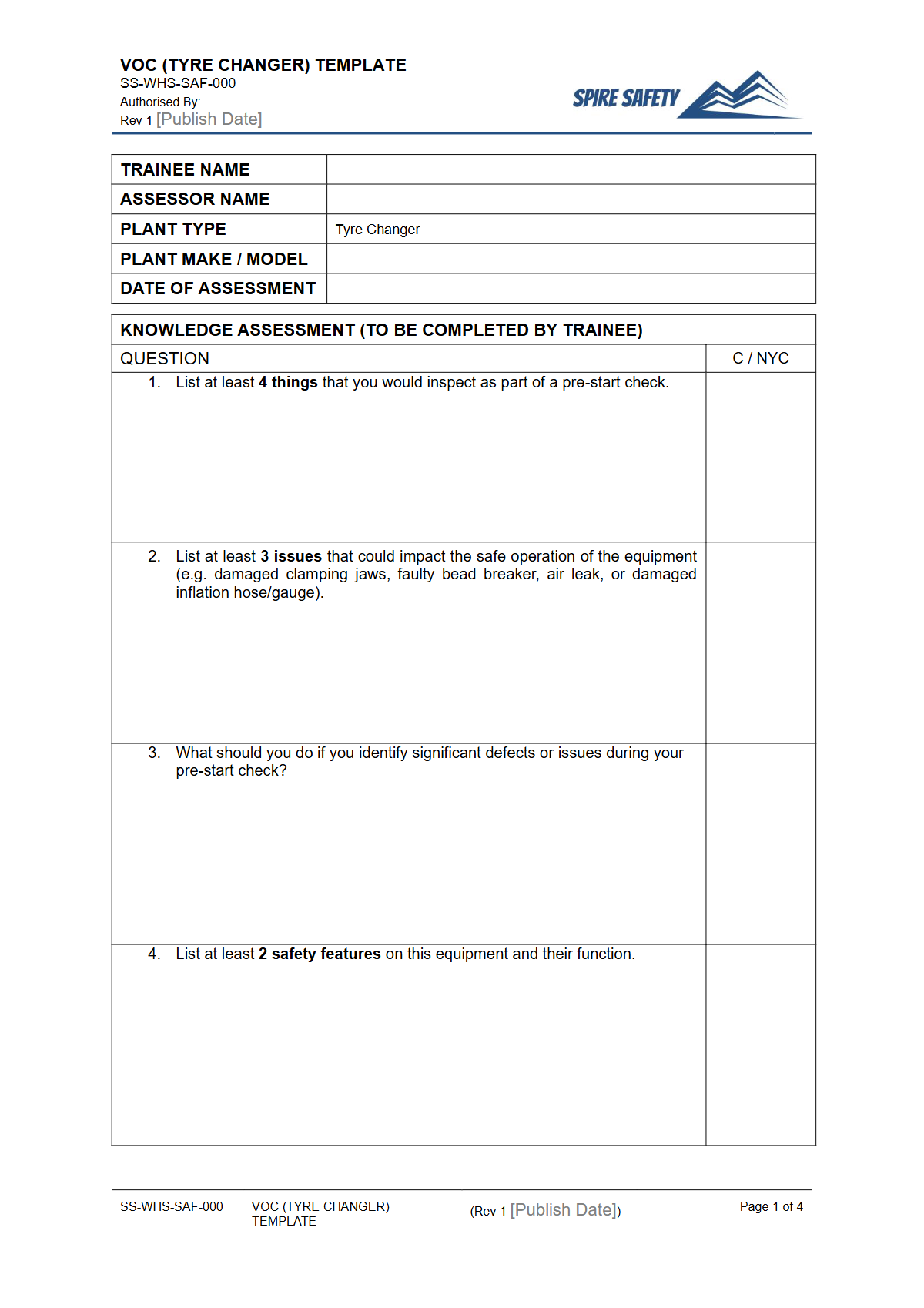
Download our free Verification of Competency (Tyre Changer) template. This structured document helps you assess operator skills for safe tyre changing.
Free Verification of Competency (Tyre Changer) Template
DOCX • 140 KB + PDF
Updated Oct 2026
No signup required
Purpose of the Free Verification of Competency (Tyre Changer) Template
Operating a tyre changer, while routine in many workshops, involves significant risks including musculoskeletal injuries, crushing, and hazards from high-pressure air. This Free Verification of Competency (Tyre Changer) Template provides a structured framework for a Person Conducting a Business or Undertaking (PCBU) to confirm that an operator has the necessary skills, knowledge, and experience to use this equipment safely and effectively.
It serves as a practical tool to meet your duty of care by ensuring workers are competent for the tasks they perform.
A Verification of Competency (VOC) is not a substitute for formal training but a crucial follow-up step. It formally assesses an individual's ability to apply their training in a real-world setting, using the specific machinery present in your workplace.
This process helps identify any gaps in their knowledge or unsafe habits that may have developed over time, allowing for targeted refresher training. Implementing VOCs is a key component of effective WHS management systems and demonstrates a proactive approach to workplace safety.
Video walkthrough
How to use the Free Verification of Competency (Tyre Changer) Template
This template is designed as a comprehensive starting point, providing a clear structure for assessing competence. It includes a mix of theoretical questions and practical observation criteria covering pre-start checks, operational procedures, and shutdown processes. To implement it effectively, follow these steps:
- Download: Choose between the DOCX and PDF formats. The DOCX version is fully editable to suit your needs.
- Customise: This is a critical step. You must adapt the template to reflect the specific make and model of the tyre changer(s) used in your workshop, your site's safe work procedures, and any unique environmental hazards. We have provided a general framework, but you need to add site-specific details to make it a meaningful assessment tool.
- Assess: The assessment must be conducted by a person who is not only experienced but also competent in operating the specific tyre changer and understands the principles of competency assessment. This could be a supervisor, an internal trainer, or a third-party specialist.
- Document: Record the assessment outcome, including any observations, identified knowledge gaps, and required actions (e.g., further training). Signed and dated records should be kept for all workers as part of your safety management documentation. Proper documentation is vital and is often reviewed during a WHS compliance audit.
When to use it
Conducting a VOC for a tyre changer is not a one-off event. It should be integrated into your safety procedures and triggered at several key points to ensure ongoing competence and safety. Consider using this assessment tool in the following scenarios:
- Pre-employment or Onboarding: To verify the skills claimed by a new employee before they are authorised to operate equipment independently.
- Introduction of New Equipment: When a new make or model of tyre changer is introduced to the workplace, even experienced operators should be assessed on the new machine.
- Post-Incident: Following an incident or a near-miss involving a tyre changer, to identify and rectify any unsafe practices or knowledge gaps that may have contributed.
- Periodic Re-assessment: As part of a regular schedule (e.g., every 1-2 years) to ensure skills have not degraded and operators are still adhering to safe work procedures.
- Observed Unsafe Behaviour: If a supervisor observes a worker operating the equipment in a way that deviates from established safety protocols.
Similarly, a Free Pressure Cleaner VOC can be used to verify competency on other common workshop equipment.
Who should use it
This template is a valuable resource for anyone with responsibility for workplace safety and operator competency in automotive workshops, tyre fitting centres, and vehicle maintenance facilities. The primary users include:
- Workshop Managers and Supervisors: Those directly responsible for overseeing daily operations and ensuring their team works safely.
- WHS/OHS Advisors and Officers: Safety professionals tasked with implementing and monitoring the organisation's safety management system.
- Internal Trainers and Assessors: Individuals responsible for training staff and verifying their skills on specific plant and equipment.
- Business Owners (PCBUs): Small business owners who need practical tools to help them meet their WHS legal obligations.
For operations involving heavier machinery, such as moving large wheel assemblies, a Verification of Competency for a Rough Terrain Forklift may also be necessary. Many of the same principles of assessment apply to other tools, as seen in our VOC for a hydraulic impact wrench. You can explore our entire collection in our free WHS resources library for more templates.
Common mistakes
Common mistakes to avoid
- Using a generic VOC template without customising it for the specific make and model of the tyre changer.
- Having an assessor who lacks deep, practical experience with the exact equipment being assessed.
- Treating the VOC as a paperwork exercise rather than a genuine observation of practical skills and safety behaviour.
- Failing to document the assessment outcome and any required corrective actions, like refresher training.
Legal references
Legal considerations
The following legal requirements may be relevant to this type of work.
- Work Health and Safety Act (Harmonised) — Provides the primary duties for protecting workers and other people from work health and safety risks.
- Work Health and Safety Regulations (Harmonised) — Sets out requirements supporting the management of workplace hazards and risks.
The following codes may be relevant to this type of work.
- Managing WHS Risks Code of Practice — Provides practical guidance on identifying hazards, assessing risks and applying effective controls.
- Work Health and Safety Consultation, Cooperation and Coordination Code of Practice — Provides practical guidance on consulting workers and coordinating with other duty holders.
- Managing the Work Environment and Facilities Code of Practice — Provides practical guidance on safe work environments, workplace facilities and related controls.
Did you know
Stored Energy Hazard
A major hazard with tyre changing is the explosive release of stored energy. A 12R22.5 truck tyre inflated to 100 PSI contains enough force to lift a 2-tonne vehicle 3.5 metres into the air if it bursts.
FAQ
Frequently asked questions
01Is a Verification of Competency the same as a licence or training course?
02Who can conduct a VOC assessment for a tyre changer?
03How often should tyre changer operators be re-assessed?
04What happens if a worker is found 'not yet competent'?
Share this resource
Free Verification of Competency (Tyre Changer) Template
Browse Categories
How To Use It
- 1Download and open in Word or PDF.
- 2Replace the placeholders with your business details.
- 3Get it reviewed by a WHS specialist before rollout.
Need it customised?
Our WHS consultants can adapt this template to your site, run a gap analysis, or audit what you already have in place.
Book a Free Consultation WHS consulting servicesor call 1300 156 382
Related templates
- Free Verification of Competency (Vehicle Hoist) Template
- Free Verification of Competency (Vehicle Loading Crane) Template
- Free Verification of Competency (Walkie Stacker) Template
- Free Verification of Competency (Water Cart) Template
- Free Verification of Competency (Wheel Balancer) Template
- Free Verification of Competency (Winch) Template