
Free Verification of Competency (Vehicle Hoist) Template
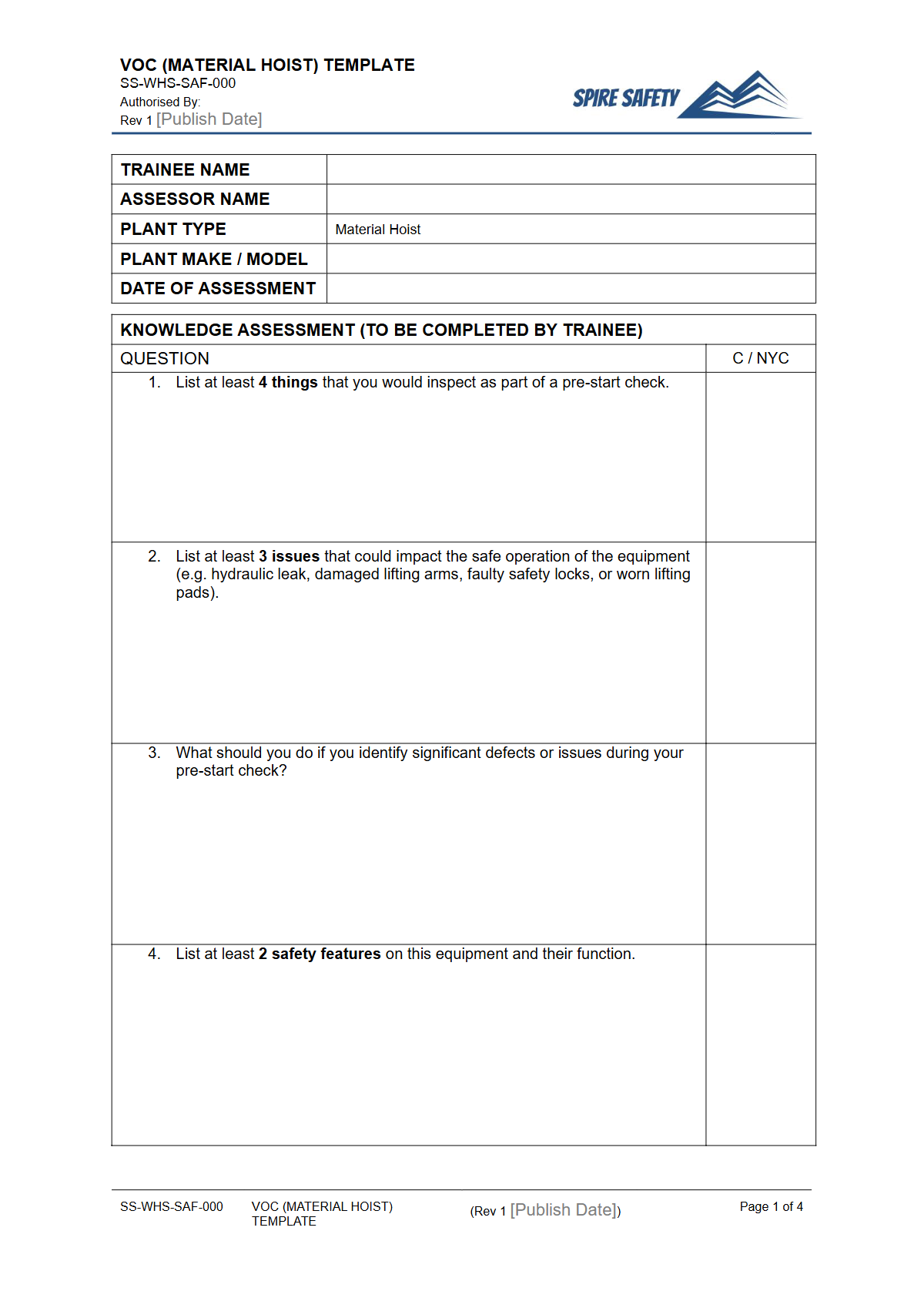
Assess and confirm the skills of your vehicle hoist operators with our free Verification of Competency (Vehicle Hoist) template.
Free Verification of Competency (Vehicle Hoist) Template
DOCX • 138 KB + PDF
Updated Oct 2026
No signup required
Purpose of the Free Verification of Competency (Vehicle Hoist) Template
Operating a vehicle hoist presents significant risks if not performed correctly. This free Verification of Competency (Vehicle Hoist) template provides a structured method for a Person Conducting a Business or Undertaking (PCBU) to confirm that their workers have the necessary skills and knowledge to operate this equipment safely.
A VOC is a crucial tool for managing workplace risks, used to verify that a worker’s existing skills and qualifications are current, valid, and sufficient for the tasks required. It serves as evidence that a PCBU has taken steps to ensure competency, complementing initial training and licensing.
Implementing robust VOC processes is a key part of maintaining effective WHS management systems. This process helps bridge the gap between a worker holding a qualification and being practically competent on specific equipment within a particular work environment. It ensures that theoretical knowledge is matched by practical, safe application, reducing the risk of incidents, injuries, and damage to equipment or vehicles.
It formally documents the assessment, providing a clear record of an individual's capabilities at a specific point in time.
Video walkthrough
How to use the Free Verification of Competency (Vehicle Hoist) Template
This downloadable template is provided in both DOCX and PDF formats. It is designed as a starting point, based on common Australian WHS practices, and must be adapted to your specific operational needs.
Start by reviewing the entire document and identifying which sections apply to your workplace and which need modification. Customise the checklist to include the specific makes and models of vehicle hoists used on your site, such as two-post, four-post, scissor, or mobile column lifts.
Add criteria relevant to your site-specific procedures, emergency protocols, and the types of vehicles being lifted.
The assessor must be a competent person with extensive technical knowledge and practical experience in operating the specific vehicle hoist(s) under assessment. They should use the customised checklist to observe the worker through all stages of operation, from pre-start checks to lifting, working under the vehicle, lowering, and shutdown procedures.
The assessor should document their observations, noting both satisfactory performance and any areas requiring further training. The same systematic approach can be used for other workshop tools, such as with a Free Drill Press VOC template, to ensure consistent safety standards across all equipment.
A Note on Customisation
This is a template, not a finished document. We strongly recommend you customise this resource to reflect the specific hazards, risks, equipment, and control measures in your workplace.
A generic assessment that doesn't account for your unique environment may not adequately manage your safety obligations. Integrating details from your safe work procedures and risk assessments is essential for a meaningful verification process.
When to use Verifications of Competency
A VOC for a vehicle hoist should be conducted at several key moments to ensure ongoing safety. It is essential for new employees to verify their claimed skills before they begin work unsupervised, even if they have prior experience.
It should also be used following the completion of initial training to confirm that the training was effective. Other critical times include instances where a worker is transitioning to a new type of vehicle hoist, after a prolonged absence from the role, or if performance issues or unsafe work practices are observed.
Regular, periodic reassessments should also be scheduled as part of your overall safety management, the frequency of which should be determined by a risk assessment.
Conducting a VOC is also a valuable proactive step after a near-miss or incident involving a vehicle hoist, even if the worker being assessed was not directly involved. This helps reinforce safe procedures and identify any gaps in knowledge across the team.
Just as you might regularly verify skills for high-risk mobile plant using a VOC for a rough terrain forklift, consistent assessment for workshop-based plant like vehicle hoists is a mark of a mature safety culture.
Who should use it
This template is intended for use by individuals responsible for workplace safety and operational supervision in the automotive service and repair industry, as well as any other business that uses vehicle hoists. This includes workshop managers, leading hands, supervisors, and internal trainers.
WHS advisors and officers can also use the template to establish or refine their organisation's competency assessment framework. The key requirement is that the person conducting the assessment (the assessor) must be competent themselves—they must possess the skills, knowledge, and experience to make an informed judgement on the operator's abilities.
For organisations looking to ensure their assessment processes are robust and systematically applied, engaging external support can provide valuable assurance. Regular reviews of your procedures and documentation by an independent party can identify improvement opportunities you might miss.
An external perspective from WHS consulting professionals can help strengthen your entire safety framework, from VOCs to incident investigations. For a wider range of safety documents, you can explore our free WHS resources library.
Common mistakes
Common mistakes to avoid
- Using a generic checklist without customising it for the specific hoist model and workplace procedures.
- Assigning an assessor who lacks deep technical expertise and practical experience with the vehicle hoist.
- Treating the assessment as a paper-based formality rather than a practical, hands-on verification of skill.
- Failing to document the assessment outcome, including any identified gaps and required corrective actions like refresher training.
Legal references
Legal considerations
The following legal requirements may be relevant to this type of work.
- Work Health and Safety Act (Harmonised) — Provides the primary duties for protecting workers and other people from work health and safety risks.
- Work Health and Safety Regulations (Harmonised) — Sets out requirements supporting the management of workplace hazards and risks.
The following codes may be relevant to this type of work.
- Managing WHS Risks Code of Practice — Provides practical guidance on identifying hazards, assessing risks and applying effective controls.
- Work Health and Safety Consultation, Cooperation and Coordination Code of Practice — Provides practical guidance on consulting workers and coordinating with other duty holders.
- Managing the Work Environment and Facilities Code of Practice — Provides practical guidance on safe work environments, workplace facilities and related controls.
Did you know
A Critical Standard
Australian Standard AS/NZS 2550.9 provides detailed guidance on the safe use of vehicle hoists, covering key aspects of operation, inspection, and maintenance that form the basis of a thorough VOC.
Leading Cause of Injury
Being hit by moving or falling objects is a leading cause of serious injury in the vehicle repair industry. Correct use of equipment like vehicle hoists is a critical control measure to prevent these incidents.
FAQ
Frequently asked questions
01What is the difference between a VOC and a training course?
02How often should vehicle hoist VOCs be conducted?
03Does this template cover all types of vehicle hoists?
04Who is considered a competent person to conduct a VOC?
Share this resource
Free Verification of Competency (Vehicle Hoist) Template
Browse Categories
How To Use It
- 1Download and open in Word or PDF.
- 2Replace the placeholders with your business details.
- 3Get it reviewed by a WHS specialist before rollout.
Need it customised?
Our WHS consultants can adapt this template to your site, run a gap analysis, or audit what you already have in place.
Book a Free Consultation WHS consulting servicesor call 1300 156 382
Related templates
- Free Verification of Competency (Vehicle Loading Crane) Template
- Free Verification of Competency (Walkie Stacker) Template
- Free Verification of Competency (Water Cart) Template
- Free Verification of Competency (Wheel Balancer) Template
- Free Verification of Competency (Winch) Template
- Free Verification of Competency (Wood Chipper) Template