
Free Verification of Competency (Wheel Balancer) Template
Ensure your workers operate wheel balancers safely and competently with our Free Verification of Competency (Wheel Balancer) Template.
Free Verification of Competency (Wheel Balancer) Template
DOCX • 140 KB + PDF
Updated Oct 2026
No signup required
Purpose of the Free Verification of Competency (Wheel Balancer) Template
Operating a wheel balancer requires precision, attention to detail, and an understanding of the associated mechanical and ergonomic risks. As a Person Conducting a Business or Undertaking (PCBU), you have a primary duty of care to ensure your workers are competent to perform their tasks safely.
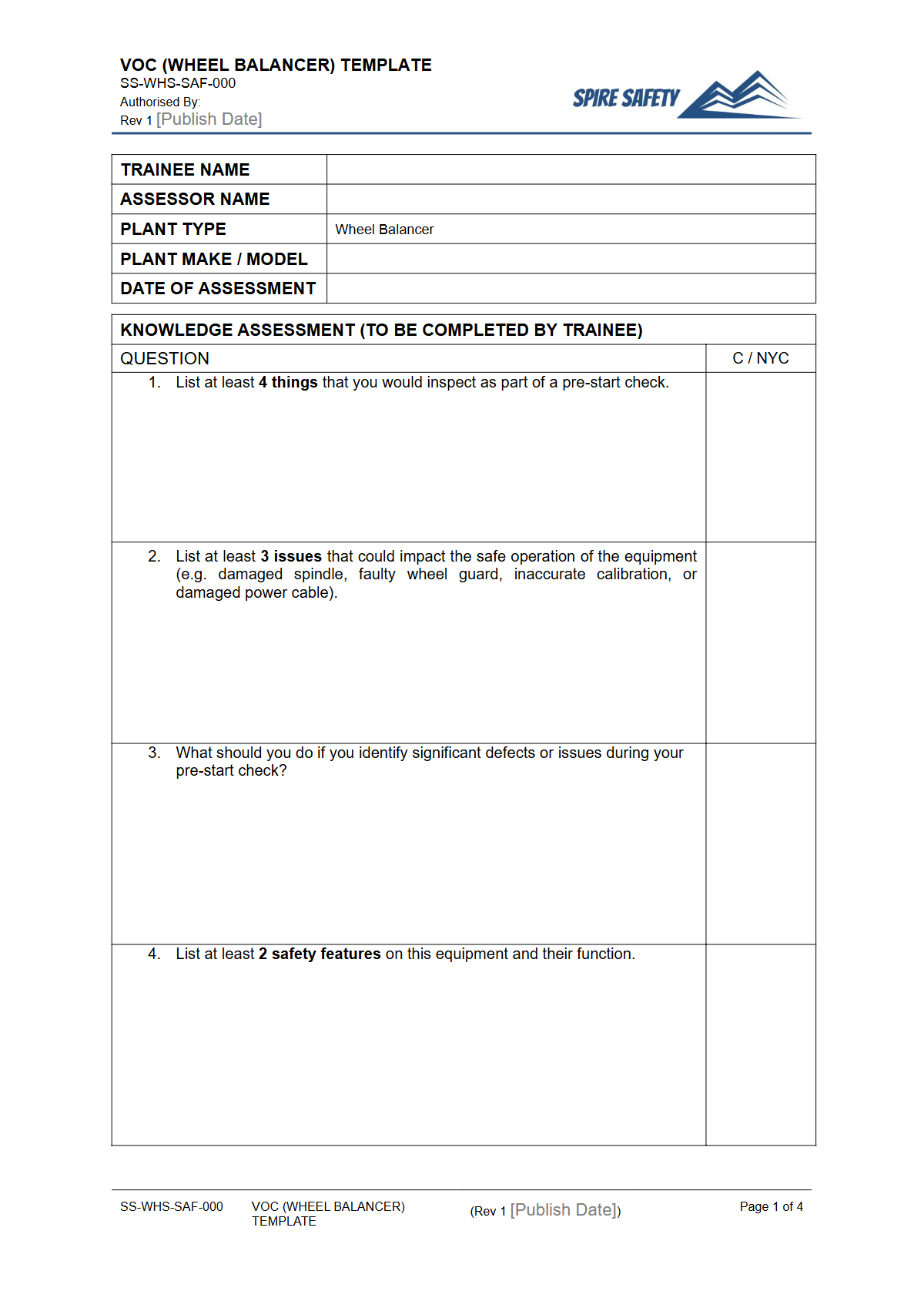
This free Verification of Competency (Wheel Balancer) Template provides a structured framework to assess and confirm that an operator has the necessary skills and safety knowledge to operate this specific piece of workshop equipment correctly.
Using a formal VOC process helps manage risks associated with wheel balancers, such as pinch points from rotating parts, musculoskeletal injuries from manual handling of heavy wheels, and incorrect operation leading to property damage or unsafe vehicle conditions. Integrating this process into your safety management helps demonstrate due diligence and contributes to a safer, more professional workshop environment.
It is a critical component of robust WHS management systems, ensuring that training is effective and skills are maintained over time.
Video walkthrough
How to use the Free Verification of Competency (Wheel Balancer) Template
This template is designed as a starting point for assessing worker competence. The process is straightforward: download the DOCX or PDF and adapt it to your workplace.
The assessor, who must be a competent person themselves, observes the operator performing the tasks outlined in the checklist. This includes pre-start checks, correct operational procedures, and shutdown processes.
The assessor notes their observations, identifies any gaps in skill or knowledge, and formally records the outcome.
Remember, this document is not a substitute for hands-on training. It is a tool for verification after training has occurred.
Like our Verification of Competency for hydraulic impact wrenches, it is most effective when used as part of a broader competency program.
Important Customisation Note
This is a template that must be customised. We recommend you adapt this document to reflect the specific make and model of your wheel balancer, your safe work procedures, site-specific hazards, and any unique operational requirements of your business.
A generic checklist may not adequately address the risks present in your workplace.
When to use it
A Verification of Competency is not a one-time event. It should be conducted at several key points to ensure ongoing safety and competence. Consider using this template in the following situations:
- Pre-employment: To verify the claimed skills and experience of a new hire before they begin work unsupervised.
- Introduction of New Equipment: When a new or different model of wheel balancer is introduced to the workplace.
- Post-Incident: After an incident or near-miss involving the equipment to identify and correct any gaps in operator knowledge or behaviour.
- Identified Performance Issues: If a worker is observed operating the equipment incorrectly or unsafely.
- Periodic Re-assessment: As part of a regular schedule (e.g., every 2-3 years) to ensure skills have not diminished over time. This aligns with the principles of regular WHS compliance auditing.
Who should use it
The VOC should be carried out by a person with the necessary knowledge, skills, and experience to competently assess another worker's performance on a wheel balancer. This person could be a workshop manager, a senior technician, a supervisor, or a dedicated WHS advisor.
The key requirement is that the assessor is fully competent in the safe use of the specific machine and can authoritatively judge the operator's abilities against best practice and your organisation's procedures.
This principle of using competent assessors applies across all equipment types, whether you are using this VOC or another tool like our free Drill Press VOC template. The credibility of the assessment depends entirely on the expertise of the assessor.
Key Assessment Criteria
This template provides a structure to assess a worker's ability across three key phases of equipment use. It prompts the assessor to verify competence in:
- Pre-Operational Checks: Confirming the operator correctly inspects the machine before use, checking for damaged components, ensuring guards are in place, and verifying that emergency stops are functional.
- Safe Operation: Assessing the operator's ability to correctly and safely lift and mount a wheel, secure it properly, input data accurately, run the balancing cycle, interpret the results, and apply weights correctly.
- Post-Operational Procedures: Verifying that the operator shuts down the machine according to procedure, cleans the work area, and reports any faults or damage.
Documenting these stages provides clear evidence of an individual's practical skill. Much like our Pipe Cutter VOC Template, it breaks a complex task into verifiable steps.
For organisations needing assistance to develop or implement such processes, engaging expert WHS consulting can provide valuable guidance and support.
Common mistakes
Common mistakes to avoid
- Using the generic template without customising it for the specific make and model of the wheel balancer.
- Having the assessment conducted by an assessor who is not fully competent with the equipment themselves.
- Treating the assessment as a 'tick-and-flick' paperwork exercise rather than a genuine observation of practical skill.
- Failing to properly document and retain records of the VOC, making it difficult to prove due diligence if an incident occurs.
Legal references
Legal considerations
The following legal requirements may be relevant to this type of work.
- Work Health and Safety Act (Harmonised) — Provides the primary duties for protecting workers and other people from work health and safety risks.
- Work Health and Safety Regulations (Harmonised) — Sets out requirements supporting the management of workplace hazards and risks.
The following codes may be relevant to this type of work.
- Managing WHS Risks Code of Practice — Provides practical guidance on identifying hazards, assessing risks and applying effective controls.
- Work Health and Safety Consultation, Cooperation and Coordination Code of Practice — Provides practical guidance on consulting workers and coordinating with other duty holders.
- Managing the Work Environment and Facilities Code of Practice — Provides practical guidance on safe work environments, workplace facilities and related controls.
Did you know
Precision Matters
An improperly balanced tyre can create vibrations that lead to premature wear on tyres, bearings, and suspension components, impacting both vehicle safety and long-term maintenance costs.
Manual Handling Risk
Modern car and truck wheels can be surprisingly heavy, posing a significant manual handling risk. Correct lifting techniques are a critical, but often overlooked, part of wheel balancer operator competency.
FAQ
Frequently asked questions
01Is a VOC legally required for a wheel balancer in Australia?
02How often should we conduct a wheel balancer VOC?
03What is the difference between training and a Verification of Competency?
04Can a workshop supervisor conduct this VOC assessment?
Share this resource
Free Verification of Competency (Wheel Balancer) Template
Browse Categories
How To Use It
- 1Download and open in Word or PDF.
- 2Replace the placeholders with your business details.
- 3Get it reviewed by a WHS specialist before rollout.
Need it customised?
Our WHS consultants can adapt this template to your site, run a gap analysis, or audit what you already have in place.
Book a Free Consultation WHS consulting servicesor call 1300 156 382
Related templates
- Free Verification of Competency (Winch) Template
- Free Verification of Competency (Wood Chipper) Template
- Free Verification of Competency (Zero Turn Mower) Template
- Free Verification of Competency Template
- Free Whacker Packer VOC (Verification of Competency) Template
- Verification of Competency (Air Compressor) Template