
Free Verification of Competency (Zero Turn Mower) Template
Download our Free Verification of Competency (Zero Turn Mower) Template to assess operator skills. This DOCX & PDF resource helps ensure safe operation.
Free Verification of Competency (Zero Turn Mower) Template
DOCX • 140 KB + PDF
Updated Oct 2026
No signup required
Purpose of the Free Verification of Competency (Zero Turn Mower) Template
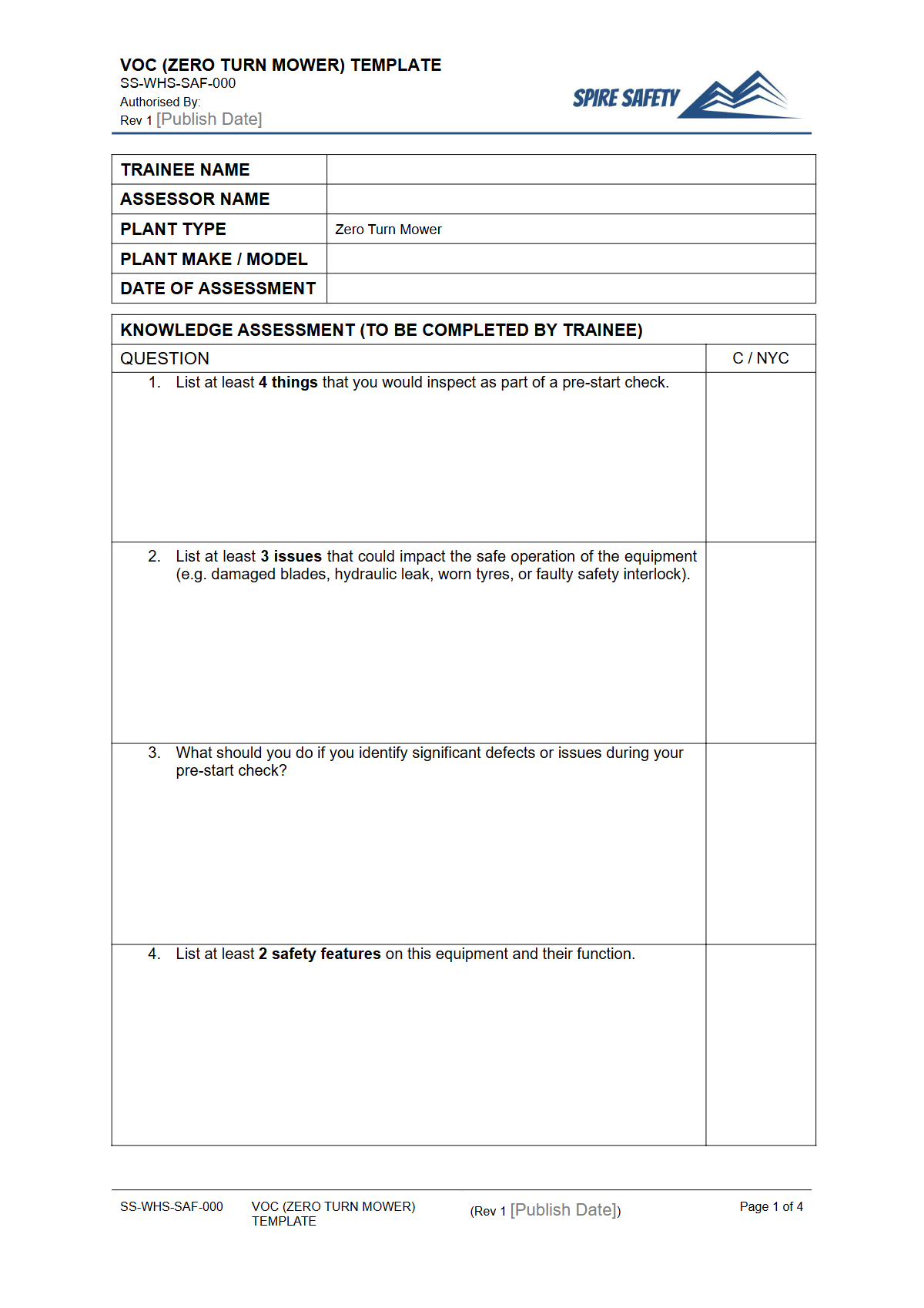
Operating a zero turn mower requires skill, awareness, and a solid understanding of the machine's specific risks. Our free Verification of Competency (Zero Turn Mower) Template provides a structured framework for assessing and documenting an operator's ability to use this equipment safely and effectively.
It’s designed to help Persons Conducting a Business or Undertaking (PCBUs) meet their work health and safety obligations by verifying that workers have the necessary competence for the task.
Zero turn mowers, while efficient, present significant hazards, including rollovers on sloped terrain, contact with the cutting blades, and projectiles being thrown from the deck. A formal VOC process helps confirm that operators can identify and manage these risks. This template is a practical tool aligned with Australian WHS principles, serving as a starting point for confirming operator skill beyond initial training, similar to how one might assess operators of other specialised mobile plant using a Verification of Competency for rough terrain forklifts.
Video walkthrough
How to use the Free Verification of Competency (Zero Turn Mower) Template
Using this template involves a straightforward process. First, download the document in your preferred format (DOCX for easy editing or PDF).
The next critical step is customisation. It is essential to adapt the template to your specific workplace environment, the exact models of zero turn mowers in use, site-specific hazards like drains or steep banks, and your organisation's internal safety procedures.
Integrating this process into your broader safety framework is key to its effectiveness.
A VOC should be conducted by a competent person who observes the operator performing relevant tasks in their normal work environment. The template guides the assessor through key areas, including pre-operational checks, operational skills, hazard awareness, and shutdown procedures.
The outcome, including any identified gaps in competence and required corrective actions (like refresher training), should be clearly documented. This documentation forms an important part of your robust WHS management systems.
Key Assessment Areas
To ensure a thorough assessment, the VOC should cover several critical domains:
- Pre-Operational Checks: Verifying the operator correctly inspects safety features like the Rollover Protective Structure (ROPS), seatbelts, guards, and kill switches. It also includes checking fluid levels, tyre pressures, and blade condition.
- Operational Skills: Assessing the operator's ability to manoeuvre the mower safely on various terrains, including gentle slopes, around obstacles, and in open areas. This includes demonstrating control at different speeds and executing smooth turns without damaging turf or losing stability.
- Hazard Identification and Risk Control: Evaluating the operator's awareness of their surroundings. This includes identifying and reacting to pedestrians, changes in terrain, hidden objects, and designated no-go zones. It's a similar skill set needed for other compact equipment, as detailed in our mini excavator VOC template.
- Emergency and Shutdown Procedures: Confirming the operator knows how to perform an emergency stop and follows the correct sequence for shutting down, parking, and securing the mower to prevent unauthorised use.
When to use it
A Verification of Competency is not a one-time event. It should be used at several key points in an operator's employment lifecycle to ensure their skills remain current and aligned with safety standards. Triggers for conducting a VOC include:
- As part of pre-employment screening for new hires with prior experience.
- After a significant period of absence from operating the equipment.
- Following an incident, near miss, or observation of unsafe work practices.
- When a new type or model of zero turn mower is introduced to the workplace.
- As part of a scheduled periodic assessment (e.g., every 2-3 years) to refresh knowledge and confirm ongoing competence.
Regularly scheduled VOCs and spot checks on operator performance can be reviewed during WHS compliance audits to demonstrate proactive safety management.
Who should use it
This template is designed for use by individuals with responsibility for workplace safety and operator supervision. This typically includes WHS managers, safety officers, site supervisors, leading hands, and team leaders.
It can also be used by internal trainers and assessors tasked with maintaining operator competence across the workforce. For organisations needing help to establish these internal processes, engaging specialist WHS consulting can provide valuable guidance and support.
Crucially, the person conducting the assessment must be competent themselves. This means they must possess the technical knowledge of the zero turn mower, have extensive hands-on operational experience, and a thorough understanding of the relevant safety procedures and assessment principles.
Just as you would use a specific template for different equipment like a water cart VOC template, the assessor must be specifically competent on the machine being assessed.
By systematically verifying operator skills, your organisation can reduce the risk of incidents and foster a stronger safety culture. For more tools to support your safety management efforts, explore our complete free WHS resources library.
Common mistakes
Common mistakes to avoid
- Using a generic checklist that isn't specific to the mower model or worksite.
- Assigning an assessor who lacks sufficient hands-on experience with zero turn mowers.
- Treating the VOC as a 'tick-and-flick' exercise without proper, real-world observation.
- Failing to formally document the assessment outcome and any required corrective actions.
Legal references
Legal considerations
The following legal requirements may be relevant to this type of work.
- Work Health and Safety Act (Harmonised) — Provides the primary duties for protecting workers and other people from work health and safety risks.
- Work Health and Safety Regulations (Harmonised) — Sets out requirements supporting the management of workplace hazards and risks.
The following codes may be relevant to this type of work.
- Managing WHS Risks Code of Practice — Provides practical guidance on identifying hazards, assessing risks and applying effective controls.
- Work Health and Safety Consultation, Cooperation and Coordination Code of Practice — Provides practical guidance on consulting workers and coordinating with other duty holders.
- Managing the Work Environment and Facilities Code of Practice — Provides practical guidance on safe work environments, workplace facilities and related controls.
Did you know
Slope Dangers
Most zero turn mower rollovers occur on slopes, even those that appear gentle. The combination of a high centre of gravity and rapid directional changes makes them particularly susceptible to instability.
Blade Tip Speed
The tips of a commercial zero turn mower's blades can spin at speeds over 300 km/h. This incredible velocity allows for a clean cut but also presents a significant hazard from thrown objects or contact.
FAQ
Frequently asked questions
01Is a VOC a legal requirement for operating a zero turn mower in Australia?
02How often should a zero turn mower VOC be conducted?
03Who is considered a competent person to conduct a VOC?
04Can I use this template for other types of mowers?
Share this resource
Free Verification of Competency (Zero Turn Mower) Template
Browse Categories
How To Use It
- 1Download and open in Word or PDF.
- 2Replace the placeholders with your business details.
- 3Get it reviewed by a WHS specialist before rollout.
Need it customised?
Our WHS consultants can adapt this template to your site, run a gap analysis, or audit what you already have in place.
Book a Free Consultation WHS consulting servicesor call 1300 156 382
Related templates
- Free Verification of Competency Template
- Free Whacker Packer VOC (Verification of Competency) Template
- Verification of Competency (Air Compressor) Template
- Verification of Competency (Asphalt Paver) Template
- Verification of Competency (Boom Lift or Knuckle Boom) Template
- Verification of Competency (Bulldozer) Template