
Free Verification of Competency (Vehicle Loading Crane) Template
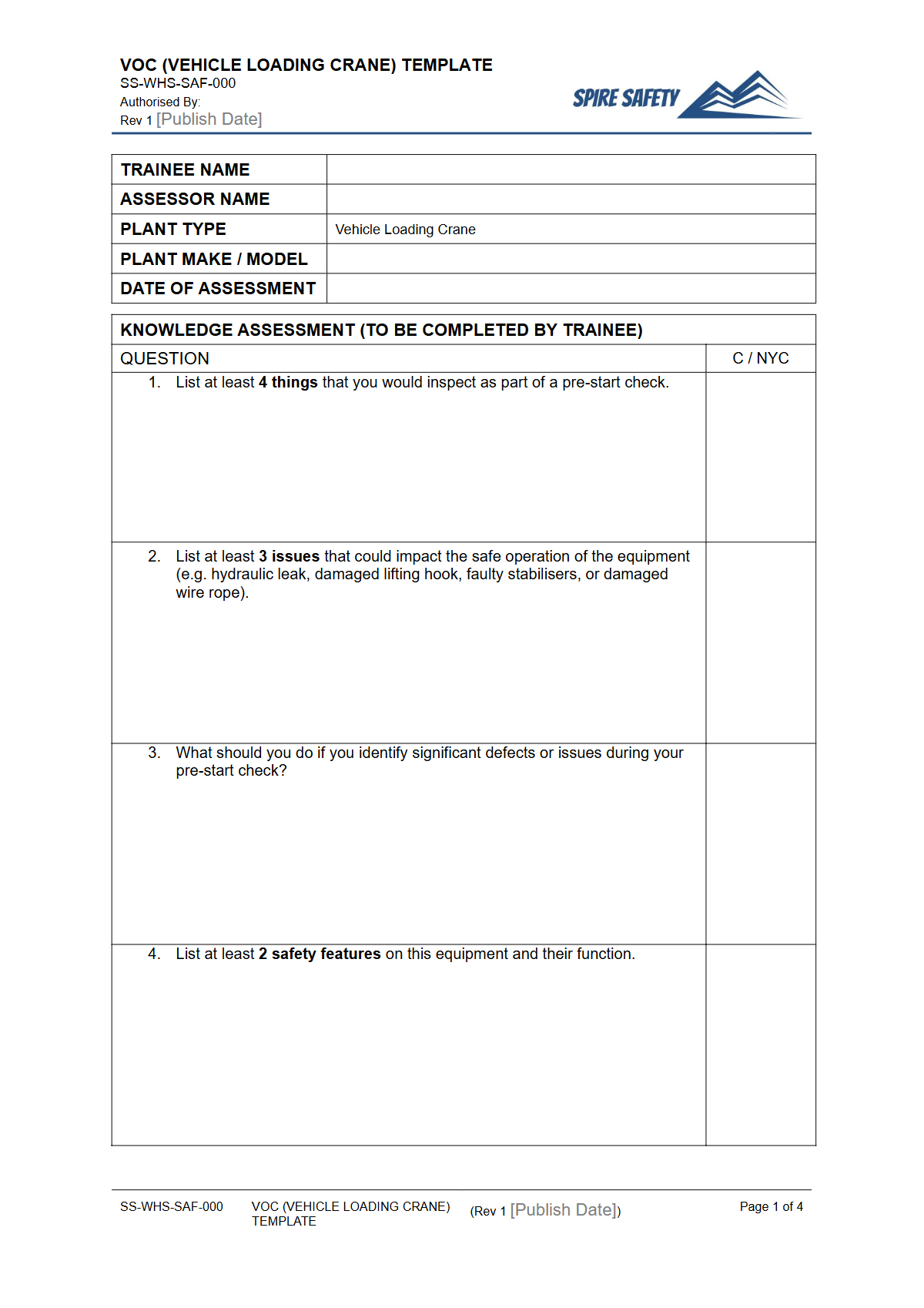
Our free Verification of Competency (Vehicle loading Crane) template helps assess operator skill and safety awareness. Download your DOCX & PDF resource now.
Free Verification of Competency (Vehicle Loading Crane) Template
DOCX • 138 KB + PDF
Updated Oct 2026
No signup required
Purpose of the Free Verification of Competency (Vehicle Loading Crane) Template
Operating a vehicle loading crane, often known as a Hiab, is a high-risk activity that demands more than just a licence. This Free Verification of Competency (Vehicle Loading Crane) Template provides a structured framework for employers to confirm that an operator can perform their duties safely and competently in their specific work environment.
While a High-Risk Work Licence (HRWL) is a prerequisite for cranes with a capacity of 10 metre tonnes or more, a VOC goes further by verifying practical skills on the actual equipment used on site. It helps identify any gaps in knowledge or unsafe habits that may have developed since initial training, providing a clear record of due diligence and commitment to workplace safety.
Using a VOC is a key activity within a robust WHS management system, demonstrating proactive risk management.
Video walkthrough
How to use the Free Verification of Competency (Vehicle Loading Crane) Template
This downloadable template serves as a comprehensive starting point for assessing an operator's ability to handle a vehicle loading crane. It is divided into sections covering pre-start checks, operational planning, safe lifting techniques, and shutdown procedures.
The process involves a competent assessor observing the operator and evaluating their performance against established criteria. The template is provided in both DOCX and PDF formats, allowing for easy customisation.
Important: This is a template, not a finished document. We have designed it to align with Australian WHS principles, but every worksite is unique.
You must customise this document to reflect your specific vehicle loading crane models, attachments, common loads, site hazards, and internal procedures. The assessor should also be familiar with the crane and tasks being assessed.
The structured format allows for consistent assessment across all operators. The principles outlined are similar to those you might find in our Verification of Competency for a Rough Terrain Forklift, focusing on practical, observable behaviours.
When to use it
A Verification of Competency for a vehicle loading crane is a valuable tool that should be used at several key moments. It is essential during pre-employment screening to confirm the skills claimed by a candidate.
It should also be conducted when introducing a new type or model of crane to the workplace, as controls and capacities can vary significantly. A VOC is a critical step following an incident or near-miss to identify and correct any unsafe behaviours.
Furthermore, many organisations incorporate periodic VOCs, such as every two years, as part of their ongoing competency and training program. This regular reassessment ensures that standards are maintained over time and can be documented as part of regular WHS compliance audits.
Who should use it
This template is designed for use by two key parties: the operator being assessed and the person conducting the assessment. The operator must hold the relevant licences and demonstrate their ability to operate the crane safely according to the manufacturer's instructions and site procedures.
The assessor must be a competent person, meaning they have the necessary knowledge, skills, and experience with vehicle loading cranes to make an informed judgement about the operator's competence. This doesn't just mean they can operate the crane; it means they have the depth of understanding to identify subtle risks, ask relevant questions, and provide constructive feedback.
For organisations without a suitable internal expert, engaging external WHS consultants can provide the required impartiality and expertise. Similar to the process for our mini excavator VOC template, the credibility of the assessment hinges on the credibility of the assessor.
This resource is just one of many tools designed to support your safety management. For more templates, checklists, and guides, browse our complete free WHS resources library.
Common mistakes
Common mistakes to avoid
- Treating the VOC as a paperwork exercise without proper, direct observation of the task.
- Using an assessor who is not familiar with the specific crane model or site hazards.
- Failing to customise the template to include site-specific procedures, such as traffic management or communication protocols.
- Not providing constructive feedback or arranging corrective training for operators who show competency gaps.
Legal references
Legal considerations
The following legal requirements may be relevant to this type of work.
- Work Health and Safety Act (Harmonised) — Provides the primary duties for protecting workers and other people from work health and safety risks.
- Work Health and Safety Regulations (Harmonised) — Sets out requirements supporting the management of workplace hazards and risks.
The following codes may be relevant to this type of work.
- Managing WHS Risks Code of Practice — Provides practical guidance on identifying hazards, assessing risks and applying effective controls.
- Work Health and Safety Consultation, Cooperation and Coordination Code of Practice — Provides practical guidance on consulting workers and coordinating with other duty holders.
- Managing the Work Environment and Facilities Code of Practice — Provides practical guidance on safe work environments, workplace facilities and related controls.
Did you know
Licence Requirements
In Australia, a High-Risk Work Licence (class CV) is required to operate a vehicle loading crane with a capacity of 10 metre tonnes or more. This is calculated by multiplying the crane's maximum lifting capacity (in tonnes) by its maximum reach (in metres).
A Leading Hazard
According to Safe Work Australia, being hit by moving objects is a leading cause of serious injury claims in the transport, postal, and warehousing industry. Proper crane operation and load management are critical to preventing these incidents.
FAQ
Frequently asked questions
01Is a VOC the same as a High-Risk Work Licence (HRWL) for a vehicle loading crane?
02How often should a vehicle loading crane VOC be completed?
03Who is a 'competent person' to conduct a crane VOC?
04Can this template be used for any vehicle loading crane?
Share this resource
Free Verification of Competency (Vehicle Loading Crane) Template
Browse Categories
How To Use It
- 1Download and open in Word or PDF.
- 2Replace the placeholders with your business details.
- 3Get it reviewed by a WHS specialist before rollout.
Need it customised?
Our WHS consultants can adapt this template to your site, run a gap analysis, or audit what you already have in place.
Book a Free Consultation WHS consulting servicesor call 1300 156 382
Related templates
- Free Verification of Competency (Walkie Stacker) Template
- Free Verification of Competency (Water Cart) Template
- Free Verification of Competency (Wheel Balancer) Template
- Free Verification of Competency (Winch) Template
- Free Verification of Competency (Wood Chipper) Template
- Free Verification of Competency (Zero Turn Mower) Template