
Free Verification of Competency (Walkie Stacker) Template
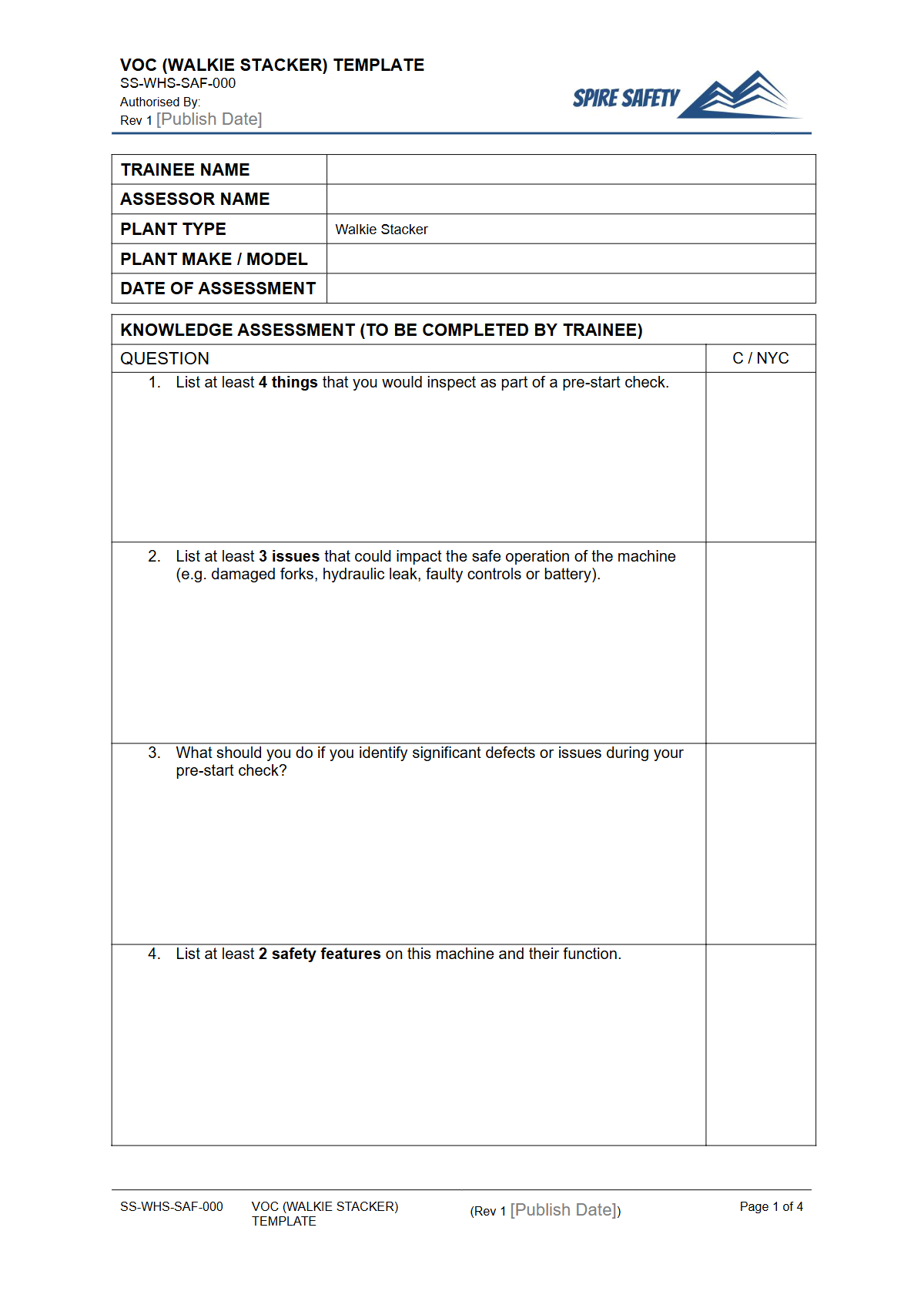
Download our Free Verification of Competency (Walkie Stacker) Template. This structured Word & PDF document helps you assess operator skills and knowledge.
Free Verification of Competency (Walkie Stacker) Template
DOCX • 138 KB + PDF
Updated Oct 2026
No signup required
Purpose of the Free Verification of Competency (Walkie Stacker) Template
Ensuring your team can operate equipment safely and competently is a cornerstone of good WHS practice. This Free Verification of Competency (Walkie Stacker) Template provides a structured starting point for assessing your workers' skills.
A Verification of Competency (VOC) is a practical way to confirm that individuals have the current knowledge and ability to operate equipment like a pedestrian walkie stacker safely, in line with your site's specific procedures.
The primary purpose of this template is to help you formalise the process of assessing an operator's ability. It's not just about ticking a box; it’s about creating a record that demonstrates due diligence.
This process helps verify that training has been effective and that skills are maintained over time. A documented VOC is crucial for identifying any knowledge gaps or unsafe habits that may have developed since initial training.
It serves as a vital component within broader WHS management systems, reinforcing a proactive safety culture in your organisation.
Video walkthrough
How to use the Free Verification of Competency (Walkie Stacker) Template
Using this VOC template is straightforward. First, download the document in your preferred format (DOCX for easy editing or PDF).
Before use, it is essential that you adapt the document to your specific operational context.
Customisation is Essential
It's crucial to remember that this is a template. We have designed it as a comprehensive starting point, but you must customise it to reflect your specific workplace, the models of walkie stackers in use, your site-specific hazards, and any relevant Safe Work Method Statements (SWMS).
Once customised, a competent person (like a supervisor or trainer) should use the checklist to observe an operator performing typical tasks. The observer should document their findings, noting areas of competence and any areas requiring further training.
This process is distinct from assessments for other machinery, such as what would be covered in a Verification of Competency for a rough terrain forklift, which involves different operational risks.
When to use it
A VOC for a walkie stacker is not a one-off event. It should be conducted at several key moments to ensure ongoing safety and competence. Common triggers include:
- Pre-employment or prior to assignment: To verify the skills claimed by a new employee or a worker changing roles.
- Post-incident: After a near miss or an incident involving a walkie stacker to identify and correct unsafe behaviours.
- Introduction of new equipment: When a new make or model of walkie stacker with different controls or features is introduced.
- Periodic reassessment: As part of a regular schedule (e.g., annually or biennially) to ensure skills have not degraded over time.
Regular assessments are a key part of proactive safety management and can be verified through processes like WHS compliance auditing. These checks ensure that your safety procedures are being followed correctly and remain effective.
Who should use it
This template is designed for use by individuals responsible for overseeing workplace safety and equipment operation. This typically includes:
- WHS Managers and Advisors: To standardise the competency verification process across the business.
- Supervisors and Team Leaders: To conduct on-the-floor assessments of their team members.
- Internal Trainers: As a tool to confirm the effectiveness of their training programs.
The person conducting the assessment must be competent themselves; they should have a thorough understanding of the walkie stacker's operation, the associated risks, and the workplace's safety procedures. While this document is specific to walkie stackers, we also offer other equipment-specific templates, from our mini excavator VOC template to our Free Drill Press VOC template, for different operational needs.
By consistently applying a structured VOC process, you build a safer work environment and a more confident, skilled workforce. For more templates and safety documents, you can explore our complete free WHS resources library.
Common mistakes
Common mistakes to avoid
- Using a generic forklift checklist without tailoring it to the specific walkie stacker model and tasks.
- Treating the VOC as a simple tick-and-flick exercise instead of a genuine observation of behaviour and skill.
- Failing to document the assessment outcomes, including any corrective actions or further training required.
- Neglecting to assess practical skills in job-specific situations, like navigating tight aisles or interacting with pedestrians.
Legal references
Legal considerations
The following legal requirements may be relevant to this type of work.
- Work Health and Safety Act (Harmonised) — Provides the primary duties for protecting workers and other people from work health and safety risks.
- Work Health and Safety Regulations (Harmonised) — Sets out requirements supporting the management of workplace hazards and risks.
The following codes may be relevant to this type of work.
- Managing WHS Risks Code of Practice — Provides practical guidance on identifying hazards, assessing risks and applying effective controls.
- Work Health and Safety Consultation, Cooperation and Coordination Code of Practice — Provides practical guidance on consulting workers and coordinating with other duty holders.
- Managing the Work Environment and Facilities Code of Practice — Provides practical guidance on safe work environments, workplace facilities and related controls.
Did you know
A Common Risk
Walkie stackers are a leading cause of foot and lower leg injuries in warehouses and retail settings, primarily due to their operation in pedestrian-heavy areas.
PCBU Duty
Under the model WHS Act, a PCBU must ensure workers receive the necessary training and supervision to protect them from risks associated with plant and equipment.
FAQ
Frequently asked questions
01Is a walkie stacker licence required in Australia?
02How often should a walkie stacker VOC be conducted?
03What should be included in a walkie stacker competency assessment?
04Can this template be used for other types of forklifts?
Share this resource
Free Verification of Competency (Walkie Stacker) Template
Browse Categories
How To Use It
- 1Download and open in Word or PDF.
- 2Replace the placeholders with your business details.
- 3Get it reviewed by a WHS specialist before rollout.
Need it customised?
Our WHS consultants can adapt this template to your site, run a gap analysis, or audit what you already have in place.
Book a Free Consultation WHS consulting servicesor call 1300 156 382
Related templates
- Free Verification of Competency (Water Cart) Template
- Free Verification of Competency (Wheel Balancer) Template
- Free Verification of Competency (Winch) Template
- Free Verification of Competency (Wood Chipper) Template
- Free Verification of Competency (Zero Turn Mower) Template
- Free Verification of Competency Template