
Free Verification of Competency (Water Cart) Template
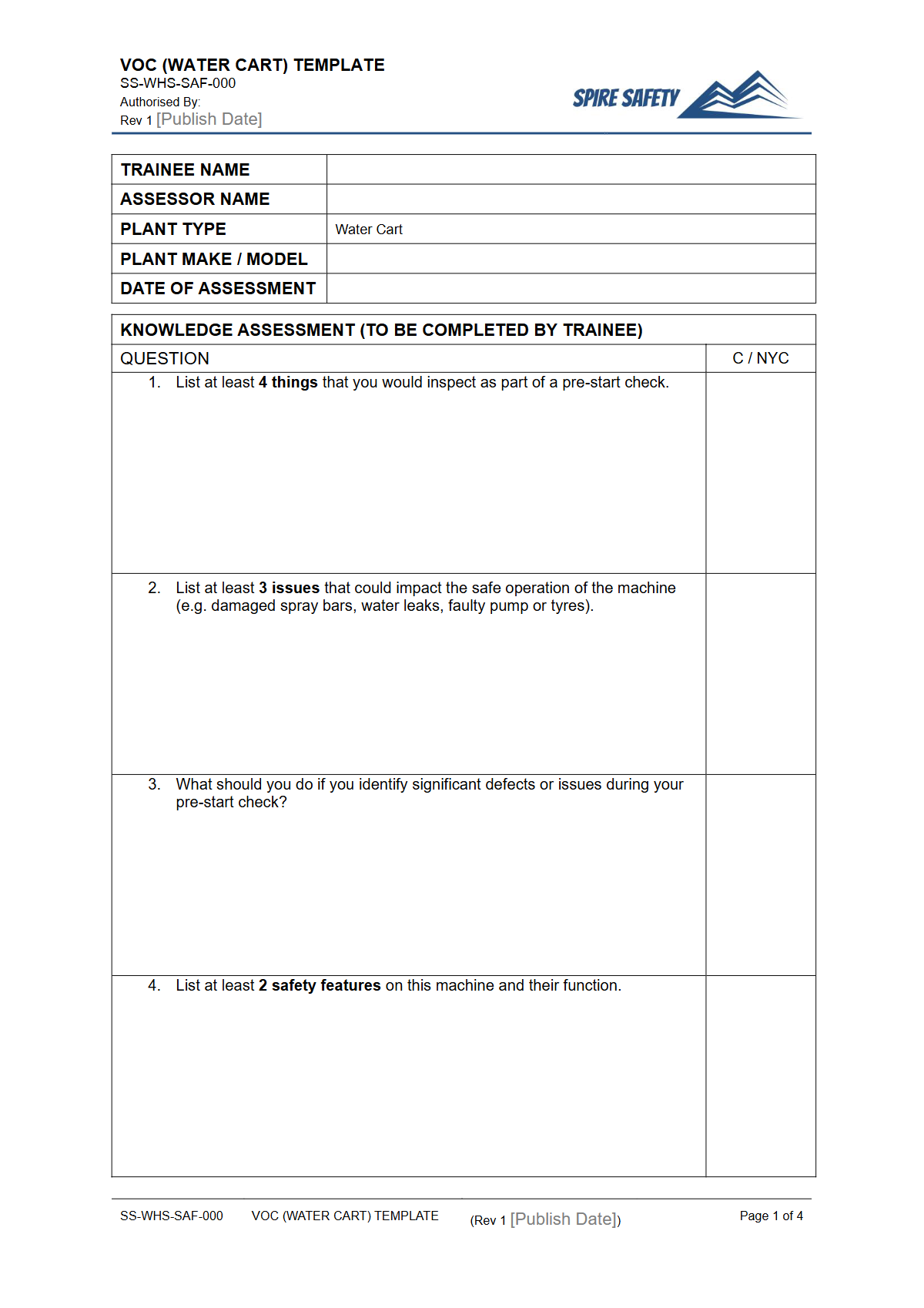
Download our Free Verification of Competency (Water Cart) Template to assess operator skills.
Free Verification of Competency (Water Cart) Template
DOCX • 138 KB + PDF
Updated Oct 2026
No signup required
Purpose of the Free Verification of Competency (Water Cart) Template
Operating a water cart requires more than just a heavy vehicle licence; it demands specific skills in managing liquid loads, controlling spray systems, and navigating varied worksite terrains. Our Free Verification of Competency (Water Cart) Template provides a structured framework for assessing an operator's ability to perform these tasks safely and efficiently.
Using this document helps a Person Conducting a Business or Undertaking (PCBU) confirm that workers have the current skills and knowledge to operate this specialised plant without endangering themselves or others. It’s a critical tool for managing risks associated with dust suppression, soil compaction, and road maintenance activities on site.
This template serves as a practical instrument within your overall safety framework, helping to ensure that your competency verification process is consistent and documented. Formalising this process demonstrates a commitment to proactive safety management and supports the development of robust WHS management systems that stand up to scrutiny.
Video walkthrough
How to use the Free Verification of Competency (Water Cart) Template
This template is designed for use by a competent assessor—such as a supervisor, experienced operator, or trainer—to evaluate a water cart operator. The assessment should involve both a theory component and, most importantly, direct observation of the operator performing tasks in a real or simulated work environment.
The assessor uses the checklist to record observations against key performance criteria, noting areas of competence and identifying any gaps that may require further training.
Important: This is a template, not a finished document. We have designed it to be a strong starting point, but it must be customised to the specific models of water carts, site conditions, unique hazards, and organisational procedures in your workplace.
Ensure you adapt the criteria to reflect your operational reality. For other earthmoving equipment, you might find our free Grader VOC template similarly useful.
When to use it
Verifying competency is not a one-off event. It should be an ongoing part of your risk management strategy. Key times to conduct a VOC for a water cart operator include:
- Pre-employment: To verify the skills claimed by a new hire before they start work.
- Post-incident: Following a near miss or incident involving a water cart to identify and correct any unsafe behaviours.
- Introduction of new equipment: When an operator transitions to a different make or model of water cart with different controls or features.
- Lapse of time: If an operator has not used a water cart for an extended period.
- Routine assessments: As part of a scheduled competency review program to ensure skills remain current.
Regularly scheduled VOCs can be a key piece of evidence during a formal WHS compliance auditing process, demonstrating your organisation's commitment to maintaining a safe workforce.
Who should use it
This verification of competency template is intended for use by individuals responsible for workplace safety and operational supervision. This includes:
- Safety Managers and WHS Advisors
- Site Supervisors and Foremen
- Project Managers
- Internal Trainers and Assessors
- Plant and Equipment Managers
Essentially, anyone with the authority and expertise to assess worker competence and make decisions about their authorisation to operate plant should find this resource valuable. Similar principles apply to other specialised road plant, as detailed in our Asphalt Paver Verification of Competency Template.
Key Assessment Criteria
A thorough VOC for a water cart operator should cover the entire operational lifecycle of the equipment. Our template guides the assessor through several critical areas, including:
- Pre-start and Post-start Checks: Verifying the operator systematically inspects the vehicle's mechanical, hydraulic, and safety features, including brakes, steering, tyres, lights, and the water delivery system.
- Safe Operation: Assessing the operator’s ability to manoeuvre the vehicle safely, manage the dynamic effects of a shifting liquid load (surge), maintain situational awareness, and apply water effectively without creating new hazards like slippery surfaces.
- Shutdown Procedures: Ensuring the operator follows correct procedures for parking, securing the vehicle, and shutting down the engine and auxiliary systems.
- Hazard Identification: Evaluating the operator's understanding of common hazards, such as overhead powerlines, soft edges, uneven ground, and interaction with other vehicles and pedestrians.
The skills involved in managing a heavy, dynamic load are also relevant to other mobile plant. You may also be interested in the criteria outlined in our Verification of Competency (Rough Terrain Forklift) template.
Maintaining Records
Proper record-keeping is a cornerstone of WHS due diligence. Once a VOC is completed, the form should be signed by both the operator and the assessor and securely stored as part of the employee's training file.
These records are vital for demonstrating compliance, tracking training needs, and providing evidence of competency in the event of an incident or regulatory audit. A well-organised system for these documents is essential.
For expert assistance in establishing such systems, consider engaging with a WHS consulting service.
By integrating this structured verification process into your operations, you move beyond simple compliance and foster a culture of genuine competence and safety. Explore our entire free WHS resources library for more tools to support your safety management system.
Common mistakes
Common mistakes to avoid
- Using a generic checklist that doesn't match the specific water cart model.
- Allowing an unqualified or inexperienced person to conduct the assessment.
- Treating the VOC as a 'tick and flick' exercise instead of a genuine skills evaluation.
- Failing to document the assessment outcome and any required retraining actions.
Legal references
Legal considerations
The following legal requirements may be relevant to this type of work.
- Work Health and Safety Act (Harmonised) — Provides the primary duties for protecting workers and other people from work health and safety risks.
- Work Health and Safety Regulations (Harmonised) — Sets out requirements supporting the management of workplace hazards and risks.
The following codes may be relevant to this type of work.
- Managing WHS Risks Code of Practice — Provides practical guidance on identifying hazards, assessing risks and applying effective controls.
- Work Health and Safety Consultation, Cooperation and Coordination Code of Practice — Provides practical guidance on consulting workers and coordinating with other duty holders.
- Managing the Work Environment and Facilities Code of Practice — Provides practical guidance on safe work environments, workplace facilities and related controls.
Did you know
Water Weight Dynamics
A large water cart can hold over 30,000 litres of water, adding more than 30 tonnes. This liquid load creates a 'surge' effect during braking and turning, significantly altering the vehicle's handling and centre of gravity.
More Than Dust
Beyond their primary role in dust suppression, water carts are essential for soil compaction on civil projects, fire control on construction sites, and maintaining haul roads to improve traction for other heavy vehicles.
FAQ
Frequently asked questions
01Is a Verification of Competency the same as a licence?
02Who can conduct a VOC for a water cart operator?
03How often should a water cart operator's competency be verified?
04Does this template cover all models of water cart?
Share this resource
Free Verification of Competency (Water Cart) Template
Browse Categories
How To Use It
- 1Download and open in Word or PDF.
- 2Replace the placeholders with your business details.
- 3Get it reviewed by a WHS specialist before rollout.
Need it customised?
Our WHS consultants can adapt this template to your site, run a gap analysis, or audit what you already have in place.
Book a Free Consultation WHS consulting servicesor call 1300 156 382
Related templates
- Free Verification of Competency (Wheel Balancer) Template
- Free Verification of Competency (Winch) Template
- Free Verification of Competency (Wood Chipper) Template
- Free Verification of Competency (Zero Turn Mower) Template
- Free Verification of Competency Template
- Free Whacker Packer VOC (Verification of Competency) Template