
Free Verification of Competency (Trencher) Template
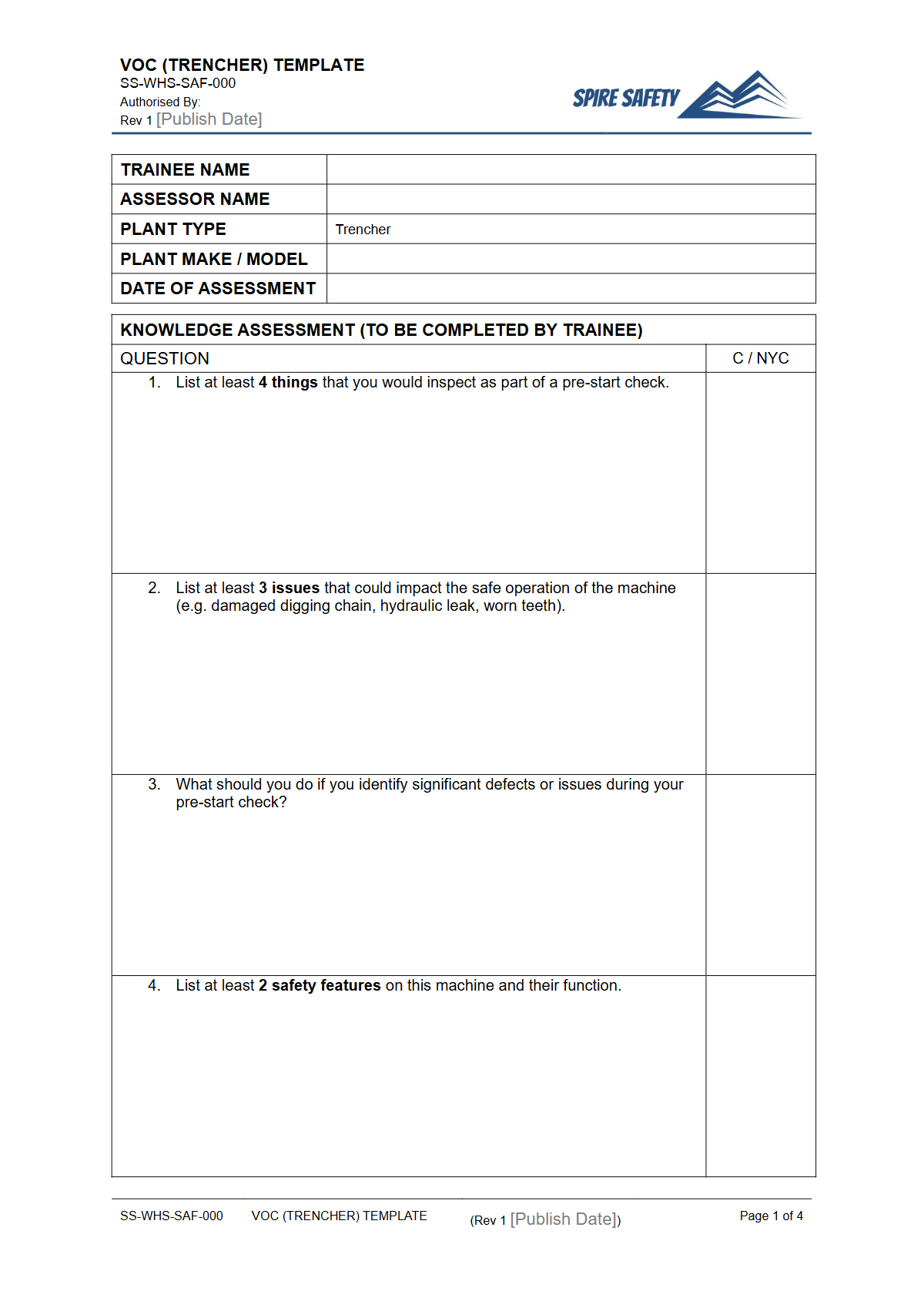
Download our free Verification of Competency (Trencher) template to assess operator skills. This customisable DOCX & PDF helps ensure safe trenching.
Free Verification of Competency (Trencher) Template
DOCX • 138 KB + PDF
Updated Oct 2026
No signup required
Purpose of the Free Verification of Competency (Trencher) Template
Operating a trencher involves significant risks, including trench collapse, striking underground services, and machine rollovers. A Person Conducting a Business or Undertaking (PCBU) has a duty to ensure that workers are competent to perform their tasks safely.
This Free Verification of Competency (Trencher) Template provides a structured framework for assessing and confirming that an operator possesses the necessary skills and knowledge to operate a trencher safely and effectively. It helps identify any gaps in training before they lead to an incident, forming a key part of your organisation's risk management process.
Using this template helps formalise the assessment process, creating a clear record that competency has been verified. It covers essential criteria, from pre-start checks and understanding machine controls to practical trenching techniques and emergency procedures.
This process is a fundamental component of robust WHS management systems, demonstrating due diligence in managing high-risk plant operations.
Video walkthrough
How to use the Free Verification of Competency (Trencher) Template
This document serves as a comprehensive starting point for your workplace. To implement it effectively, follow these steps:
- Download: Choose the DOCX format for easy editing or the PDF for straightforward printing.
- Customise: It is essential that you adapt this template to your specific needs. Update the content to reflect the make and model of the trencher being used, the specific site conditions (e.g., soil type, terrain, presence of services), and your organisation’s unique safe work procedures. We have included common criteria, but your environment may have additional risks to consider.
- Assess: The assessment should be conducted by a person with the appropriate knowledge, skills, and experience in operating the specific trencher. The process should include a combination of theoretical questions (to test knowledge) and direct observation of the operator performing tasks in a controlled and safe environment.
- Document: Complete all sections of the form, including the assessor's comments and the final outcome. Both the assessor and the operator should sign the document. Keep the completed VOC on file as a record of training and competency.
For similar assessments on related earthmoving equipment, you may find our Verification of Competency (Mini Excavator) Template a useful resource to maintain consistency in your processes.
When to use it
A Verification of Competency is not a one-time event. It should be conducted at several key moments to ensure ongoing safety and skill retention. These include:
- Pre-employment: To verify the skills and claims of a new hire before they begin work.
- Introduction of new equipment: When an operator is required to use a new or different model of trencher.
- Post-incident: Following an incident or near-miss involving a trencher to identify and correct any unsafe behaviours or knowledge gaps.
- Periodic re-assessment: As part of a regular schedule (e.g., every 1-3 years, depending on risk) to ensure skills have not diminished over time.
- Identified performance issues: If a supervisor observes an operator performing a task unsafely or inefficiently.
Regular assessments are crucial for maintaining high safety standards on-site. The data gathered from these VOCs can also inform scheduled WHS compliance auditing activities, highlighting areas where training programs may need improvement.
Who should use it
This template is designed for use by individuals responsible for workplace health and safety and operational management. This includes:
- WHS Managers and Advisors: To implement a standardised process for competency verification across the organisation.
- Site Supervisors and Foremen: To conduct on-the-ground assessments and ensure their team members are safe to operate machinery.
- Training Coordinators: To identify training needs and maintain comprehensive records of worker capabilities.
- Internal or External Assessors: As a tool to guide the assessment process and document their findings systematically.
Effective management of plant extends beyond the trencher itself. For tasks like dust suppression, which are common on excavation sites, our Verification of Competency (Water Cart) template offers a similar structure for assessment.
If you require templates for other types of plant and equipment, you can browse our complete free WHS resources library for more options.
Common mistakes
Common mistakes to avoid
- Using a generic checklist without customising it for the specific trencher model and site conditions.
- Assigning an assessor who lacks direct, hands-on experience with the equipment being assessed.
- Failing to include a practical observation of the operator handling simulated emergency procedures.
- Treating the VOC as a 'tick-and-flick' administrative task rather than a genuine skills evaluation.
Legal references
Legal considerations
The following legal requirements may be relevant to this type of work.
- Work Health and Safety Act (Harmonised) — Provides the primary duties for protecting workers and other people from work health and safety risks.
- Work Health and Safety Regulations (Harmonised) — Sets out requirements supporting the management of workplace hazards and risks.
The following codes may be relevant to this type of work.
- Managing WHS Risks Code of Practice — Provides practical guidance on identifying hazards, assessing risks and applying effective controls.
- Work Health and Safety Consultation, Cooperation and Coordination Code of Practice — Provides practical guidance on consulting workers and coordinating with other duty holders.
- Managing the Work Environment and Facilities Code of Practice — Provides practical guidance on safe work environments, workplace facilities and related controls.
Did you know
Soil Weight
A single cubic metre of soil can weigh more than 1.5 tonnes. This immense weight is why trench collapses are so dangerous and why proper shoring and battering techniques are critical safety measures.
Dial Before You Dig
Before any trenching work begins in Australia, it is essential practice to use the Dial Before You Dig service. Striking underground utilities like gas pipes, water mains, or electrical cables can have catastrophic and fatal consequences.
FAQ
Frequently asked questions
01What is the difference between a trencher operator's licence and a VOC?
02Does this template cover all types of trenchers?
03Who is considered a competent person to conduct a trencher VOC?
04How often should a trencher operator's competency be verified?
Share this resource
Free Verification of Competency (Trencher) Template
Browse Categories
How To Use It
- 1Download and open in Word or PDF.
- 2Replace the placeholders with your business details.
- 3Get it reviewed by a WHS specialist before rollout.
Need it customised?
Our WHS consultants can adapt this template to your site, run a gap analysis, or audit what you already have in place.
Book a Free Consultation WHS consulting servicesor call 1300 156 382
Related templates
- Free Verification of Competency (Truck-Mounted Crane or Franna) Template
- Free Verification of Competency (Tyre Changer) Template
- Free Verification of Competency (Vehicle Hoist) Template
- Free Verification of Competency (Vehicle Loading Crane) Template
- Free Verification of Competency (Walkie Stacker) Template
- Free Verification of Competency (Water Cart) Template