
Free Verification of Competency (Transmission Jack) Template
Download our free Verification of Competency (Transmission Jack) Template to assess worker skill and safety knowledge. Get your DOCX and PDF now.
Free Verification of Competency (Transmission Jack) Template
DOCX • 140 KB + PDF
Updated Oct 2026
No signup required
Purpose of the Free Verification of Competency (Transmission Jack) Template
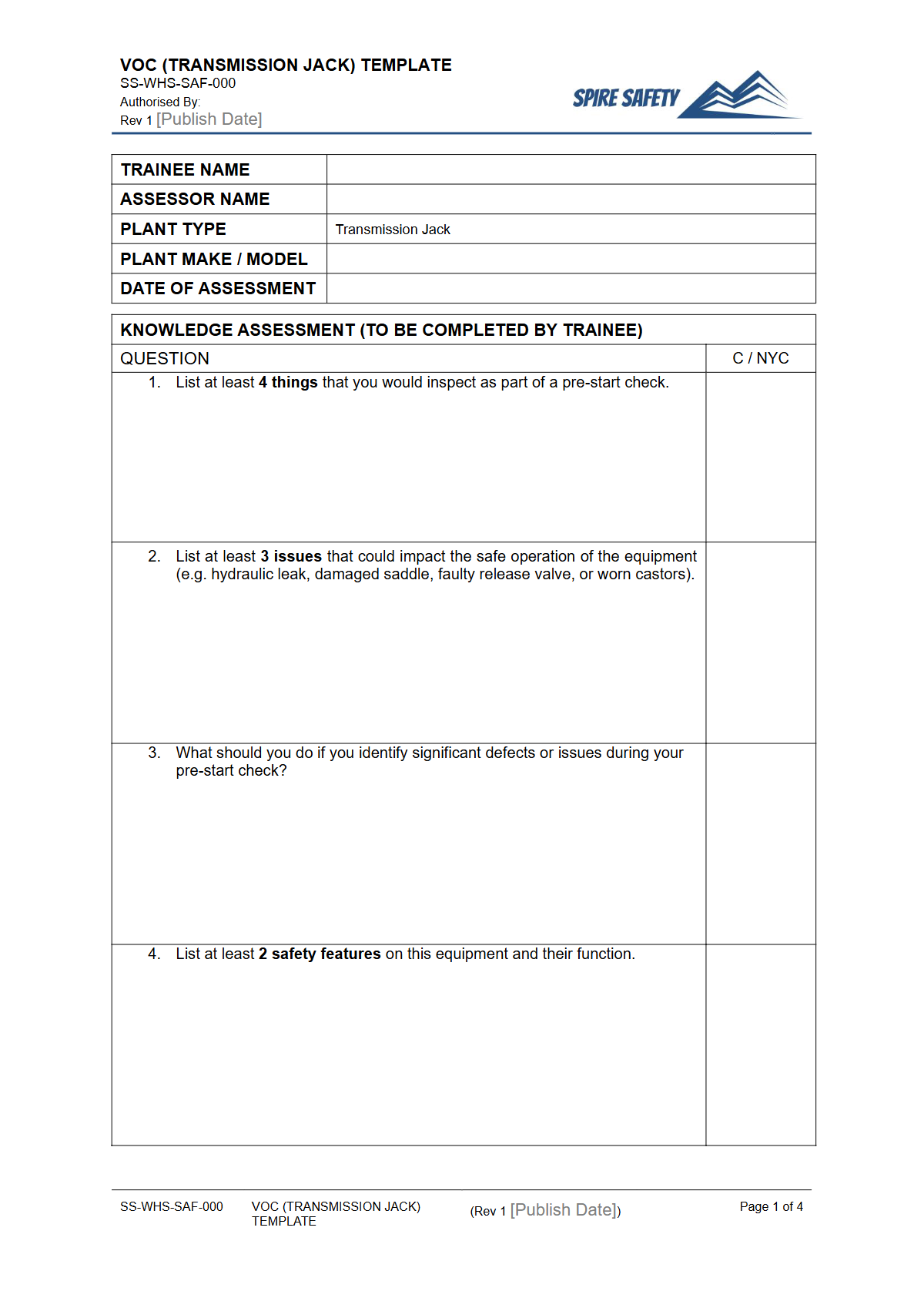
Operating workshop equipment like a transmission jack requires specific skills to manage the significant risks involved. This Free Verification of Competency (Transmission Jack) Template provides a structured framework for a Person Conducting a Business or Undertaking (PCBU) to assess whether a worker has the required competence.
It's designed to help you verify and document that operators can use the equipment safely and effectively, in line with their duty of care obligations. Using a formal assessment process is a fundamental part of a proactive safety culture and robust WHS management systems, helping to prevent incidents before they occur.
Video walkthrough
How to use the Free Verification of Competency (Transmission Jack) Template
This template is a practical tool for supervisors, trainers, or other competent personnel to conduct and record assessments. The process is straightforward: download the document, adapt it to your operational context, and use it to guide the assessment.
The document includes sections for pre-operational checks, safe operating procedures, and post-use tasks. A record of the assessment, signed by both the assessor and the operator, provides clear evidence of the verification process.
For assessing skills on similar workshop equipment, our Verification of Competency (Wrecker or Impact Wrench) template can also be a valuable resource.
Important: Customise to Your Workplace
This document is a general template aligned with Australian WHS principles. We strongly advise that you customise it to reflect your specific workplace environment, the exact model of transmission jack in use, your internal safety policies, and any relevant state or territory-specific regulations. A generic checklist cannot account for all site-specific risks and procedures.
When to conduct a VOC
A Verification of Competency is not a one-off event. It should be conducted at several key points to ensure ongoing safety and skill retention. Consider using this template in the following scenarios:
- Pre-employment: To verify the claimed skills of a potential new hire.
- Initial Use: Before a current employee uses a transmission jack for the first time, even if they have prior experience elsewhere.
- Post-Incident: Following an incident or near-miss involving the equipment to identify and correct any competency gaps.
- Periodic Re-assessment: As part of a regular schedule (e.g., every 2-3 years, as determined by your risk assessment) to ensure skills remain current.
- New Equipment Introduction: When a new make or model of transmission jack is introduced to the workplace.
The principles of verifying competency apply across a range of tools and machinery. For another common workshop item, you may find our Free Drill Press VOC (Verification of Competency) Template useful.
Who should conduct the assessment
The assessor must be a competent person. In the context of operating a transmission jack, this means the assessor should possess in-depth knowledge and recent, relevant experience with the equipment.
They must be able to not only perform the task to a high standard but also understand the associated hazards, risk controls, and emergency procedures. The assessor could be a workshop supervisor, an experienced leading hand, or an external expert.
Their role is to objectively observe the operator's performance and ask targeted questions to confirm their understanding. Competency also extends to other tools, and you can apply the same principle when using a resource like the Verification of Competency (Pipe Cutter) Template.
Key Assessment Criteria for Transmission Jack Operation
A thorough VOC for a transmission jack should cover the full cycle of use. Key areas to assess include:
- Pre-operational Checks: Confirming the jack is free from hydraulic leaks, the wheels and casters are in good condition, and all safety mechanisms are functional.
- Risk Assessment: The operator's ability to identify task-specific hazards, such as uneven ground, overhead obstructions, and the potential for an unstable load.
- Capacity and Compatibility: Verifying the operator checks the jack's rated capacity against the weight of the transmission and ensures the saddle is appropriate for the load.
- Safe Positioning and Lifting: Correctly centering the jack under the load, ensuring the vehicle is securely supported on stands, and raising the load smoothly.
- Manoeuvring and Lowering: Safely moving the jack with the load secured and lowering it in a controlled manner.
- Post-Use Procedures: Properly cleaning, inspecting, and storing the jack after use.
Documenting these steps thoroughly is crucial. These records can be an important part of a third-party WHS compliance auditing process, demonstrating your organisation's commitment to safety protocols.
Common mistakes
Common mistakes to avoid
- Using the transmission jack to support a vehicle; it is designed for lifting and positioning components, not as a vehicle stand.
- Failing to match the jack's saddle to the shape of the transmission, leading to an unstable and dangerous load.
- Neglecting pre-use inspections for hydraulic leaks, damaged wheels, or bent components.
- Treating the VOC as a paperwork exercise without conducting a thorough practical observation and questioning.
Legal references
Legal considerations
The following legal requirements may be relevant to this type of work.
- Work Health and Safety Act (Harmonised) — Provides the primary duties for protecting workers and other people from work health and safety risks.
- Work Health and Safety Regulations (Harmonised) — Sets out requirements supporting the management of workplace hazards and risks.
The following codes may be relevant to this type of work.
- Managing WHS Risks Code of Practice — Provides practical guidance on identifying hazards, assessing risks and applying effective controls.
- Work Health and Safety Consultation, Cooperation and Coordination Code of Practice — Provides practical guidance on consulting workers and coordinating with other duty holders.
- Managing the Work Environment and Facilities Code of Practice — Provides practical guidance on safe work environments, workplace facilities and related controls.
Did you know
Hydraulic Pressure
Transmission jacks rely on Pascal's principle, where pressure applied to an enclosed fluid is transmitted undiminished. Even a small leak can lead to a sudden loss of this pressure, causing a catastrophic failure and load drop.
FAQ
Frequently asked questions
01What is the difference between training and a Verification of Competency (VOC)?
02Is a VOC legally required to use a transmission jack in Australia?
03How often should a transmission jack VOC be renewed?
04Can an experienced worker be 'grandfathered' in without a formal VOC?
Share this resource
Free Verification of Competency (Transmission Jack) Template
Browse Categories
How To Use It
- 1Download and open in Word or PDF.
- 2Replace the placeholders with your business details.
- 3Get it reviewed by a WHS specialist before rollout.
Need it customised?
Our WHS consultants can adapt this template to your site, run a gap analysis, or audit what you already have in place.
Book a Free Consultation WHS consulting servicesor call 1300 156 382
Related templates
- Free Verification of Competency (Trencher) Template
- Free Verification of Competency (Truck-Mounted Crane or Franna) Template
- Free Verification of Competency (Tyre Changer) Template
- Free Verification of Competency (Vehicle Hoist) Template
- Free Verification of Competency (Vehicle Loading Crane) Template
- Free Verification of Competency (Walkie Stacker) Template