
Free Verification of Competency (TIG Welder) Template
Download our free Verification of Competency (TIG Welder) Template. This structured Word & PDF resource helps assess operator skills and safety knowledge.
Free Verification of Competency (TIG Welder) Template
DOCX • 138 KB + PDF
Updated Oct 2026
No signup required
Purpose of the Free Verification of Competency (TIG Welder) Template
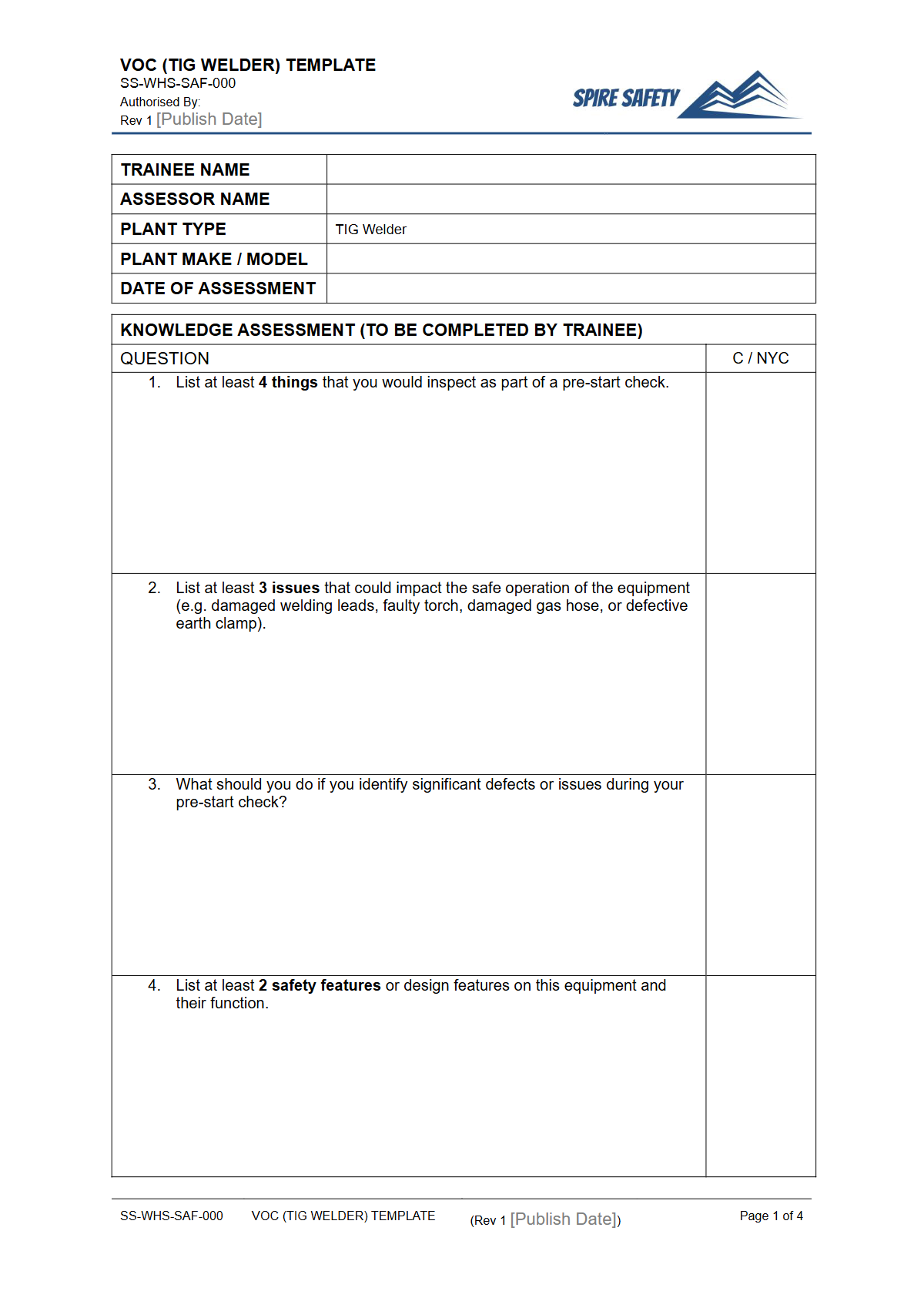
A Verification of Competency (VOC) is a critical process for any person conducting a business or undertaking (PCBU) to confirm that their workers have the current skills and knowledge to perform tasks safely and effectively. This Free Verification of Competency (TIG Welder) Template provides a structured framework to assess an operator's ability to use TIG welding equipment according to safe work procedures and industry best practice.
Using this template helps demonstrate due diligence in managing workplace risks associated with welding. For other hot work processes, you might also find our Verification of Competency (MIG Welder) template useful.
Video walkthrough
How to use the Free Verification of Competency (TIG Welder) Template
This document is a starting point designed for easy adaptation. It is divided into sections covering theoretical knowledge, pre-operational checks, practical operation, and shutdown procedures.
An assessor, who must be a competent person with extensive experience in TIG welding, observes the operator and marks their performance against set criteria. The results provide clear evidence of competency or identify specific areas where further training is required.
This process should be integrated into your broader WHS management systems to ensure a holistic approach to safety.
Important: This is a generic template that must be customised. Before use, review and amend the contents to reflect your specific equipment, site hazards, risk controls, and internal procedures.
We have not included every possible criterion; you must add or remove items to align with your Safe Work Method Statements (SWMS) and operational needs.
Key Assessment Areas
When customising this template, ensure it covers critical TIG welding competencies. This includes checking the operator's understanding of welding parameters (amperage, voltage, gas flow), correct selection and preparation of tungsten electrodes, pre-use inspection of the welder and leads, correct use of personal protective equipment (PPE), and the ability to produce a weld to the required standard. For tasks often performed alongside welding, assessing competency on other tools may be necessary, such as with a Verification of Competency for a pipe cutter.
When to use it
Verifying competency is not a one-off event. This TIG welder VOC should be used in several situations to ensure ongoing safety and skill levels.
Key triggers include pre-employment screening for new hires, before a worker uses a new or unfamiliar model of TIG welder, as part of a return-to-work plan after an extended absence, or following an incident or near-miss involving welding equipment. Regular, planned VOCs (e.g., annually or biennially) are also a key part of maintaining a safe system of work.
The same logic applies to other workshop machinery, for which a specific tool like our Drill Press VOC (Verification of Competency) Template would be appropriate.
Who should use it
This template is designed for use by individuals responsible for workplace safety and operator training. This typically includes WHS Managers, Safety Officers, Site Supervisors, and Team Leaders.
The actual assessment should be conducted by a person with demonstrated expertise and significant experience in TIG welding—they act as the subject matter expert. The completed document serves as a formal record for management, demonstrating that steps have been taken to verify worker capabilities.
Periodically reviewing these records can be a valuable part of internal reviews or formal WHS compliance auditing activities.
By consistently applying this verification process, your organisation can build a stronger safety culture and reduce the risk of incidents. You can find more tools like this one in our comprehensive free WHS resources library to support your safety management efforts.
Common mistakes
Common mistakes to avoid
- Using a generic template without customising it for site-specific welders, hazards, and procedures.
- Having an assessor who is not a subject matter expert in TIG welding.
- Treating the VOC as a 'tick-and-flick' exercise rather than a thorough practical observation.
- Failing to keep accurate, detailed records of the assessment process and outcomes for each worker.
Legal references
Legal considerations
The following legal requirements may be relevant to this type of work.
- Work Health and Safety Act (Harmonised) — Provides the primary duties for protecting workers and other people from work health and safety risks.
- Work Health and Safety Regulations (Harmonised) — Sets out requirements supporting the management of workplace hazards and risks.
The following codes may be relevant to this type of work.
- Managing WHS Risks Code of Practice — Provides practical guidance on identifying hazards, assessing risks and applying effective controls.
- Work Health and Safety Consultation, Cooperation and Coordination Code of Practice — Provides practical guidance on consulting workers and coordinating with other duty holders.
- Managing the Work Environment and Facilities Code of Practice — Provides practical guidance on safe work environments, workplace facilities and related controls.
Did you know
Welding Fumes and Health
In 2017, the International Agency for Research on Cancer (IARC) reclassified welding fumes as a 'Group 1 carcinogen', meaning there is sufficient evidence to say they cause cancer in humans. This highlights the importance of effective ventilation and respiratory protection.
FAQ
Frequently asked questions
01What is a Verification of Competency (VOC)?
02Is a VOC a legal requirement for welders in Australia?
03How often should TIG welder competency be verified?
04Who is qualified to conduct a TIG welder VOC?
Share this resource
Free Verification of Competency (TIG Welder) Template
Browse Categories
How To Use It
- 1Download and open in Word or PDF.
- 2Replace the placeholders with your business details.
- 3Get it reviewed by a WHS specialist before rollout.
Need it customised?
Our WHS consultants can adapt this template to your site, run a gap analysis, or audit what you already have in place.
Book a Free Consultation WHS consulting servicesor call 1300 156 382
Related templates
- Free Verification of Competency (Tile Saw or Wet Saw) Template
- Free Verification of Competency (Tilting Bucket) Template
- Free Verification of Competency (Torque Wrench) Template
- Free Verification of Competency (Tower Crane) Template
- Free Verification of Competency (Trailer-Mounted Generator) Template
- Free Verification of Competency (Transmission Jack) Template