
Free Verification of Competency (Tile Saw or Wet Saw) Template
Download our free Verification of Competency (Tile Saw or Wet Saw) Template to assess operator skill and safety knowledge.
Free Verification of Competency (Tile Saw or Wet Saw) Template
DOCX • 138 KB + PDF
Updated Oct 2026
No signup required
Purpose of the Free Verification of Competency (Tile Saw or Wet Saw) Template
Operating a tile saw, also known as a wet saw, involves significant risks, including cuts from the diamond blade, electrical hazards from the combination of water and power, and exposure to respirable crystalline silica (RCS) dust. This free Verification of Competency (Tile Saw or Wet Saw) Template provides a structured framework for employers to confirm that their workers have the necessary skills and safety knowledge to operate this equipment competently.
It goes beyond initial training, providing a method to formally assess and document a worker's ability to perform the task safely in their specific work environment. Using a VOC helps a Person Conducting a Business or Undertaking (PCBU) meet their primary duty of care under WHS law.
A thorough VOC process is a critical component of a robust safety framework. Integrating these assessments into your broader WHS management systems demonstrates a commitment to proactive risk management.
It helps ensure that safety is not just a theoretical concept but is actively practised and verified on the job, protecting workers from harm and the business from liability.
Video walkthrough
How to use the Free Verification of Competency (Tile Saw or Wet Saw) Template
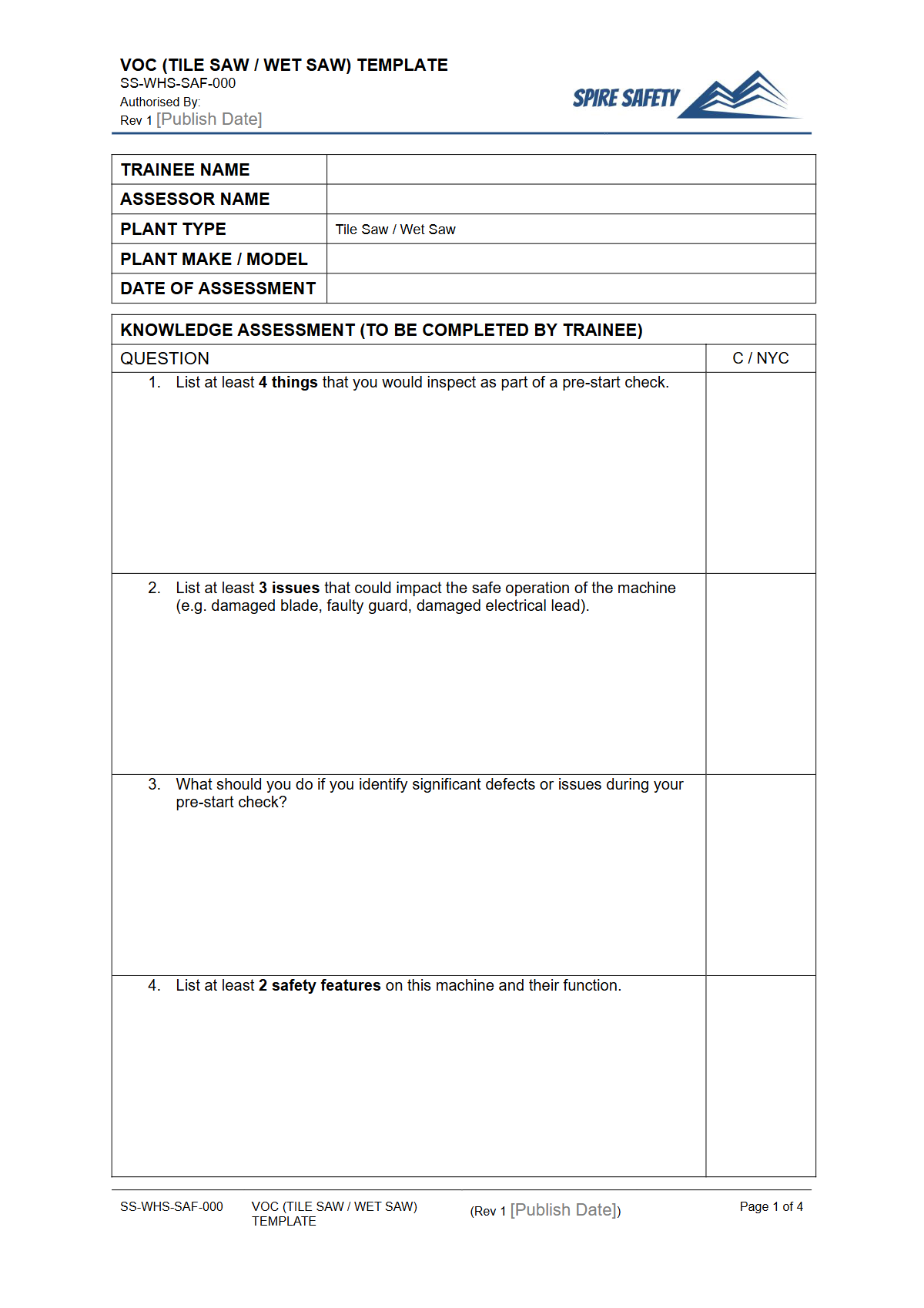
This template is designed for an assessor to use while observing an operator perform tasks with a tile or wet saw. The process should involve a combination of practical demonstration and verbal questioning.
The assessor should follow the operator through pre-operational checks, setup, cutting various materials (as applicable), troubleshooting minor issues, and correct shutdown and cleaning procedures. Each section of the template provides criteria to score the operator's performance, leading to a final assessment of 'Competent' or 'Not Yet Competent'.
If an operator is found 'Not Yet Competent', the form includes space to outline a plan for further training and reassessment.
You can adapt this document for various portable power tools by referencing other specific guides, such as our free Drill Press VOC. It demonstrates how assessment criteria can be tailored to the unique risks of different equipment.
Important Customisation Note
Please note: We provide this template as a structured starting point. It is essential that you customise it to reflect the specific make and model of the tile saw used at your site, your safe work method statements (SWMS), and your organisation’s unique operational procedures.
Generic assessments are not sufficient; the VOC must be site and equipment-specific to be effective.
When to Conduct a Verification of Competency
A VOC for a tile saw operator is not a one-off event. It should be conducted at several key points to ensure ongoing safety and competence. These include:
- Pre-employment or prior to assignment: Before a new or existing worker is assigned to operate a tile saw for the first time.
- Introduction of new equipment: When a new model of wet saw is introduced that has different features or operating procedures.
- Post-incident: After an incident or near-miss involving the equipment to identify any competency gaps that may have contributed.
- Periodic Reassessment: As part of a regular schedule (e.g., every one to two years) to ensure skills have not diminished over time. The frequency should be based on a risk assessment.
Evidence of competency, such as completed VOCs, is often reviewed during a formal WHS compliance auditing process. Maintaining these records is a key part of due diligence.
Who Should Use This Template
This template is intended for use by individuals responsible for workplace safety and training. The key roles involved are:
- The Assessor: A person with extensive technical knowledge, hands-on experience, and a deep understanding of the safety requirements for the specific tile saw being assessed. This is often a supervisor, leading hand, or a dedicated trainer.
- The Operator: The worker whose skills are being assessed.
- WHS Managers/Advisors: Professionals who oversee the implementation of the VOC program as part of the organisation's overall safety strategy. They ensure records are maintained and that the process is applied consistently.
The principles of competency verification apply to a wide range of machinery, not just tile saws. For example, the process for assessing an operator using our Verification of Competency (Cement Mixer) Template follows a similar structure of observation and questioning, tailored to that specific equipment's risks.
What's Included in the Tile Saw VOC Template
Our template is logically structured to guide the assessor through a comprehensive evaluation. It covers the full lifecycle of a task, ensuring no critical step is missed.
Key sections include pre-operational checks, where the operator inspects the blade, guards, water supply, and electrical cords. The operational assessment verifies the operator's ability to secure the workpiece, maintain control during the cut, and effectively use the water delivery system to suppress dust.
It also assesses their use of personal protective equipment (PPE). The process is similar in principle to other equipment assessments, like what you would find in a free Pressure Cleaner VOC, focusing on machine-specific safety protocols.
Developing and implementing a comprehensive VOC program can be complex. If you need assistance customising templates, training your assessors, or integrating these processes into your safety system, engaging expert WHS consulting services can provide valuable guidance and support.
You can also explore our entire free WHS resources library for more templates and guides to support your safety objectives.
Common mistakes
Common mistakes to avoid
- Using a generic checklist that doesn't match the specific make and model of the saw.
- Allowing an assessor to conduct the VOC without having sufficient personal hands-on experience with the equipment.
- Failing to adequately assess the operator's knowledge and practical application of silica dust controls.
- Treating the VOC as a 'tick-and-flick' administrative task rather than a genuine observation of skill.
Legal references
Legal considerations
The following legal requirements may be relevant to this type of work.
- Work Health and Safety Act (Harmonised) — Provides the primary duties for protecting workers and other people from work health and safety risks.
- Work Health and Safety Regulations (Harmonised) — Sets out requirements supporting the management of workplace hazards and risks.
The following codes may be relevant to this type of work.
- Managing WHS Risks Code of Practice — Provides practical guidance on identifying hazards, assessing risks and applying effective controls.
- Work Health and Safety Consultation, Cooperation and Coordination Code of Practice — Provides practical guidance on consulting workers and coordinating with other duty holders.
- Managing the Work Environment and Facilities Code of Practice — Provides practical guidance on safe work environments, workplace facilities and related controls.
Did you know
Silica Dust Risk
Wet saws are essential for suppressing respirable crystalline silica (RCS) dust, a serious health hazard in tiling and construction. A key part of a VOC is ensuring the operator understands and correctly uses the water-flow system for this purpose.
Competency vs. Licence
Holding a general construction induction card (White Card) does not automatically mean a worker is competent to use specific equipment like a tile saw. Competency must be verified for each individual piece of plant or equipment.
FAQ
Frequently asked questions
01Is a Verification of Competency a legal requirement for a tile saw in Australia?
02How is a VOC different from a training certificate?
03Who is considered a competent person to conduct a wet saw VOC?
04How often should we re-verify competency for tile saw operators?
Share this resource
Free Verification of Competency (Tile Saw or Wet Saw) Template
Browse Categories
How To Use It
- 1Download and open in Word or PDF.
- 2Replace the placeholders with your business details.
- 3Get it reviewed by a WHS specialist before rollout.
Need it customised?
Our WHS consultants can adapt this template to your site, run a gap analysis, or audit what you already have in place.
Book a Free Consultation WHS consulting servicesor call 1300 156 382
Related templates
- Free Verification of Competency (Tilting Bucket) Template
- Free Verification of Competency (Torque Wrench) Template
- Free Verification of Competency (Tower Crane) Template
- Free Verification of Competency (Trailer-Mounted Generator) Template
- Free Verification of Competency (Transmission Jack) Template
- Free Verification of Competency (Trencher) Template