
Free Verification of Competency (Tilting Bucket) Template
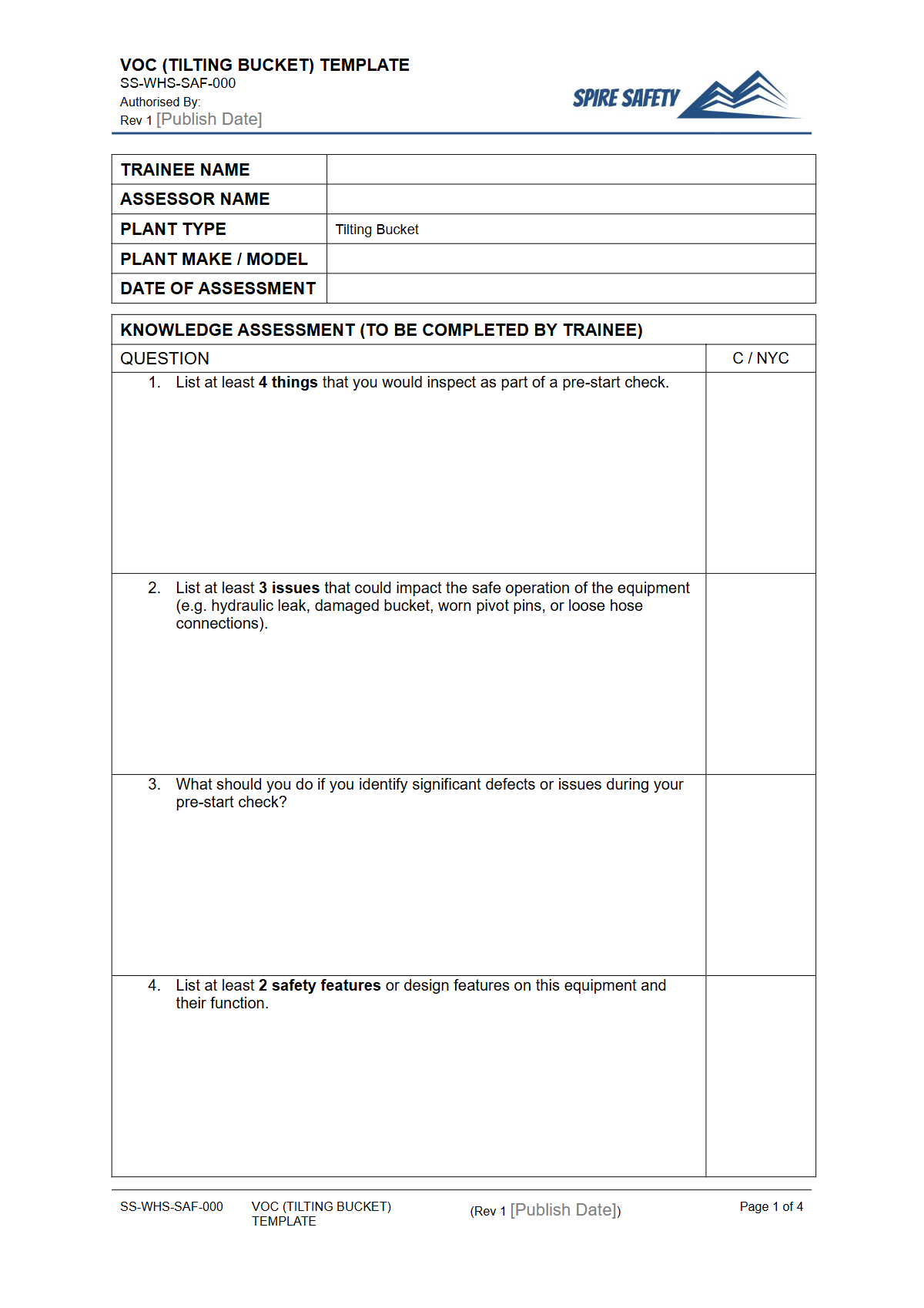
Download our free Verification of Competency (Tilting Bucket) template. This structured DOCX & PDF resource helps assess operator skills and safety knowledge.
Free Verification of Competency (Tilting Bucket) Template
DOCX • 139 KB + PDF
Updated Oct 2026
No signup required
Purpose of the Free Verification of Competency (Tilting Bucket) Template
Operating earthmoving equipment requires skill and a strong safety focus, especially when using specialised attachments. This Free Verification of Competency (Tilting Bucket) Template provides a structured framework for Persons Conducting a Business or Undertaking (PCBUs) to confirm that an operator has the necessary skills and knowledge to safely use a tilting bucket attachment.
An operator may hold a licence for the base machine, but a VOC is crucial for verifying their ability to handle the specific operational dynamics, controls, and risks associated with a tilting bucket. Using this template helps demonstrate due diligence in meeting WHS obligations to provide adequate training and supervision.
A tilting bucket introduces different forces and operational considerations compared to a standard bucket. Verifying competency specifically for this attachment is a key part of managing plant-related risks.
While this document is specific to tilting buckets, the principles can be adapted from other plant assessments, like our Verification of Competency (Mini Excavator) Template, which focuses on the host machine itself.
Video walkthrough
How to Use the Free Verification of Competency (Tilting Bucket) Template
Our Free Verification of Competency (Tilting Bucket) Template is designed for practical application in the workplace. The process involves a combination of theoretical questions and direct observation of practical tasks.
Download the DOCX file to edit the criteria to suit your operational context, or use the PDF for immediate printing.
The Assessment Process:
- Preparation: The assessor should review the operator's existing licences, qualifications, and experience. The operator should be briefed on the VOC process, its purpose, and the criteria they will be assessed against.
- Theory Assessment: The assessor asks a series of questions to gauge the operator’s understanding of the tilting bucket's functions, limitations, pre-start checks, and associated hazards.
- Practical Assessment: The assessor observes the operator performing a range of tasks relevant to your workplace. This should include pre-start inspections, correct attachment connection, trenching, battering, and safe shutdown procedures.
- Documentation: The assessor records their findings directly on the template, noting areas of competence and any identified gaps. Both the assessor and the operator should sign the completed form.
Important: This template provides a structured foundation. We recommend you customise it to reflect the specific tilting bucket models, host machines, tasks, and hazards found in your workplace.
A generic assessment may not adequately address your site-specific risks. A similar approach should be taken for other specialised attachments, such as those detailed in our Verification of Competency (Trencher) resource.
When Should a VOC be Conducted?
A Verification of Competency is not a one-time event. It should be integrated into your safety management system as a recurring activity. Key times to conduct a VOC for a tilting bucket operator include:
- Pre-employment or prior to mobilisation: To verify the skills and claims of a new operator before they start work.
- Introduction of new equipment: When a new make or model of tilting bucket or host machine is introduced.
- Post-incident: After an incident or near-miss involving the equipment to identify and correct behavioural or knowledge gaps.
- Identified performance issues: If a supervisor observes unsafe or inefficient operation.
- Periodic refreshers: As part of a regular schedule (e.g., every 2-3 years) to ensure skills remain current.
Integrating VOCs into your safety framework is a proactive measure that supports your overall WHS management systems by ensuring your workforce remains competent and aware of risks.
Who Should Conduct the Assessment?
The credibility and effectiveness of a VOC depend heavily on the person conducting it. The assessor must be a subject matter expert with current, demonstrable experience in operating the specific type of tilting bucket being assessed.
They should also have a thorough understanding of the relevant WHS legislation and codes of practice. A supervisor without hands-on experience on the attachment is not a suitable assessor.
An ideal assessor is often a senior operator, an internal trainer, or an external specialist who can accurately judge technique, identify unsafe practices, and provide constructive feedback. Their competence ensures the verification is robust and meaningful. The same principle applies when assessing operators of other heavy plant, as seen in our Free Grader VOC (Verification of Competency) Template.
Regular VOCs are a cornerstone of plant safety management, whether for earthmoving machinery or other high-risk equipment. For example, the criteria in a Verification of Competency (Rough Terrain Forklift) assessment would differ significantly but the underlying principle of verifying specific skills remains the same.
This template is one of many tools available in our free WHS resources library to help you build a safer workplace.
Common mistakes
Common mistakes to avoid
- Using the template as a simple 'tick and flick' exercise without genuine observation.
- Failing to customise the assessment for site-specific tasks, ground conditions, and equipment models.
- Assigning an assessor who lacks current, hands-on experience with tilting buckets.
- Only assessing theoretical knowledge and neglecting to observe practical skills in a realistic work scenario.
Legal references
Legal considerations
The following legal requirements may be relevant to this type of work.
- Work Health and Safety Act (Harmonised) — Provides the primary duties for protecting workers and other people from work health and safety risks.
- Work Health and Safety Regulations (Harmonised) — Sets out requirements supporting the management of workplace hazards and risks.
The following codes may be relevant to this type of work.
- Managing WHS Risks Code of Practice — Provides practical guidance on identifying hazards, assessing risks and applying effective controls.
- Work Health and Safety Consultation, Cooperation and Coordination Code of Practice — Provides practical guidance on consulting workers and coordinating with other duty holders.
- Managing the Work Environment and Facilities Code of Practice — Provides practical guidance on safe work environments, workplace facilities and related controls.
Did you know
Attachment-Specific Risk
Many mobile plant incidents are not caused by errors in driving the base machine, but by incorrect selection, attachment, or use of attachments like tilting buckets, highlighting the need for specific competency checks.
FAQ
Frequently asked questions
01What is the difference between a tilting bucket VOC and an excavator licence?
02How often should a tilting bucket VOC be conducted?
03Can an experienced operator from our team conduct the assessment?
04Is this template suitable for any brand of tilting bucket?
Share this resource
Free Verification of Competency (Tilting Bucket) Template
Browse Categories
How To Use It
- 1Download and open in Word or PDF.
- 2Replace the placeholders with your business details.
- 3Get it reviewed by a WHS specialist before rollout.
Need it customised?
Our WHS consultants can adapt this template to your site, run a gap analysis, or audit what you already have in place.
Book a Free Consultation WHS consulting servicesor call 1300 156 382
Related templates
- Free Verification of Competency (Torque Wrench) Template
- Free Verification of Competency (Tower Crane) Template
- Free Verification of Competency (Trailer-Mounted Generator) Template
- Free Verification of Competency (Transmission Jack) Template
- Free Verification of Competency (Trencher) Template
- Free Verification of Competency (Truck-Mounted Crane or Franna) Template