
Free Verification of Competency (Rough Terrain Forklift) Template
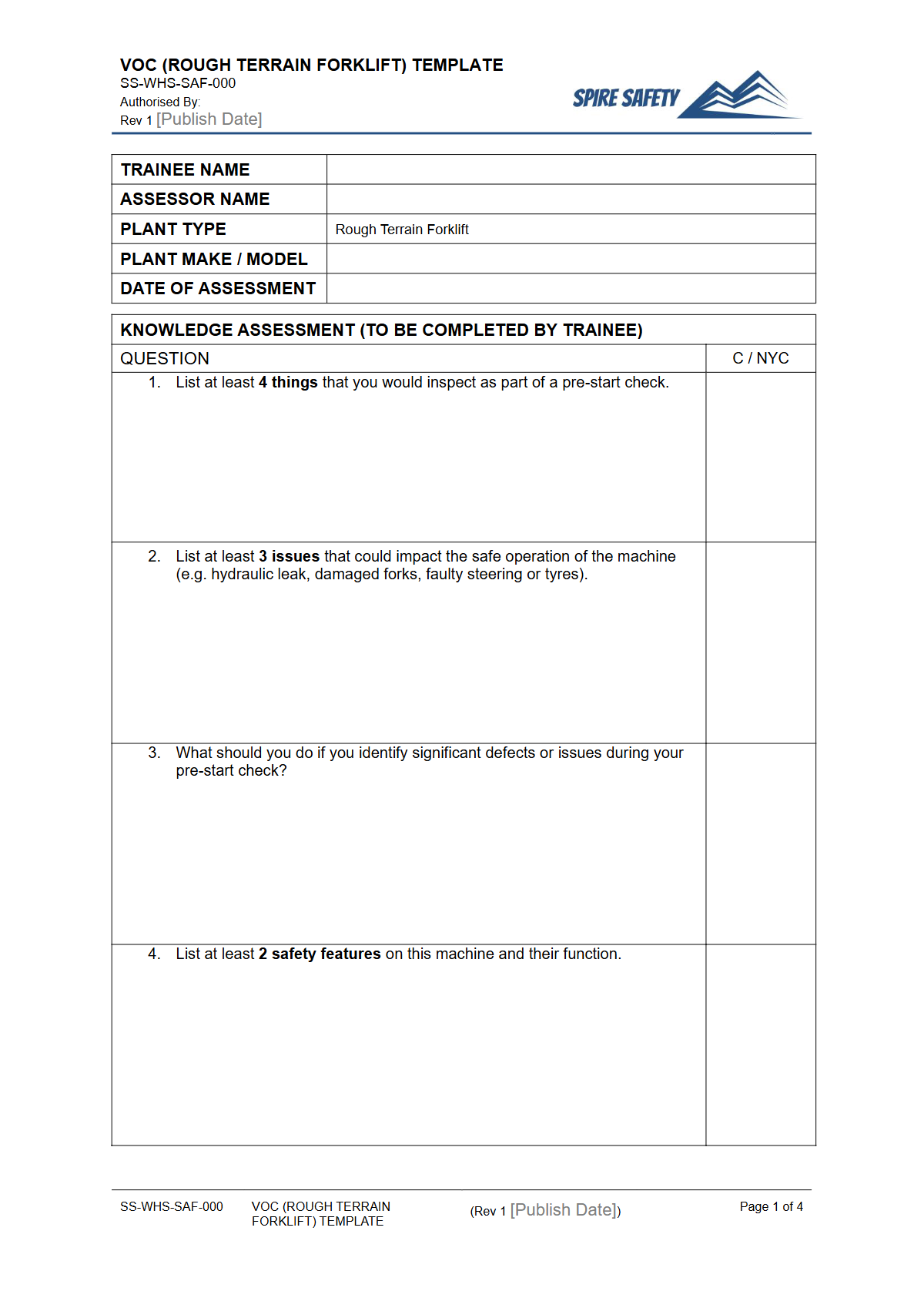
Download our free Verification of Competency (Rough Terrain Forklift) template. This Word & PDF resource helps you assess operator skills and knowledge.
Free Verification of Competency (Rough Terrain Forklift) Template
DOCX • 138 KB + PDF
Updated Oct 2026
No signup required
Purpose of the Free Verification of Competency (Rough Terrain Forklift) Template
Operating a rough terrain forklift requires a unique set of skills beyond those needed for a standard counterbalance forklift. This free Verification of Competency (Rough Terrain Forklift) Template provides a structured method for employers and site managers to confirm that operators are not only licensed but also genuinely competent to handle the specific machine in its intended work environment.
Using this document helps a Person Conducting a Business or Undertaking (PCBU) meet their primary duty of care by ensuring workers can safely manage the distinct challenges of uneven ground, slopes, and variable site conditions. It serves as a critical record of due diligence and is a key component of an effective WHS management system.
Video walkthrough
How to use the Free Verification of Competency (Rough Terrain Forklift) Template
This template is designed to be a practical tool for assessing both the theoretical knowledge and practical skills of an operator. The process typically involves a qualified assessor observing the operator performing a range of tasks specific to rough terrain forklift operations.
These tasks should mirror real-world activities on your site, from pre-start checks to manoeuvring with a load on uneven surfaces. The document includes sections for recording observations, asking knowledge-based questions, and documenting the final outcome.
Important: This is a template, not a finished document. It is crucial that you adapt this resource to reflect your specific workplace.
We have provided a solid framework, but you must customise the checklist to include the make and model of your forklift, your site-specific hazards (e.g., overhead powerlines, soft ground, pedestrian routes), and your safe work procedures. A generic assessment is not sufficient. A similar customisation process is required when assessing other plant, such as when using a Verification of Competency (Mini Excavator) Template.
When to use it
A Verification of Competency is not a one-time event. It should be integrated into your safety procedures and conducted at several key points.
Use this template for pre-employment screening to validate a new hire's claimed experience, or before a current employee is assigned to operate a rough terrain forklift for the first time. It is also essential to conduct a VOC following an incident or a near miss to identify and correct any behavioural or knowledge gaps.
Furthermore, introducing a new model of forklift or making significant changes to the work area warrants a fresh competency check. Many organisations also schedule periodic VOCs (e.g., every two years) as part of a robust refresher training program, a practice that applies to all heavy machinery, as seen in our Free Grader VOC (Verification of Competency) Template.
Who should use it
The responsibility for conducting a VOC falls to a 'competent person'. This individual must possess the necessary technical knowledge, skills, and experience to make an informed judgement about the operator's abilities.
Typically, this would be a site supervisor, an experienced team leader, a dedicated trainer and assessor, or an external WHS consultant. The assessor must be intimately familiar with not only the principles of safe forklift operation but also the specific operational characteristics and risks of the rough terrain model in question.
A regular warehouse forklift supervisor may not be the right person unless they also have extensive experience with rough terrain equipment. The same principle of assessor expertise applies when evaluating operators of other site vehicles, like those covered in our Verification of Competency (Water Cart) resource.
The completed document should be signed by both the assessor and the operator and kept as a training record. These records are often a key point of focus during a WHS compliance auditing process.
Common mistakes
Common mistakes to avoid
- Treating the VOC as a tick-box exercise without a thorough practical observation.
- Using an assessor who is not familiar with the specific model of rough terrain forklift being tested.
- Failing to customise the template to include site-specific hazards and operational procedures.
- Neglecting to provide feedback or corrective training to operators who show gaps in their competency.
Legal references
Legal considerations
The following legal requirements may be relevant to this type of work.
- Work Health and Safety Act (Harmonised) — Provides the primary duties for protecting workers and other people from work health and safety risks.
- Work Health and Safety Regulations (Harmonised) — Sets out requirements supporting the management of workplace hazards and risks.
The following codes may be relevant to this type of work.
- Managing WHS Risks Code of Practice — Provides practical guidance on identifying hazards, assessing risks and applying effective controls.
- Work Health and Safety Consultation, Cooperation and Coordination Code of Practice — Provides practical guidance on consulting workers and coordinating with other duty holders.
- Managing the Work Environment and Facilities Code of Practice — Provides practical guidance on safe work environments, workplace facilities and related controls.
Did you know
Unique Risks
Rough terrain forklifts have different stability characteristics compared to standard forklifts, primarily due to their large pneumatic tyres, enhanced suspension, and drivetrains designed for outdoor, uneven surfaces.
Beyond the Licence
Safe Work Australia's model Code of Practice for Plant emphasises that PCBUs must ensure operators are competent for the specific type of plant they use, a responsibility that goes beyond simply checking for a licence.
FAQ
Frequently asked questions
01Is a High Risk Work Licence (HRWL) enough to operate a rough terrain forklift?
02How often should a Verification of Competency for a forklift be conducted?
03Who is a 'competent person' to conduct this VOC assessment?
04Can this template be used for a standard counterbalance forklift?
Share this resource
Free Verification of Competency (Rough Terrain Forklift) Template
Browse Categories
How To Use It
- 1Download and open in Word or PDF.
- 2Replace the placeholders with your business details.
- 3Get it reviewed by a WHS specialist before rollout.
Need it customised?
Our WHS consultants can adapt this template to your site, run a gap analysis, or audit what you already have in place.
Book a Free Consultation WHS consulting servicesor call 1300 156 382
Related templates
- Free Verification of Competency (Sand Blaster) Template
- Free Verification of Competency (SDS Max Rotary Hammer) Template
- Free Verification of Competency (SDS Plus Rotary Hammer) Template
- Free Verification of Competency (Semi-Trailer or Prime Mover) Template
- Free Verification of Competency (Side Tipper Truck) Template
- Free Verification of Competency (Skid Steer Auger Attachment) Template