
Free Verification of Competency (Rotary Hoe) Template
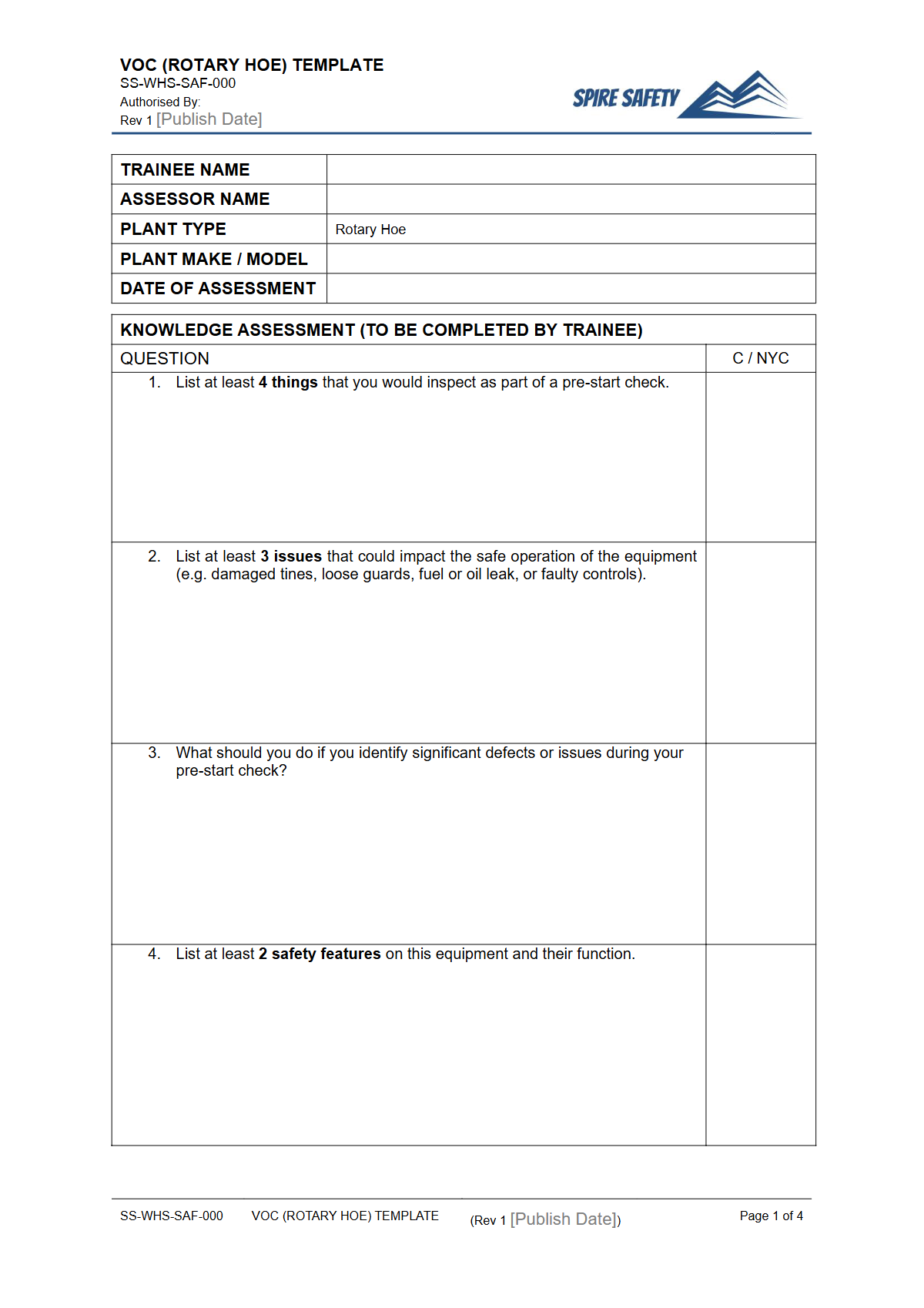
Download our free Verification of Competency (Rotary Hoe) template to assess operator skills. This DOCX and PDF resource helps ensure safe equipment use.
Free Verification of Competency (Rotary Hoe) Template
DOCX • 140 KB + PDF
Updated Oct 2026
No signup required
Purpose of the Free Verification of Competency (Rotary Hoe) Template
This template is designed to guide a competent assessor through a formal process of evaluating a rotary hoe operator. It helps a Person Conducting a Business or Undertaking (PCBU) meet their primary duty of care by ensuring workers are competent for their assigned tasks.
Operating a rotary hoe involves significant risks, including contact with rotating tines, projectiles thrown by the machine, musculoskeletal injuries from improper handling, and loss of control on uneven or sloped ground. A systematic VOC process helps confirm that operators can manage these risks effectively. This process is just as important for handheld equipment as it is for larger machinery, such as that covered in our Verification of Competency for trenchers.
Video walkthrough
How to use the Free Verification of Competency (Rotary Hoe) Template
To use this document effectively, a competent person (such as a supervisor or experienced operator) should observe the worker performing all the tasks listed. The assessment covers theoretical knowledge, pre-start checks, operational skills in a real or simulated environment, and shutdown procedures.
The observer uses the checklist to record performance against each criterion, noting any areas where the operator may need further training or instruction. This process creates a formal record of the assessment outcome. For a VOC program to be effective, it must be integrated into your broader comprehensive WHS management systems.
Important: This is a template only. We have designed it to be a robust starting point, but it must be customised to your specific workplace.
You need to review and adapt the contents to reflect the exact make and model of the rotary hoe in use, your site-specific hazards, and your organisation's safe work procedures.
When to conduct a Verification of Competency
A Verification of Competency for a rotary hoe should be conducted at several key points. It is commonly used as a pre-employment check to confirm the skills of a new hire.
It is also essential following a significant break from using the equipment, after an incident or near miss occurs, or when a new model of rotary hoe is introduced to the workplace. Many organisations also implement a schedule for periodic reassessment (e.g., every 2 years) as part of their ongoing safety management, ensuring skills remain current. This systematic approach is also beneficial for operators of powerful handheld tools, such as when conducting a VOC for an SDS Plus rotary hammer.
Who should conduct the assessment
This VOC template should be used by individuals deemed competent to assess others on the use of a rotary hoe. This typically includes site supervisors, team leaders, WHS advisors, or experienced operators who have demonstrated a high level of skill and safety awareness themselves.
The assessor must have the technical knowledge to correctly judge the operator's performance and the authority to provide feedback and recommend corrective actions, such as refresher training. If your team lacks an appropriate internal assessor, engaging specialist WHS consulting support can provide the necessary expertise.
What's included in the template?
This downloadable resource provides a comprehensive checklist broken down into key assessment areas. It includes sections for:
- Candidate and Assessor Details: Formal record-keeping of who was assessed and by whom.
- Theoretical Assessment: Questions to test knowledge of relevant safety procedures, hazard identification, and equipment specifications.
- Pre-Operational Checks: A step-by-step list to ensure the machine is inspected for safety and function before use.
- Practical Assessment: Criteria for evaluating the operator's ability to safely start, manoeuvre, operate, and shut down the rotary hoe.
- Final Assessment Outcome: A clear section to declare the operator 'Competent' or 'Not Yet Competent' and outline any required actions.
Explore more resources
Building a strong safety culture involves more than just one document. Consistently verifying worker competence across all types of plant and equipment is a cornerstone of good WHS practice. For more templates, checklists, and guides, browse our complete free WHS resources library.
Common mistakes
Common mistakes to avoid
- Using a generic checklist without customising it for the specific rotary hoe model and site conditions.
- Failing to conduct a thorough pre-start check of the equipment's safety features, such as guards and emergency stops.
- Treating the assessment as a 'tick and flick' exercise rather than a genuine evaluation of skill and safety awareness.
- Neglecting to check for underground services like pipes, irrigation lines, or electrical cables before starting work.
Legal references
Legal considerations
The following legal requirements may be relevant to this type of work.
- Work Health and Safety Act (Harmonised) — Provides the primary duties for protecting workers and other people from work health and safety risks.
- Work Health and Safety Regulations (Harmonised) — Sets out requirements supporting the management of workplace hazards and risks.
The following codes may be relevant to this type of work.
- Managing WHS Risks Code of Practice — Provides practical guidance on identifying hazards, assessing risks and applying effective controls.
- Work Health and Safety Consultation, Cooperation and Coordination Code of Practice — Provides practical guidance on consulting workers and coordinating with other duty holders.
- Managing the Work Environment and Facilities Code of Practice — Provides practical guidance on safe work environments, workplace facilities and related controls.
Did you know
Kickback Risk
Rotary hoes can lurch or 'kick back' violently if the tines strike a solid, immovable object like a large rock or tree root. This is a primary cause of operator injury, highlighting the importance of surveying the area before starting work.
Soil Structure Damage
While rotary hoes are effective for aerating and tilling soil, overuse or using them in wet conditions can destroy the natural soil structure. This can lead to compaction and poor drainage over time.
FAQ
Frequently asked questions
01Is a VOC a legal requirement for operating a rotary hoe in Australia?
02How often should I conduct a VOC for a rotary hoe operator?
03Can this VOC template replace formal training or a licence?
04Who is considered a 'competent person' to conduct this assessment?
Share this resource
Free Verification of Competency (Rotary Hoe) Template
Browse Categories
How To Use It
- 1Download and open in Word or PDF.
- 2Replace the placeholders with your business details.
- 3Get it reviewed by a WHS specialist before rollout.
Need it customised?
Our WHS consultants can adapt this template to your site, run a gap analysis, or audit what you already have in place.
Book a Free Consultation WHS consulting servicesor call 1300 156 382
Related templates
- Free Verification of Competency (Rough Terrain Forklift) Template
- Free Verification of Competency (Sand Blaster) Template
- Free Verification of Competency (SDS Max Rotary Hammer) Template
- Free Verification of Competency (SDS Plus Rotary Hammer) Template
- Free Verification of Competency (Semi-Trailer or Prime Mover) Template
- Free Verification of Competency (Side Tipper Truck) Template