
Free Verification of Competency (Rebar Tying Gun) Template
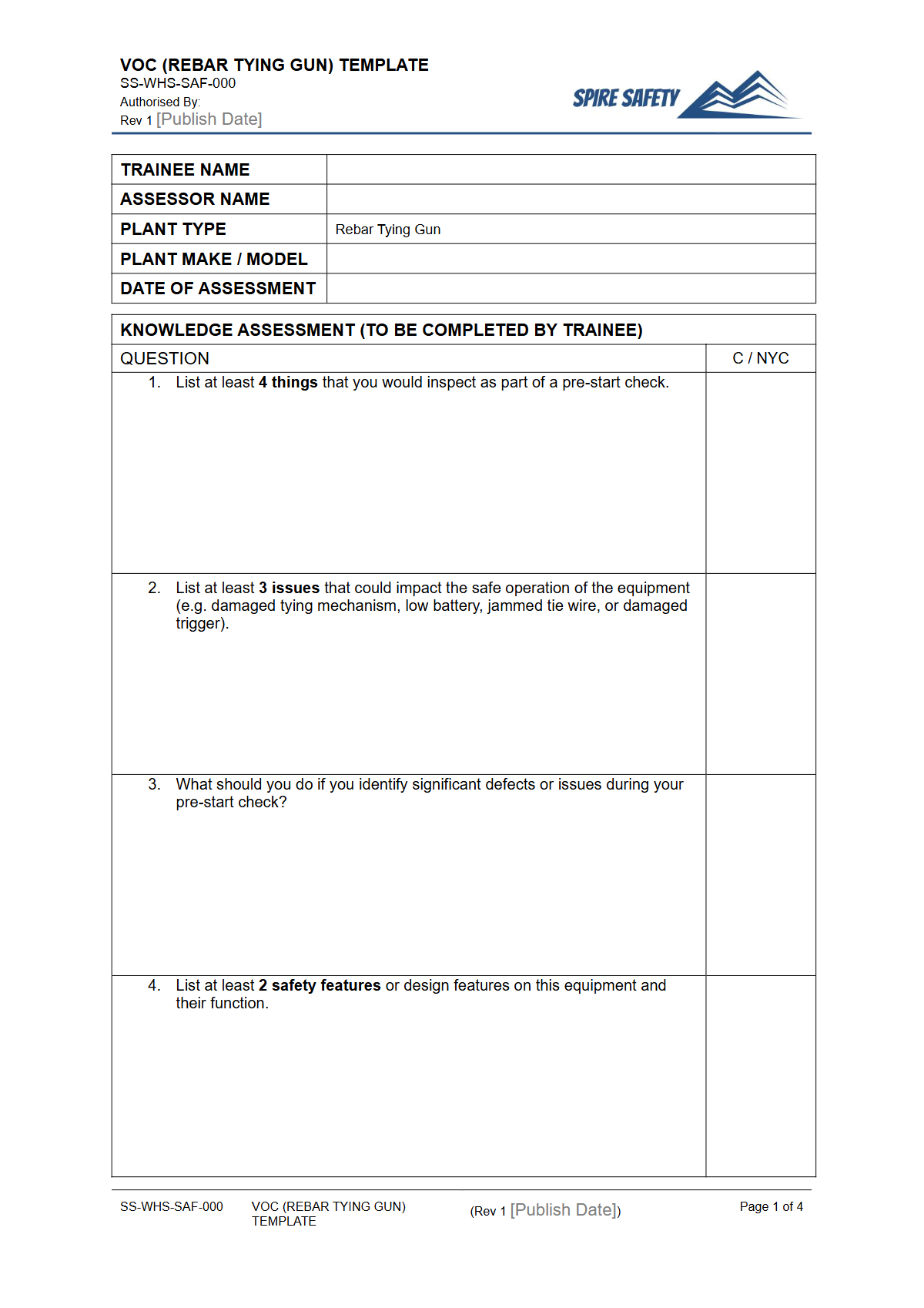
Efficiently assess operator skills for rebar tying guns with our free VOC template. This structured document helps verify competence and supports safety.
Free Verification of Competency (Rebar Tying Gun) Template
DOCX • 138 KB + PDF
Updated Oct 2026
No signup required
Purpose of the Free Verification of Competency (Rebar Tying Gun) Template
This Free Verification of Competency (Rebar Tying Gun) Template provides a structured framework for assessing and confirming that a worker can operate a rebar tying gun safely and competently. It is designed to help Persons Conducting a Business or Undertaking (PCBUs) meet their work health and safety (WHS) duties by ensuring workers have the necessary skills and knowledge for the tools they use.
Using this template helps standardise the assessment process, creating a clear record of the operator's capabilities, including their understanding of pre-start checks, safe operation, maintenance, and hazard identification.
A Verification of Competency (VOC) is not a substitute for formal training. Instead, it is an evidence-gathering process to verify that the skills and knowledge gained through training or previous experience are still current and meet the requirements of the job.
This document serves as a crucial part of a comprehensive WHS management system, helping to manage risks associated with using powered hand tools on construction and engineering sites.
Video walkthrough
How to use the Free Verification of Competency (Rebar Tying Gun) Template
To effectively implement this resource, follow these steps. First, download the template in your preferred format (DOCX or PDF).
The DOCX version allows for full customisation to suit your specific needs. The assessment should be conducted by a person who is competent and experienced with the specific model of rebar tying gun being used, such as a site supervisor or a senior operator.
The assessment process involves a combination of theoretical questions and a practical demonstration. The assessor should observe the worker performing key tasks, from conducting pre-start inspections to using the tool in a simulated or live work environment.
The template guides the assessor through criteria such as correct handling, battery management, loading tie wire, and recognising common faults. Similar to how you would assess someone using other powered tools, like with our free Drill Press VOC template, the focus is on practical, observable skills.
Important Note on Customisation
This resource provides a solid foundation, but it must be customised to your specific workplace. We've included common criteria, but you need to add, remove, or adjust sections to reflect your site-specific risks, equipment models, and internal procedures.
Always refer to the manufacturer's operating manual for the rebar tying gun in use and incorporate its specific safety warnings and operational instructions into the assessment.
When to use it
A VOC for a rebar tying gun should be conducted at several key points to ensure ongoing safety and competence. It's a standard practice for pre-employment screening to verify the skills of new hires.
A VOC is also essential after a significant break from using the equipment, or if a supervisor observes unsafe or inefficient work practices. Other critical triggers include the introduction of a new make or model of rebar tying gun to the worksite, or as a post-incident investigation tool to identify gaps in competence.
Many organisations also integrate VOCs into a regular schedule (e.g., annually or biennially) as part of their commitment to regular WHS compliance auditing and continuous improvement.
Who should use it
This template is designed for use by WHS managers, site supervisors, project managers, and team leaders in the construction, civil, and manufacturing industries. Essentially, anyone with responsibility for directing and supervising work involving rebar tying guns can use this document to formalise their assessment process.
The person conducting the verification—the assessor—must be a 'competent person'. This means they must possess the relevant skills, knowledge, and experience to not only operate the rebar tying gun safely themselves but also to effectively judge another person's performance.
The same principle applies when assessing competence on other site equipment, such as when using our free Verification of Competency (Cement Mixer) template. Proper assessment is a key pillar of site safety.
By using a structured template, organisations can ensure consistency in their assessments and maintain detailed records. These records are invaluable for demonstrating due diligence and form an important part of a worker's training file.
Integrating such processes into your daily operations strengthens your overall safety culture. For more guidance on building these processes, consider exploring how they fit within a comprehensive WHS management system. The principles used here for a hand tool are scalable to larger equipment, such as that covered in our Verification of Competency for a hydraulic impact wrench. You can find many more templates like this in our comprehensive library of free WHS resources.
Common mistakes
Common mistakes to avoid
- Treating the VOC as a 'tick and flick' exercise without proper practical observation.
- Using an assessor who is not themselves competent with the specific rebar tying gun model.
- Failing to customise the template to include site-specific hazards or procedures.
- Not keeping clear, dated records of the VOC outcome for each worker.
Legal references
Legal considerations
The following legal requirements may be relevant to this type of work.
- Work Health and Safety Act (Harmonised) — Provides the primary duties for protecting workers and other people from work health and safety risks.
- Work Health and Safety Regulations (Harmonised) — Sets out requirements supporting the management of workplace hazards and risks.
The following codes may be relevant to this type of work.
- Managing WHS Risks Code of Practice — Provides practical guidance on identifying hazards, assessing risks and applying effective controls.
- Work Health and Safety Consultation, Cooperation and Coordination Code of Practice — Provides practical guidance on consulting workers and coordinating with other duty holders.
- Managing the Work Environment and Facilities Code of Practice — Provides practical guidance on safe work environments, workplace facilities and related controls.
Did you know
Ergonomic Benefits
Modern rebar tying guns can significantly reduce the risk of musculoskeletal injuries compared to manual tying methods, which often lead to repetitive strain injuries in the hands and wrists.
Speed & Efficiency
An automated rebar tying gun can secure a tie in under a second, making it up to five times faster than manual tying and dramatically increasing productivity on construction sites.
FAQ
Frequently asked questions
01Is a Verification of Competency (VOC) the same as training?
02Who is a 'competent person' to conduct a rebar tying gun VOC?
03How often should a VOC for a rebar tying gun be conducted?
04Does this template cover all models of rebar tying guns?
Share this resource
Free Verification of Competency (Rebar Tying Gun) Template
Browse Categories
How To Use It
- 1Download and open in Word or PDF.
- 2Replace the placeholders with your business details.
- 3Get it reviewed by a WHS specialist before rollout.
Need it customised?
Our WHS consultants can adapt this template to your site, run a gap analysis, or audit what you already have in place.
Book a Free Consultation WHS consulting servicesor call 1300 156 382
Related templates
- Free Verification of Competency (Ride-On Sweeper) Template
- Free Verification of Competency (Rivet Gun) Template
- Free Verification of Competency (Road Saw or Diamond Blade Saw) Template
- Free Verification of Competency (Rock Grab Attachment) Template
- Free Verification of Competency (Rock Saw Attachment) Template
- Free Verification of Competency (Rotary Hammer) Template