
Free Verification of Competency (Rebar Bender) Template
Download our free Verification of Competency (Rebar Bender) Template to assess operator skills. This DOCX & PDF resource helps document WHS training.
Free Verification of Competency (Rebar Bender) Template
DOCX • 138 KB + PDF
Updated Oct 2026
No signup required
Purpose of the Free Verification of Competency (Rebar Bender) Template
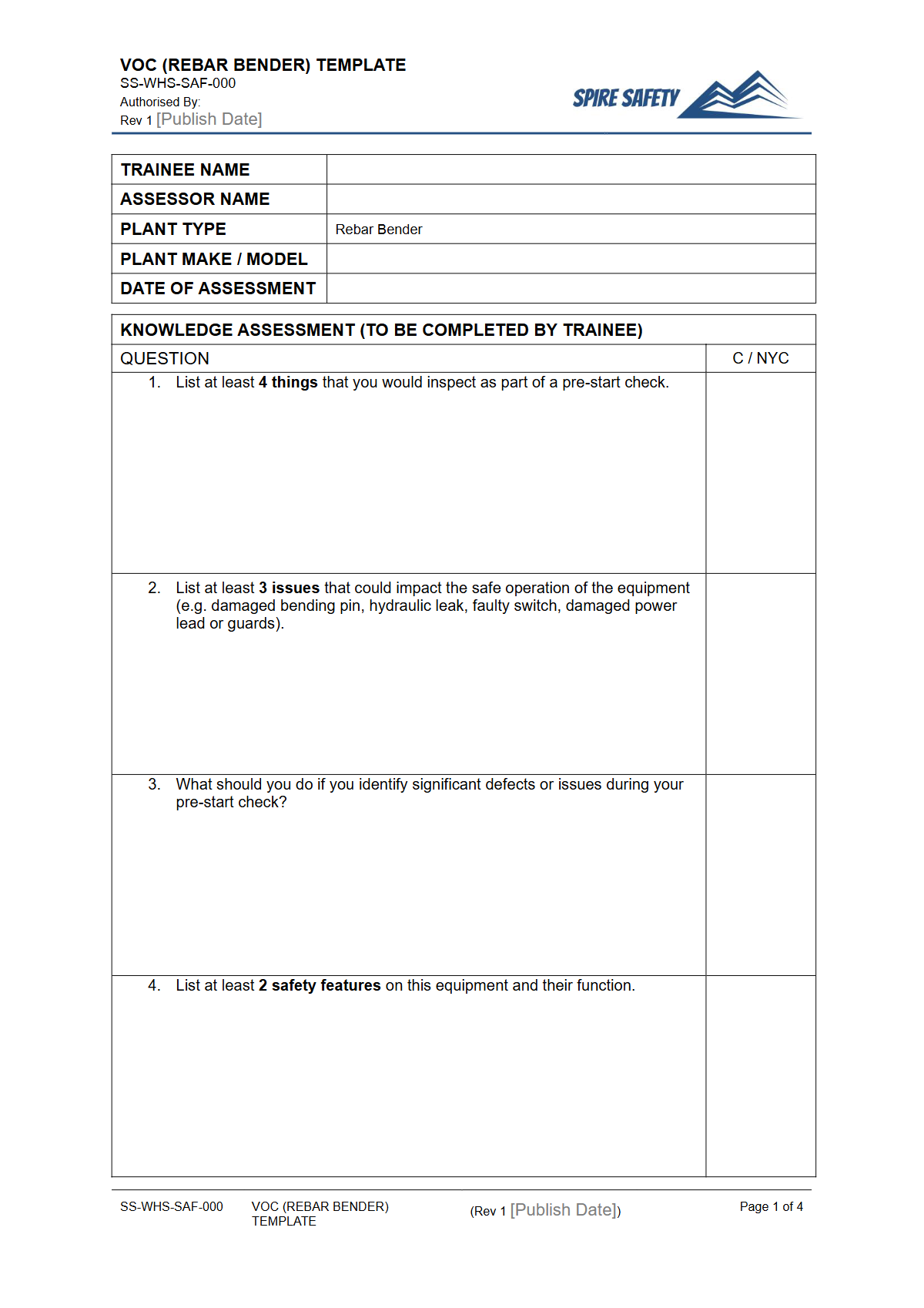
This Free Verification of Competency (Rebar Bender) Template provides a structured starting point for organisations to confirm their workers have the necessary skills and knowledge to operate a rebar bender safely. A Verification of Competency (VOC) is a critical process used to assess an individual's ability to perform their duties after they have already received initial training.
It is not a substitute for formal training but rather a confirmation that the acquired skills are being applied correctly and safely in the workplace.
Using a rebar bender involves significant risks, including muscular stress from handling heavy materials, crush injuries from moving parts, and entanglement hazards. Implementing a robust VOC process helps a Person Conducting a Business or Undertaking (PCBU) meet their primary duty of care under Australian WHS laws.
It forms a key part of effective WHS management systems by creating a clear record of due diligence in ensuring worker competency for high-risk tasks. Documenting these assessments is also essential evidence during regular WHS compliance audits.
Video walkthrough
How to Use the Free Verification of Competency (Rebar Bender) Template
Our template is provided in both DOCX and PDF formats for your convenience. It is designed to be a comprehensive but user-friendly tool, divided into logical sections to guide the assessment process.
The typical flow includes sections for operator details, a checklist for theoretical knowledge (e.g., understanding of machine-specific risks and controls), and a practical observation checklist where the assessor observes the operator performing tasks. These tasks should cover the full operational cycle, from pre-start checks to safe shutdown procedures. For a similar process on related equipment, you might reference our pipe cutter VOC template.
Key Assessment Criteria
When assessing an operator's competence with a rebar bender, the assessor should focus on critical safety and operational behaviours. The template prompts evaluation of the following areas:
- Pre-start inspection: Verifying that the operator correctly checks for defects, damage, correct guarding, and functionality of emergency stops.
- Work area setup: Ensuring the area is clear of trip hazards, has stable footing, and is well-lit.
- Material handling: Observing safe manual handling techniques for lifting and positioning heavy rebar.
- Machine operation: Checking for correct use of controls, appropriate speed, and proper positioning of the rebar against the bending pins or rollers.
- Personal Protective Equipment (PPE): Confirming the operator is wearing appropriate PPE, such as safety glasses, gloves, and steel-capped boots.
- Shutdown procedure: Verifying the machine is powered down and secured correctly after use.
Important: This document is a template, not a finished document. It is crucial that you customise it to reflect your specific workplace, the models of rebar benders used, your safe work procedures, and relevant state or territory regulations.
Our document provides a framework; you must complete it with your site-specific details. This principle of customisation applies to all equipment assessments, including when using a resource like our free Drill Press VOC template.
When to Use It
A Verification of Competency for a rebar bender should be conducted at several key points to manage risk effectively. It is not a one-off event. Consider using this assessment process:
- Pre-employment: To verify the skills and claims of new hires before they commence work.
- Introduction of new equipment: When a new make or model of rebar bender is introduced to the workplace.
- Post-incident: As part of an investigation after an incident or a near-miss involving a rebar bender to identify any competency gaps.
- Identified performance issues: If a supervisor observes unsafe practices or repeated operational errors.
- Periodic reassessment: As part of a regular schedule (e.g., annually or biennially) to ensure skills are maintained, especially for tasks performed infrequently. For other common construction equipment, you can adapt a similar schedule, as outlined in our free Cement Mixer VOC template.
Who Should Use It
This template is designed for use by individuals responsible for workplace safety and training. This includes WHS Managers, Safety Officers, Site Supervisors, Forepersons, and internal trainers.
The person conducting the assessment (the assessor) must be competent themselves. This means they should have extensive knowledge, skill, and recent experience in the safe operation of the specific rebar bender being assessed.
They must also have the skills to conduct an assessment fairly and objectively and be able to provide constructive feedback. If your organisation lacks this internal expertise, engaging external WHS consulting services may be a valuable option to ensure the verification process is robust and impartial.
Common mistakes
Common mistakes to avoid
- Using a generic template without customising it for the specific rebar bender model and site procedures.
- Having an assessor who is not themselves fully competent and experienced with the equipment.
- Treating the VOC as a 'tick and flick' exercise rather than a genuine observation of skill.
- Failing to document corrective actions or provide further training for operators deemed 'Not Yet Competent'.
Legal references
Legal considerations
The following legal requirements may be relevant to this type of work.
- Work Health and Safety Act (Harmonised) — Provides the primary duties for protecting workers and other people from work health and safety risks.
- Work Health and Safety Regulations (Harmonised) — Sets out requirements supporting the management of workplace hazards and risks.
The following codes may be relevant to this type of work.
- Managing WHS Risks Code of Practice — Provides practical guidance on identifying hazards, assessing risks and applying effective controls.
- Work Health and Safety Consultation, Cooperation and Coordination Code of Practice — Provides practical guidance on consulting workers and coordinating with other duty holders.
- Managing the Work Environment and Facilities Code of Practice — Provides practical guidance on safe work environments, workplace facilities and related controls.
Did you know
Ergonomic Risks
Musculoskeletal disorders are a leading cause of serious workers' compensation claims in the construction industry. Correctly assessing manual handling techniques for loading and unloading rebar is a critical part of a VOC.
Steel's Strength
The numbers used to grade rebar (e.g., N250) indicate its yield strength in megapascals (MPa). This strength is what allows it to effectively reinforce concrete, but it also means significant force is required to bend it, highlighting the power and potential danger of rebar bender machinery.
FAQ
Frequently asked questions
01Is a rebar bender VOC legally required in Australia?
02Who is considered a 'competent person' to conduct a rebar bender VOC?
03How often should a rebar bender operator's competency be verified?
04Can this template be used for both electric and portable hydraulic rebar benders?
Share this resource
Free Verification of Competency (Rebar Bender) Template
Browse Categories
How To Use It
- 1Download and open in Word or PDF.
- 2Replace the placeholders with your business details.
- 3Get it reviewed by a WHS specialist before rollout.
Need it customised?
Our WHS consultants can adapt this template to your site, run a gap analysis, or audit what you already have in place.
Book a Free Consultation WHS consulting servicesor call 1300 156 382
Related templates
- Free Verification of Competency (Rebar Cutter) Template
- Free Verification of Competency (Rebar Tying Gun) Template
- Free Verification of Competency (Ride-On Sweeper) Template
- Free Verification of Competency (Rivet Gun) Template
- Free Verification of Competency (Road Saw or Diamond Blade Saw) Template
- Free Verification of Competency (Rock Grab Attachment) Template