
Free Verification of Competency (Random Orbital Sander) Template
Download our free Verification of Competency (Random Orbital Sander) template to assess operator skills.
Free Verification of Competency (Random Orbital Sander) Template
DOCX • 138 KB + PDF
Updated Oct 2026
No signup required
Purpose of the Free Verification of Competency (Random Orbital Sander) Template
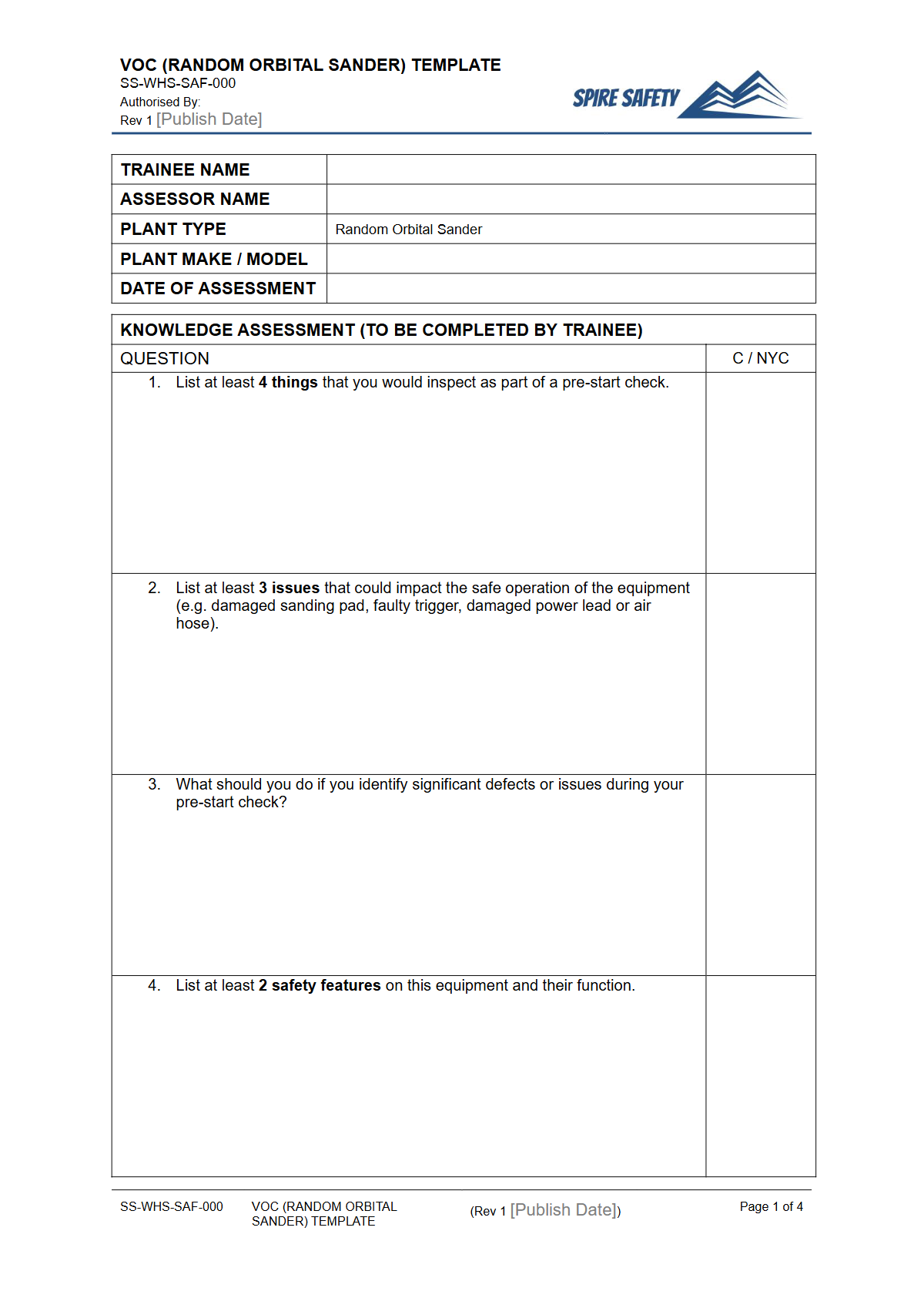
Ensuring workers can safely and effectively operate equipment is a core part of workplace safety. This Free Verification of Competency (Random orbital sander) Template provides a structured framework for assessing and documenting an operator's skills and knowledge.
It is designed as a starting point for businesses to confirm that their team members have the necessary competence to use random orbital sanders without endangering themselves or others. The template covers key criteria including pre-operational checks, safe operating procedures, hazard identification (such as dust, noise, and vibration), and correct shutdown processes.
Using a standardised assessment tool helps a Person Conducting a Business or Undertaking (PCBU) meet their duty of care. It creates a clear record that demonstrates steps have been taken to verify a worker’s ability to perform a task safely. This documentation is a vital component of a robust safety management system and is often reviewed during a WHS compliance audit.
Video walkthrough
How to use the Free Verification of Competency (Random Orbital Sander) Template
This resource is provided in both DOCX and PDF formats for your convenience. The DOCX file is fully editable, allowing you to adapt the criteria to suit the specific models of sanders used in your workplace and your unique operational risks.
The assessment should be conducted by a competent person, such as a supervisor or experienced operator, who has the expertise to accurately judge the worker's performance.
The process involves observing the worker as they perform the task and asking relevant questions to gauge their understanding of the associated hazards and controls. Each criterion can be marked as 'Competent' or 'Not Yet Competent', with space provided for comments and feedback.
Formalising this process is a key part of building effective WHS management systems that actively manage risk.
Important: We have provided this template as a guide; you must customise it to reflect your specific equipment, site conditions, internal procedures, and organisational policies. A generic document is not sufficient for demonstrating due diligence.
When to conduct a VOC
A Verification of Competency for a random orbital sander is not a one-time event. It should be used in several situations to ensure ongoing safety and skill retention. Consider conducting a VOC:
- Before a worker is authorised to use a random orbital sander for the first time.
- As part of refresher training, scheduled at regular intervals (e.g., annually or biennially).
- Following a workplace incident or near-miss involving the equipment.
- When a new brand or model of sander is introduced to the workplace.
- If a supervisor observes unsafe or incorrect operating practices.
- For workers returning to the task after an extended absence.
Who should use this template
This template is designed for use by anyone responsible for workplace safety, training, and supervision. This includes WHS advisors, Health and Safety Representatives (HSRs), supervisors, team leaders, and managers in industries where random orbital sanders are common, such as:
- Construction and building trades
- Woodworking and cabinet making
- Automotive repair and refinishing
- Manufacturing
- Boat building and maintenance
The principles of verifying competency are transferable across various types of workshop equipment. For example, similar assessment structures can be used for other tools, as shown in our Free Drill Press VOC (Verification of Competency) Template.
Beyond handheld tools, verifying competency is crucial for a wide range of powered equipment. A consistent approach across your organisation demonstrates a commitment to safety, whether for workshop equipment or general site machinery like that covered in our Free Pressure Cleaner VOC (Verification of Competency) Template.
This document is just one of many tools available to help strengthen your safety processes. You can find a wide range of checklists, forms, and templates in our complete free WHS resources library to support your health and safety objectives.
Common mistakes
Common mistakes to avoid
- Applying excessive pressure, which can damage the workpiece and overload the motor.
- Neglecting to wear appropriate PPE, especially a dust mask and safety glasses.
- Using the wrong grit of sandpaper for the specific task, leading to poor finishes or material damage.
- Failing to ensure the dust extraction port is clear and connected to a vacuum system.
Legal references
Legal considerations
The following legal requirements may be relevant to this type of work.
- Work Health and Safety Act (Harmonised) — Provides the primary duties for protecting workers and other people from work health and safety risks.
- Work Health and Safety Regulations (Harmonised) — Sets out requirements supporting the management of workplace hazards and risks.
The following codes may be relevant to this type of work.
- Managing WHS Risks Code of Practice — Provides practical guidance on identifying hazards, assessing risks and applying effective controls.
- Work Health and Safety Consultation, Cooperation and Coordination Code of Practice — Provides practical guidance on consulting workers and coordinating with other duty holders.
- Managing the Work Environment and Facilities Code of Practice — Provides practical guidance on safe work environments, workplace facilities and related controls.
Did you know
The 'Random' Advantage
The 'random' in a random orbital sander refers to its unique sanding pad motion, which spins in a circle while also oscillating in an elliptical pattern. This dual action prevents the tool from leaving noticeable swirl marks, a common issue with standard orbital sanders.
Dust is a Major Hazard
The fine dust produced by sanders is a significant health risk, potentially containing silica, wood dust, or chemicals from paint and fillers. Effective on-tool dust extraction is not just for cleanliness but is a critical health control to prevent respiratory diseases.
FAQ
Frequently asked questions
01What is a Verification of Competency (VOC) for a random orbital sander?
02Is a VOC legally required for using a random orbital sander in Australia?
03How often should a VOC for a random orbital sander be conducted?
04Can I use this template for other types of sanders, like a belt sander?
Share this resource
Free Verification of Competency (Random Orbital Sander) Template
Browse Categories
How To Use It
- 1Download and open in Word or PDF.
- 2Replace the placeholders with your business details.
- 3Get it reviewed by a WHS specialist before rollout.
Need it customised?
Our WHS consultants can adapt this template to your site, run a gap analysis, or audit what you already have in place.
Book a Free Consultation WHS consulting servicesor call 1300 156 382
Related templates
- Free Verification of Competency (Reach Forklift) Template
- Free Verification of Competency (Reach Stacker) Template
- Free Verification of Competency (Rebar Bender) Template
- Free Verification of Competency (Rebar Cutter) Template
- Free Verification of Competency (Rebar Tying Gun) Template
- Free Verification of Competency (Ride-On Sweeper) Template