
Free Verification of Competency (Reach Forklift) Template
Need to verify reach forklift operator skills? Our free Verification of Competency (Reach Forklift) template provides a structured starting point. Download now.
Free Verification of Competency (Reach Forklift) Template
DOCX • 140 KB + PDF
Updated Oct 2026
No signup required
Purpose of the Free Verification of Competency (Reach Forklift) Template
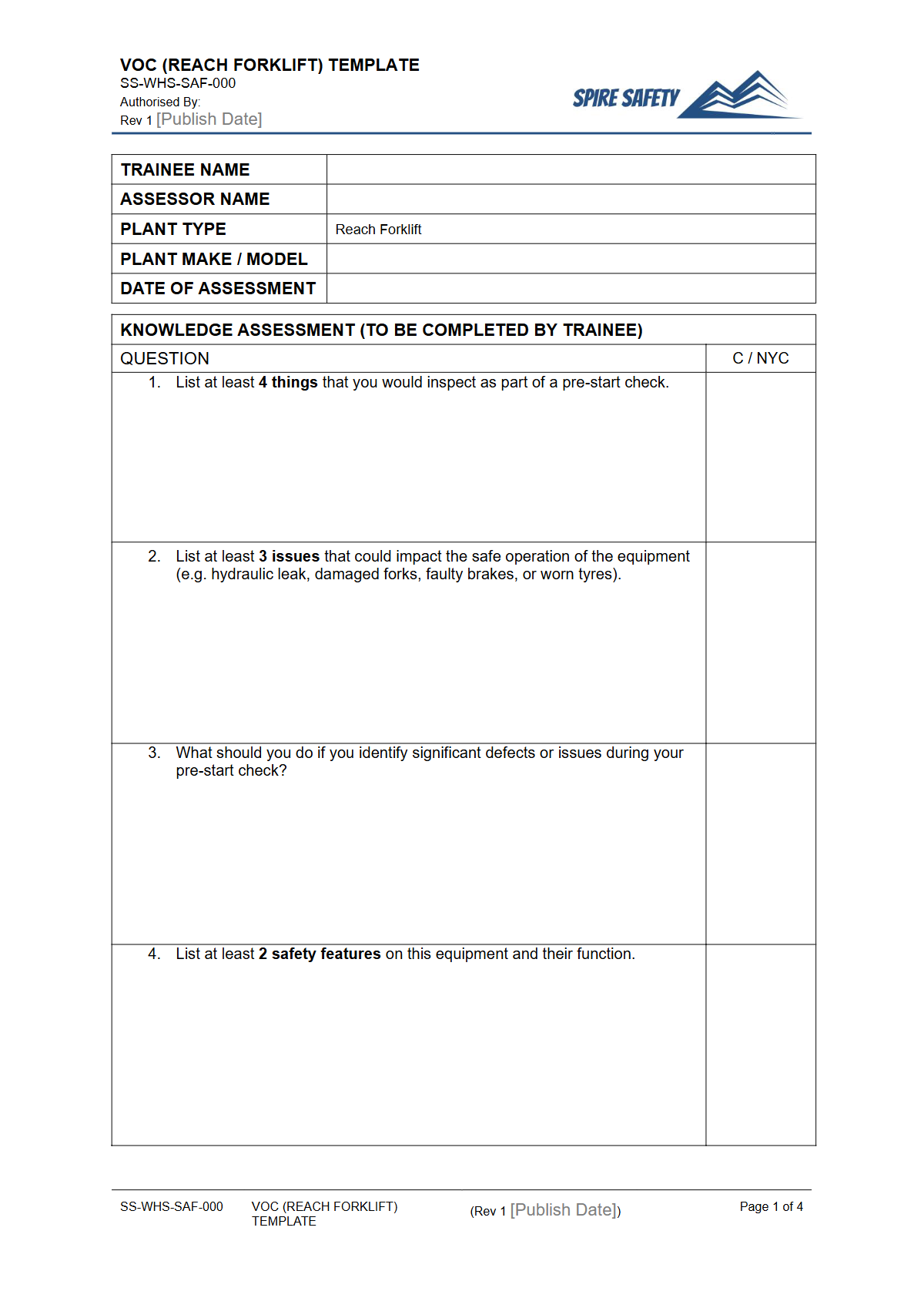
This free Verification of Competency (Reach Forklift) template provides a structured method for organisations to confirm that a licenced operator has the current skills and knowledge to operate a reach forklift safely in their specific work environment. A Verification of Competency (VOC) is a crucial process used by a Person Conducting a Business or Undertaking (PCBU) to meet their primary duty of care.
It is not a replacement for the mandatory high-risk work licence (HRWL Class LF) but serves as an ongoing assessment of competence.
Using a reach forklift is a high-risk activity, and simply holding a licence does not guarantee an operator is familiar with a specific model, its attachments, or the unique hazards of a particular warehouse or worksite. This template helps formalise the assessment process, covering both theoretical knowledge and practical operational skills.
Integrating such procedures is a key element of effective WHS management systems, demonstrating proactive risk management.
Video walkthrough
How to use the Free Verification of Competency (Reach Forklift) Template
This resource is provided as a downloadable DOCX file that you can adapt for your organisation's needs. A PDF version is also available for straightforward printing.
The VOC process should involve a combination of theory questions, a pre-start inspection, and observation of the operator performing typical tasks in the workplace.
Important: This is a template document. We have designed it as a structured starting point, but you must customise it to reflect the specific reach forklift models, attachments, workplace environment, and operational procedures at your site.
Generic assessments can miss site-specific risks.
To implement it effectively:
- Review and modify the assessment criteria to align with your Safe Work Method Statements (SWMS), traffic management plan, and the manufacturer's operating manual for your reach trucks.
- Ensure the designated assessor is a competent person with extensive experience on the specific equipment and knowledge of assessment principles.
- Conduct the assessment in the real work environment where possible, or a simulated environment that accurately reflects workplace conditions.
- Document the outcome clearly, providing feedback to the operator. Store the completed record in the worker's training file.
The criteria for assessing competence on a reach forklift will differ from other mobile plant. For example, the challenges of operating in a warehouse are very different from those assessed in our Verification of Competency (Rough Terrain Forklift) template, highlighting the need for customisation.
When to conduct a Verifications of Competency
A VOC for reach forklift operators should be conducted at several key moments to ensure ongoing safety and competence. It is not a one-time event. Consider using this template in the following situations:
- Pre-employment: For new employees who already hold a forklift licence, to verify their skills on your specific equipment before they begin work.
- Introduction of New Equipment: When a new make, model, or configuration of reach forklift is introduced to the workplace.
- Post-Incident: After an incident or near-miss involving a reach forklift to identify and address any competency gaps that may have contributed.
- Extended Absence: If an operator has not used a reach forklift for a significant period.
- Periodic Re-assessment: As part of a regular schedule (e.g., every 2-3 years) to ensure skills and knowledge remain current. This can be a valuable input for WHS compliance auditing activities.
Who should use it
This template is designed for use by anyone responsible for workplace safety and operator competence. This includes:
- Work Health and Safety (WHS) Managers and Advisors
- Warehouse, Logistics, and Operations Managers
- Supervisors and Team Leaders
- Internal Trainers and Assessors
- Human Resources (HR) professionals involved in skills verification
The individual conducting the assessment must be competent to do so. This means they should not only be an expert operator of the same class of plant but also have the capacity to assess another person's performance objectively and provide constructive feedback.
If your organisation does not have a suitable person internally, seeking external WHS consulting can provide an independent and expert assessment. For other useful safety documents, browse our full free WHS resources library.
Common mistakes
Common mistakes to avoid
- Treating the VOC as a 'tick and flick' exercise without genuine observation and assessment.
- Using a generic forklift template without customising it for the specific reach truck model and worksite.
- Allowing an inexperienced or unqualified person to conduct the assessment.
- Failing to document the VOC outcome and store it as part of the worker's training and competency records.
Legal references
Legal considerations
The following legal requirements may be relevant to this type of work.
- Work Health and Safety Act (Harmonised) — Provides the primary duties for protecting workers and other people from work health and safety risks.
- Work Health and Safety Regulations (Harmonised) — Sets out requirements supporting the management of workplace hazards and risks.
The following codes may be relevant to this type of work.
- Managing WHS Risks Code of Practice — Provides practical guidance on identifying hazards, assessing risks and applying effective controls.
- Work Health and Safety Consultation, Cooperation and Coordination Code of Practice — Provides practical guidance on consulting workers and coordinating with other duty holders.
- Managing the Work Environment and Facilities Code of Practice — Provides practical guidance on safe work environments, workplace facilities and related controls.
Did you know
Reach vs. Counterbalance
Reach forklifts use a 'scissor' mechanism to extend the forks, allowing them to reach into racking in narrow aisles. This mechanism significantly changes their stability and handling characteristics compared to a standard counterbalance forklift.
High-Risk Work Licence
In Australia, operating most types of forklifts, including reach trucks, requires a High-Risk Work Licence (HRWL) class LF, issued by the relevant state or territory WHS regulator.
FAQ
Frequently asked questions
01Is a Verification of Competency the same as a reach forklift licence?
02How often should a reach forklift VOC be conducted?
03Who is considered a 'competent person' to conduct a reach forklift VOC?
04Can this template be used for a standard counterbalance forklift?
Share this resource
Free Verification of Competency (Reach Forklift) Template
Browse Categories
How To Use It
- 1Download and open in Word or PDF.
- 2Replace the placeholders with your business details.
- 3Get it reviewed by a WHS specialist before rollout.
Need it customised?
Our WHS consultants can adapt this template to your site, run a gap analysis, or audit what you already have in place.
Book a Free Consultation WHS consulting servicesor call 1300 156 382
Related templates
- Free Verification of Competency (Reach Stacker) Template
- Free Verification of Competency (Rebar Bender) Template
- Free Verification of Competency (Rebar Cutter) Template
- Free Verification of Competency (Rebar Tying Gun) Template
- Free Verification of Competency (Ride-On Sweeper) Template
- Free Verification of Competency (Rivet Gun) Template