
Free Verification of Competency (Pole Saw) Template
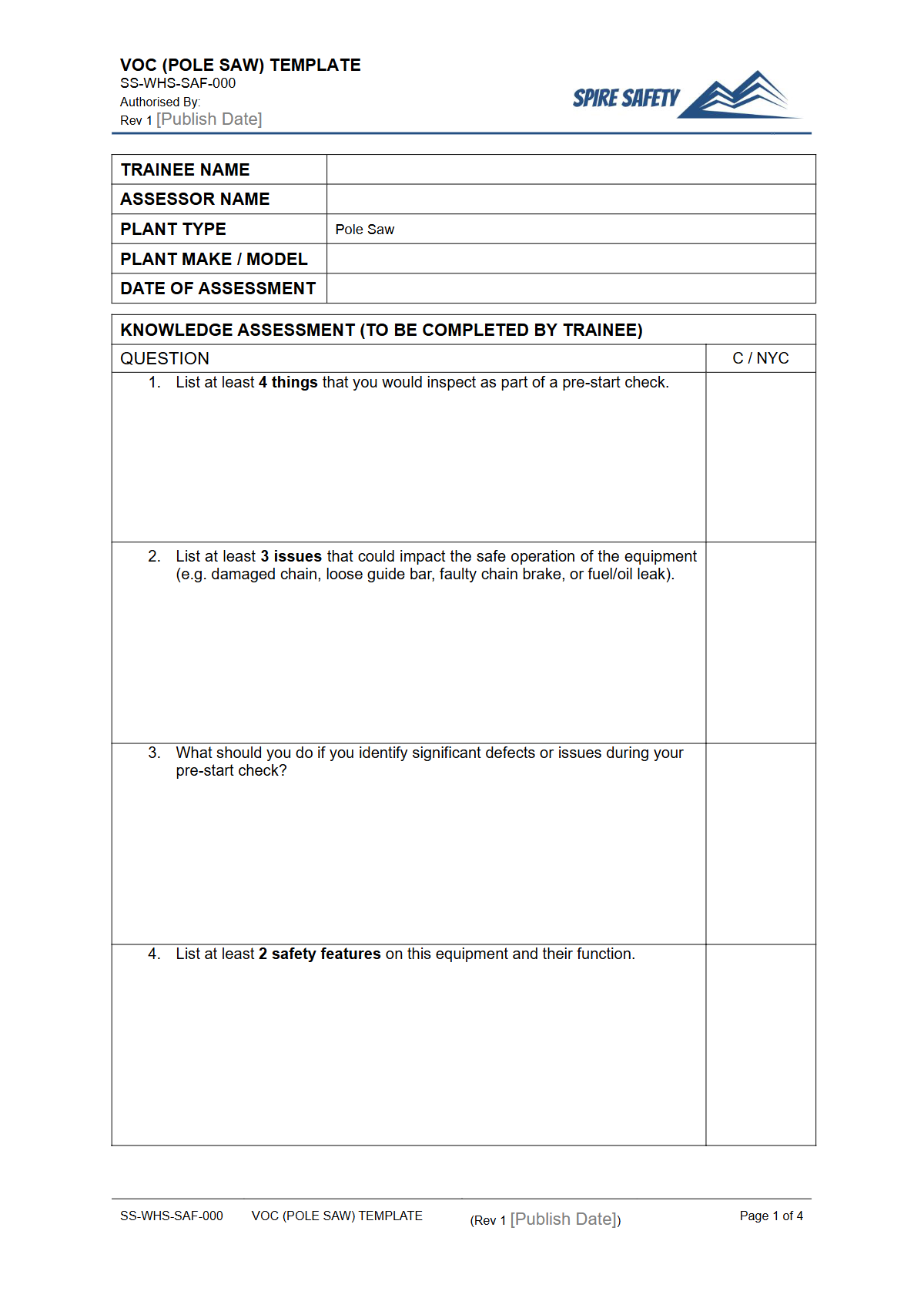
Download our Free Verification of Competency (Pole Saw) Template. This customisable DOCX and PDF helps you assess operator skill and safety knowledge.
Free Verification of Competency (Pole Saw) Template
DOCX • 140 KB + PDF
Updated Oct 2026
No signup required
Purpose of the Free Verification of Competency (Pole Saw) Template
Operating a pole saw requires specific skills to manage risks associated with cutting at height, overhead hazards, and tool operation. Our Free Verification of Competency (Pole Saw) Template provides a structured framework for employers and supervisors to assess and document a worker's ability to operate this equipment safely.
A Verification of Competency (VOC) is a critical process for a Person Conducting a Business or Undertaking (PCBU) to meet their primary duty of care under WHS legislation. This template is designed as a starting point to confirm that operators not only have a licence or ticket (if applicable) but can also demonstrate practical competence in a real-world setting.
This resource helps formalise the assessment process, covering key criteria from pre-start checks and hazard identification to correct cutting techniques and shutdown procedures. Using a consistent template ensures that all operators are evaluated against the same safety standards, which is a key component in developing robust WHS management systems. It provides documented evidence that you have taken reasonably practicable steps to ensure worker competency for this specific task.
Video walkthrough
How to use the Free Verification of Competency (Pole Saw) Template
To effectively use the Free Verification of Competency (Pole Saw) Template, follow these steps. First, download the template in either DOCX for easy editing or PDF for straightforward printing.
The next step is crucial for its effectiveness and your organisation's compliance. You must adapt the document to suit your specific workplace, including the exact make and model of the pole saw used, the typical operating environments (e.g., near structures, public spaces, or terrain types), and your company’s specific safety procedures.
Once customised, a competent person (such as an experienced supervisor or external trainer) should use the template to guide the assessment. This involves observing the operator performing various tasks with the pole saw, from start-up to pack-down.
The assessor asks questions to test theoretical knowledge and records observations on the checklist provided. The completed document should be signed by both the assessor and the operator and kept as a training record. A similar structured approach can be taken for other equipment, such as what's covered in our mini excavator VOC template.
A Note on Customisation
IMPORTANT: This document is a template only. We are not familiar with your specific worksite, equipment, or operational context.
You MUST customise this template to reflect the specific hazards, risks, and controls relevant to your organisation. Failure to do so could result in an inadequate assessment and may not fulfil your WHS obligations.
When to use it
A VOC for pole saw operation should be conducted at several key points to ensure ongoing safety and competence. It is not a one-time event. Consider using this template in the following situations:
- Pre-Employment: To verify the skills and competence of a new hire who claims to be an experienced operator.
- Post-Training: After an operator completes initial training to confirm they have absorbed and can apply the knowledge.
- Introduction of New Equipment: When a new make or model of pole saw is introduced to the workplace, as controls and features can differ.
- Post-Incident: Following a near-miss or incident involving a pole saw to identify any competency gaps and implement corrective training.
- Refresher Assessments: At regular intervals as part of ongoing worker supervision and training programs, helping to prevent skill fade and complacency. Conducting these periodic checks can be supplemented by broader safety reviews like professional WHS compliance auditing.
Who should use it
This template is designed for use by individuals responsible for workplace safety and operator supervision. This typically includes:
- WHS Managers and Safety Officers: To implement a standardised process for competency verification across the organisation.
- Supervisors and Team Leaders: As a practical tool to conduct on-the-job assessments of their team members.
- Business Owners (especially in smaller organisations): To personally ensure their workers are competent and to maintain safety records.
- Procurement and Hire Managers: To assess operators of hired equipment before they commence work on site.
Crucially, the person conducting the assessment must be competent themselves. They must possess extensive knowledge and experience in the safe operation of pole saws to be able to accurately judge the operator's performance and provide meaningful feedback.
The process is similar for other handheld cutting equipment, and you may find our pipe cutter VOC template useful for those related tasks.
For those managing a variety of outdoor and maintenance equipment, you may also benefit from our free pressure cleaner VOC template. Having a library of specific assessments ensures each piece of plant is treated with appropriate focus. You can browse our complete free WHS resources library for more templates and guides.
Common mistakes
Common mistakes to avoid
- Using the template as a simple tick-box exercise without genuine, practical observation.
- Allowing an assessor who isn't competent or familiar with the specific pole saw model to conduct the verification.
- Failing to customise the template for site-specific risks like proximity to power lines, uneven ground, or public access areas.
- Neglecting to assess and verify competence in pre-start checks, fuel mixing, chain tensioning, and post-use maintenance.
Legal references
Legal considerations
The following legal requirements may be relevant to this type of work.
- Work Health and Safety Act (Harmonised) — Provides the primary duties for protecting workers and other people from work health and safety risks.
- Work Health and Safety Regulations (Harmonised) — Sets out requirements supporting the management of workplace hazards and risks.
The following codes may be relevant to this type of work.
- Managing WHS Risks Code of Practice — Provides practical guidance on identifying hazards, assessing risks and applying effective controls.
- Work Health and Safety Consultation, Cooperation and Coordination Code of Practice — Provides practical guidance on consulting workers and coordinating with other duty holders.
- Managing the Work Environment and Facilities Code of Practice — Provides practical guidance on safe work environments, workplace facilities and related controls.
Did you know
Vibration Risks
Prolonged use of vibrating tools like pole saws can lead to Hand-Arm Vibration Syndrome (HAVS), a permanent and debilitating condition. Regular breaks and well-maintained equipment are crucial controls.
Kickback Zone
The upper quadrant of the guide bar's tip is the 'kickback zone.' If this area contacts an object, the saw can violently kick up and back toward the operator, a leading cause of serious injuries.
FAQ
Frequently asked questions
01What is the difference between a licence and a VOC for a pole saw?
02How often should I conduct a pole saw VOC?
03Can I use this template for a regular chainsaw?
04Does the assessor need any specific qualifications?
Share this resource
Free Verification of Competency (Pole Saw) Template
Browse Categories
How To Use It
- 1Download and open in Word or PDF.
- 2Replace the placeholders with your business details.
- 3Get it reviewed by a WHS specialist before rollout.
Need it customised?
Our WHS consultants can adapt this template to your site, run a gap analysis, or audit what you already have in place.
Book a Free Consultation WHS consulting servicesor call 1300 156 382
Related templates
- Free Verification of Competency (Pop Rivet Gun) Template
- Free Verification of Competency (Portable Water Pump) Template
- Free Verification of Competency (Portable Welding Machine) Template
- Free Verification of Competency (Post Hole Digger or Auger) Template
- Free Verification of Competency (Power Trowel) Template
- Free Verification of Competency (Random Orbital Sander) Template