
Free Verification of Competency (Portable Water Pump) Template
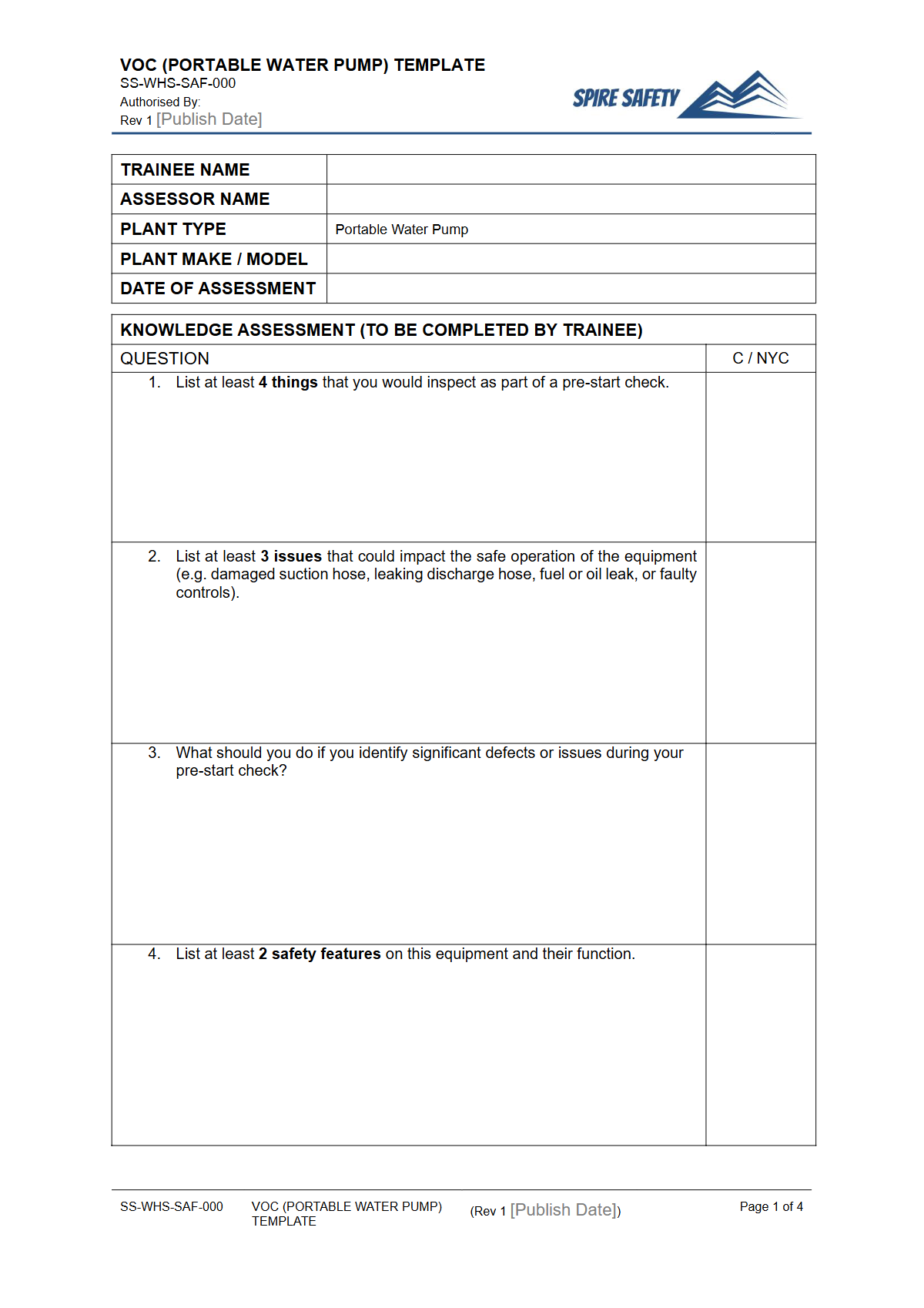
Download our Free Verification of Competency (Portable Water Pump) Template to assess operator skill and safety knowledge. Get your DOCX and PDF now.
Free Verification of Competency (Portable Water Pump) Template
DOCX • 140 KB + PDF
Updated Oct 2026
No signup required
Purpose of the Free Verification of Competency (Portable Water Pump) Template
Operating a portable water pump, whether for dewatering a trench, managing water on a construction site, or for agricultural irrigation, involves specific risks. This free Verification of Competency (Portable Water Pump) template provides a structured framework for employers to confirm that workers have the necessary skills and knowledge to operate the equipment safely and effectively.
It goes beyond simple familiarisation, allowing an assessor to formally observe and document an operator's ability to perform pre-start checks, operate the pump correctly, manage hoses and connections, and follow safe shutdown procedures.
A formal VOC process helps a Person Conducting a Business or Undertaking (PCBU) meet their primary duty of care. It ensures workers are not only trained but can also apply that training in a practical setting.
Using this template helps document these assessments, forming a critical part of your site's safety records and demonstrating due diligence in managing plant-related risks. While portable pumps may seem simple, a documented assessment process is a key component of all robust WHS management systems.
Video walkthrough
How to use the Free Verification of Competency (Portable Water Pump) Template
This template is designed for practical, on-the-job assessment. It is available in both DOCX for easy editing and PDF for straightforward printing.
To conduct the assessment:
- First, download the template and thoroughly review its contents.
- Customise the checklist to match the specific make and model of the portable water pump used at your workplace, the site conditions, and your organisation’s safe work procedures. You should also add any site-specific hazards, such as working near water bodies or in confined spaces.
- The assessment must be conducted by a person who is competent and experienced in the safe operation of the specific portable water pump. The assessor will observe the operator carrying out tasks outlined in the template.
- The assessor uses the checklist to record observations against each competency criterion, marking each as satisfactory or not yet satisfactory and adding comments where necessary.
- Upon completion, both the assessor and the operator should sign the document. If any competency gaps are identified, a plan for further training or supervision must be put in place and documented before the worker is permitted to operate the pump unsupervised.
IMPORTANT: This is a template only. We have designed it as a starting point, but you must customise it to reflect the specific portable water pump models, workplace environment, policies, procedures, and unique risks present at your site.
A generic assessment that doesn't account for your specific operational context may not be sufficient. For similar equipment, you might adapt our pressure cleaner VOC template to suit your needs.
When to use it
A Verification of Competency for a portable water pump should be conducted at several key moments to ensure ongoing safety and skill. These include:
- Pre-employment: To verify the skills and claims of a potential new hire.
- Task assignment: Before an existing worker operates a portable water pump for the first time, or uses a new or different model.
- Post-incident: Following an incident or near miss involving the equipment to identify and address any competency gaps.
- Periodic re-assessment: As part of a scheduled competency review program (e.g., annually or biennially) to ensure skills remain current.
- Legislative or procedural changes: When there are significant changes to WHS legislation, industry standards, or your organisation's safe work procedures related to the equipment.
This proactive approach helps manage risk effectively, rather than waiting for an incident to occur. A similar assessment schedule is often applied to related ground works, as detailed in our Verification of Competency (Trencher) template.
Who should use it
This template is intended for use by individuals responsible for workplace safety and operational supervision. This typically includes:
- WHS Managers and Safety Advisors
- Site Supervisors and Forepersons
- Project Managers
- Maintenance and Workshop Managers
- Human Resources personnel involved in skills verification
The person conducting the assessment (the assessor) must be a competent individual. This means they must have the requisite knowledge, skills, and experience with the specific portable water pump to make an informed judgement about the operator's abilities.
They should be familiar with the manufacturer's instructions, relevant safety procedures, and the specific hazards of the operating environment. For complex site requirements, engaging external specialists for expert WHS consulting can provide an additional layer of assurance for high-risk activities.
For tasks involving the transfer of water over larger areas, a formal assessment using a Verification of Competency for a water cart may be more appropriate. Many worksites also feature a range of other portable equipment, each requiring its own assessment, such as the process outlined in our portable welding machine VOC.
Common mistakes
Common mistakes to avoid
- Using a generic template without customising it for the specific pump model and worksite risks.
- The assessor not being competent or experienced with the equipment themselves.
- Treating the VOC as a 'tick-and-flick' exercise without meaningful observation or feedback.
- Failing to document and implement corrective actions (like retraining) when competency gaps are found.
Legal references
Legal considerations
The following legal requirements may be relevant to this type of work.
- Work Health and Safety Act (Harmonised) — Provides the primary duties for protecting workers and other people from work health and safety risks.
- Work Health and Safety Regulations (Harmonised) — Sets out requirements supporting the management of workplace hazards and risks.
The following codes may be relevant to this type of work.
- Managing WHS Risks Code of Practice — Provides practical guidance on identifying hazards, assessing risks and applying effective controls.
- Work Health and Safety Consultation, Cooperation and Coordination Code of Practice — Provides practical guidance on consulting workers and coordinating with other duty holders.
- Managing the Work Environment and Facilities Code of Practice — Provides practical guidance on safe work environments, workplace facilities and related controls.
Did you know
Noise Hazard
A typical petrol-powered portable water pump can operate at 95-105 decibels (dB) at the operator's position, well above the 85 dB exposure standard where hearing protection is mandatory.
Manual Handling Risk
Many 'portable' water pumps weigh over 25kg, placing them in a high-risk category for manual handling injuries if not lifted and moved correctly using team lifts or mechanical aids.
FAQ
Frequently asked questions
01What's the difference between a VOC and a licence?
02How often should I conduct a VOC for a portable water pump?
03Can any supervisor conduct the VOC assessment?
04What are the main hazards of using a portable water pump?
Share this resource
Free Verification of Competency (Portable Water Pump) Template
Browse Categories
How To Use It
- 1Download and open in Word or PDF.
- 2Replace the placeholders with your business details.
- 3Get it reviewed by a WHS specialist before rollout.
Need it customised?
Our WHS consultants can adapt this template to your site, run a gap analysis, or audit what you already have in place.
Book a Free Consultation WHS consulting servicesor call 1300 156 382
Related templates
- Free Verification of Competency (Portable Welding Machine) Template
- Free Verification of Competency (Post Hole Digger or Auger) Template
- Free Verification of Competency (Power Trowel) Template
- Free Verification of Competency (Random Orbital Sander) Template
- Free Verification of Competency (Reach Forklift) Template
- Free Verification of Competency (Reach Stacker) Template