
Free Verification of Competency (Pick and Carry Crane) Template
Download our free Verification of Competency (Pick and Carry Crane) Template. This structured document helps assess operator skills. Get your DOCX & PDF now.
Free Verification of Competency (Pick and Carry Crane) Template
DOCX • 140 KB + PDF
Updated Oct 2026
No signup required
Purpose of the Free Verification of Competency (Pick and Carry Crane) Template
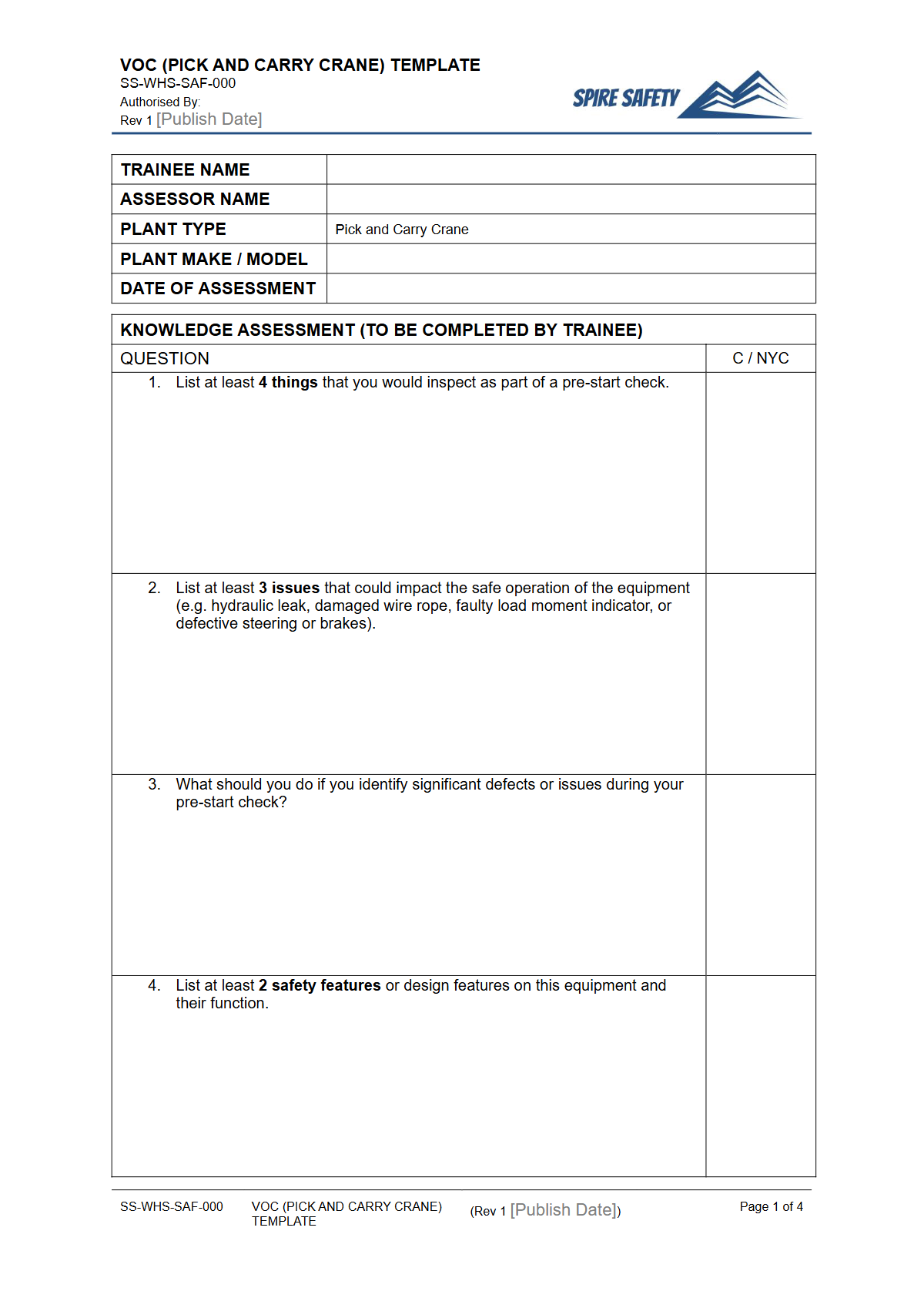
This free Verification of Competency (Pick and Carry Crane) Template provides a structured framework for assessing an operator's ability to safely handle this specific type of mobile crane. While a High Risk Work Licence (HRWL) is mandatory for crane operation, a VOC goes a step further.
It helps a Person Conducting a Business or Undertaking (PCBU) confirm that an operator can apply their skills and knowledge practically and safely within the specific context of your workplace, using your equipment and following your procedures. It serves as crucial evidence that you are taking proactive steps to ensure worker competency.
Using this template helps formalise the assessment process, ensuring key criteria are consistently evaluated. It forms a critical component of robust WHS management systems by documenting how your organisation verifies skills for high-risk tasks.
The template covers theoretical knowledge, pre-operational checks, practical operation, and shutdown procedures, providing a comprehensive evaluation tool.
Video walkthrough
How to use the Free Verification of Competency (Pick and Carry Crane) Template
Using this Pick and Carry Crane VOC template effectively involves several key steps to ensure a thorough and fair assessment. The process begins after an operator provides their relevant High Risk Work Licence (CN for non-slewing cranes, or a higher class).
The assessor, who must be a competent person with extensive experience on the specific crane, then uses the template to guide the verification.
Assessment Workflow:
- Customise the Template: Download the DOCX file and adapt it to your site. Add your company logo and details. Most importantly, update the checklist to reflect the specific models of pick and carry cranes used, your site-specific hazards (e.g., uneven ground, overhead powerlines), and your safe work procedures.
- Brief the Operator: Explain the purpose and process of the VOC. Ensure the operator is clear on what will be assessed and feels prepared.
- Theory Assessment: Use the provided questions to gauge the operator's understanding of crane principles, load charts, legislative requirements, and site rules.
- Practical Assessment: Observe the operator performing a series of tasks, from pre-start inspections and function tests to conducting a lift, travelling with a load, and correctly shutting down the machine.
- Record and Review: Document the outcomes directly in the template. If competency is verified, both the assessor and operator sign off. If gaps are identified, document them clearly and create an action plan for further training. These records are vital during a WHS compliance auditing process.
Important Note: This document is a template and must be customised. It provides a starting point aligned with Australian WHS practice, but we cannot be responsible for its application.
You must adapt it to the specific equipment, procedures, and risks of your workplace to ensure it is fit for purpose.
When to use it
A Verification of Competency for a pick and carry crane operator should be conducted at several key points to manage risk effectively. It is not a one-off event but an ongoing part of the competency management lifecycle.
- Pre-Employment: To verify the skills and claims of a new hire before they begin work.
- New Equipment Introduction: When an experienced operator is required to use a new or unfamiliar model of pick and carry crane.
- Post-Incident: Following a near miss or incident involving the crane to identify and address any competency gaps that may have contributed.
- Periodic Reassessment: At regular intervals (e.g., every 2-3 years) as part of a scheduled competency maintenance program, similar to how you might use a free Grader VOC for other plant operators.
- Observed Unsafe Behaviour: If a supervisor or co-worker observes an operator performing a task in an unsafe or incorrect manner.
Who should use it
The responsibility for using this VOC template falls to individuals tasked with managing and ensuring site safety and operator proficiency. This includes a range of roles within an organisation.
Primarily, the assessment should be conducted by a person who is not only familiar with the VOC process but is also a subject matter expert on pick and carry cranes. This individual must hold the relevant competencies and have significant, demonstrable experience in operating the specific class and model of crane being assessed.
This could be a site supervisor, a dedicated trainer, or an external consultant. The process for verifying mobile crane skills shares principles with assessments for other specialised equipment, such as that detailed in the Verification of Competency for a Rough Terrain Forklift.
Additionally, WHS managers, safety advisors, and human resources personnel should be familiar with the template and its role in the broader safety framework. They are often responsible for scheduling VOCs, maintaining records, and organising gap training, ensuring the process aligns with the organisation's overall risk management strategy.
This structured approach isn't limited to cranes; a similar process applies when using a Verification of Competency (Water Cart) template for plant operators. You can find more templates and safety documents in our free WHS resources library to build out your competency program.
Common mistakes
Common mistakes to avoid
- Using a generic checklist that doesn't reflect site-specific hazards or crane models.
- Allowing an assessor who is not a subject matter expert on the specific crane to conduct the VOC.
- Treating the process as a 'tick and flick' exercise rather than a genuine assessment of skill.
- Failing to document and act on identified competency gaps through targeted training.
Legal references
Legal considerations
The following legal requirements may be relevant to this type of work.
- Work Health and Safety Act (Harmonised) — Provides the primary duties for protecting workers and other people from work health and safety risks.
- Work Health and Safety Regulations (Harmonised) — Sets out requirements supporting the management of workplace hazards and risks.
The following codes may be relevant to this type of work.
- Managing WHS Risks Code of Practice — Provides practical guidance on identifying hazards, assessing risks and applying effective controls.
- Work Health and Safety Consultation, Cooperation and Coordination Code of Practice — Provides practical guidance on consulting workers and coordinating with other duty holders.
- Managing the Work Environment and Facilities Code of Practice — Provides practical guidance on safe work environments, workplace facilities and related controls.
Did you know
A Unique Risk
Pick and carry cranes, particularly older models, are a leading cause of crane-related incidents in Australia, primarily due to their articulation-steer design which can reduce stability during turns.
FAQ
Frequently asked questions
01Is a Verification of Competency (VOC) the same as a High Risk Work Licence for a crane?
02How often should a pick and carry crane operator's competency be verified?
03Who is considered a 'competent person' to conduct a VOC assessment?
04What happens if an operator is found 'Not Yet Competent'?
Share this resource
Free Verification of Competency (Pick and Carry Crane) Template
Browse Categories
How To Use It
- 1Download and open in Word or PDF.
- 2Replace the placeholders with your business details.
- 3Get it reviewed by a WHS specialist before rollout.
Need it customised?
Our WHS consultants can adapt this template to your site, run a gap analysis, or audit what you already have in place.
Book a Free Consultation WHS consulting servicesor call 1300 156 382
Related templates
- Free Verification of Competency (Pipe Bender) Template
- Free Verification of Competency (Plasma Cutter) Template
- Free Verification of Competency (Pole Hedge Trimmer) Template
- Free Verification of Competency (Pole Saw) Template
- Free Verification of Competency (Pop Rivet Gun) Template
- Free Verification of Competency (Portable Water Pump) Template