
Free Verification of Competency (Parts Washer) Template
Download our free Verification of Competency (Parts Washer) template in DOCX and PDF.
Free Verification of Competency (Parts Washer) Template
DOCX • 140 KB + PDF
Updated Oct 2026
No signup required
Purpose of the Free Verification of Competency (Parts Washer) Template
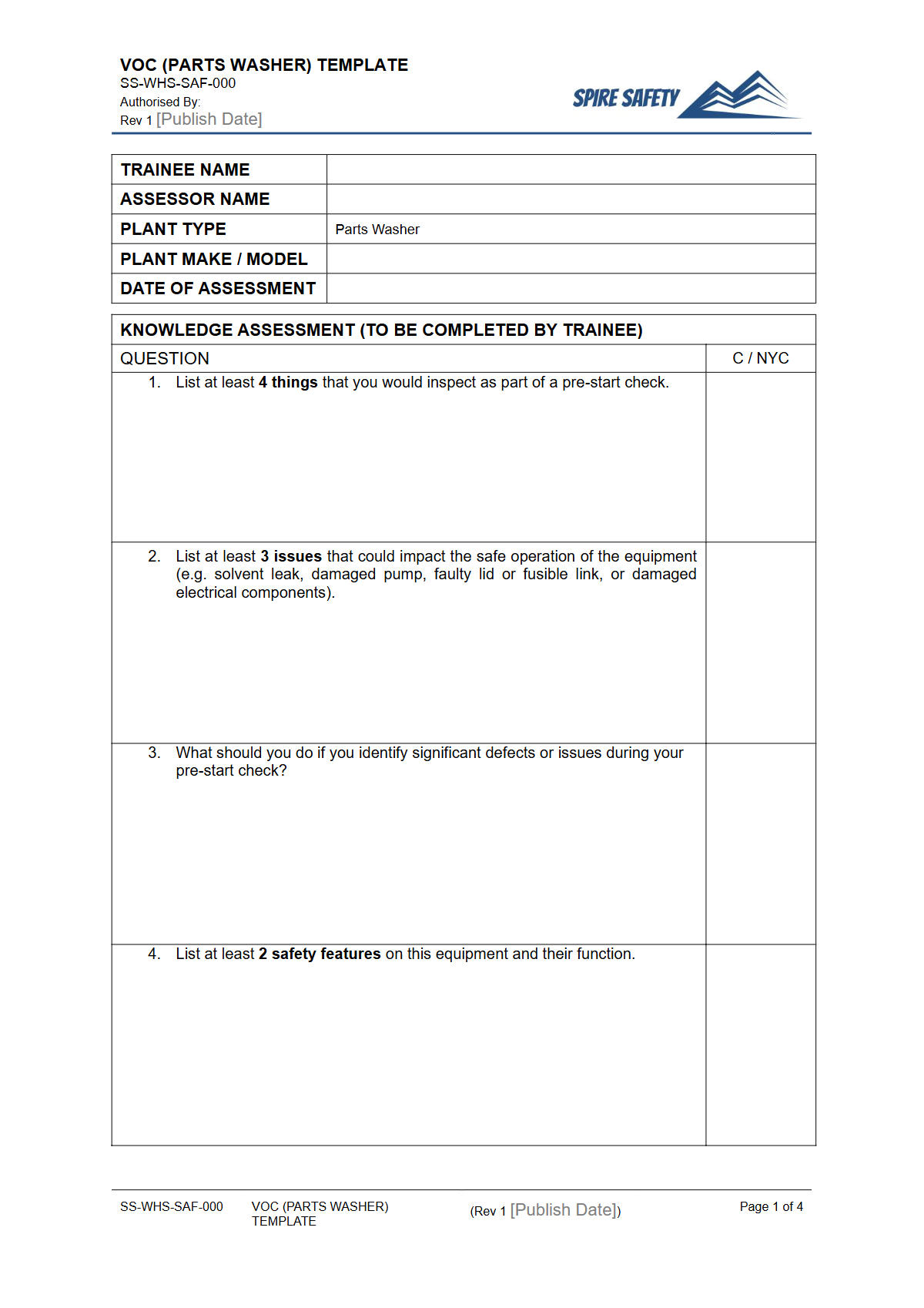
Operating workshop equipment like a parts washer requires specific skills and safety awareness, particularly concerning the chemicals used. This free Verification of Competency (Parts Washer) template provides a structured framework for employers to assess and confirm that an operator can use the equipment safely and effectively.
It serves as a formal record, demonstrating that a worker’s skills have been verified against established operational and safety criteria. Using a VOC goes beyond simple training records; it confirms practical competence in the live work environment, which is a key part of meeting your duties under WHS legislation.
This document is designed to be a starting point, helping you create a consistent assessment process. Integrating such verifications into your broader safety framework is crucial for maintaining a safe workplace.
A robust verification process is a cornerstone of effective WHS management systems, ensuring that training is not just delivered but also understood and applied correctly.
Video walkthrough
How to use the Free Verification of Competency (Parts Washer) Template
This resource provides a clear and editable format for assessing operator competence. After downloading the DOCX or PDF file, you must adapt it to your specific operational context.
The assessor should be a competent person with extensive knowledge of the parts washer in use, its associated risks, and the correct emergency procedures.
Key steps for implementation include:
- Customisation: This is a generic template. You must customise it to reflect the specific make and model of the parts washer at your site. This includes its unique controls, features, and required maintenance checks.
- Chemical Specifics: Update the checklist to include questions and observation points related to the specific cleaning solvents or degreasers used. This should cover Safety Data Sheet (SDS) requirements, correct handling procedures, and necessary Personal Protective Equipment (PPE).
- Practical Observation: The assessment should primarily involve observing the operator perform tasks in their normal work area. This includes pre-start checks, correct operation, chemical handling, and shutdown procedures.
- Documentation: The completed form should be signed by both the assessor and the operator. It should be stored as an official record of their competency. If gaps are identified, a plan for further training should be documented and actioned.
Important: We have provided this template as a guide. It is essential that you customise this document to suit the specific equipment, chemicals, policies, and procedures of your workplace.
Its effectiveness is dependent on this customisation.
When to use a VOC
A Verification of Competency for a parts washer is not a one-time event. It should be conducted at several key points to ensure ongoing safety and skill retention. Consider using this template in the following situations:
- Pre-employment: To verify the skills and experience claimed by a new hire.
- Post-training: To confirm that a worker has absorbed and can apply newly acquired training.
- Introduction of new equipment: When a new model of parts washer with different features or operating procedures is introduced.
- Post-incident: After an incident or near-miss involving a parts washer to identify and close any competency gaps.
- Refresher intervals: As part of a regular assessment schedule (e.g., annually or biennially) to ensure skills have not diminished over time.
Regularly scheduled VOCs and proper record-keeping are often reviewed during formal WHS compliance auditing to demonstrate that the organisation is proactively managing plant and equipment risks.
Who should use it
This template is intended for use by individuals responsible for workplace safety and training. This typically includes:
- Supervisors and Team Leaders: Those who directly oversee operators of workshop equipment.
- WHS/OHS Officers and Advisors: Safety professionals responsible for implementing and monitoring safety procedures.
- Internal Trainers and Assessors: Designated personnel with the expertise to assess equipment operation.
The person conducting the assessment must be competent themselves, holding a deep understanding of the parts washer’s operation, associated hazards like chemical exposure and fire risk, and the organisation’s safe work procedures. Similar structured assessments are vital for other common workshop tools, and you can adapt this process using our Free Drill Press VOC template for other equipment.
Ensuring competence across all plant is a fundamental safety responsibility.
While a parts washer is used for cleaning components, other types of cleaning equipment carry their own unique risks that also demand formal competency checks. For high-powered water-based systems, our Free Pressure Cleaner VOC (Verification of Competency) Template provides a relevant starting point.
This principle also extends to powered hand tools commonly found in the same environment; our Verification of Competency for a hydraulic impact wrench is another example of applying a consistent verification process. For more templates covering a wide range of plant and equipment, browse our complete free WHS resources library.
Common mistakes
Common mistakes to avoid
- Using a generic template without customising it for the specific parts washer model and chemicals used.
- Treating the VOC as a paperwork exercise without conducting a thorough practical observation.
- Failing to document the assessment outcome, including any corrective actions or retraining required for operators found 'not yet competent'.
- The assessor lacking sufficient expertise on the equipment themselves, leading to an ineffective verification.
Legal references
Legal considerations
The following legal requirements may be relevant to this type of work.
- Work Health and Safety Act (Harmonised) — Provides the primary duties for protecting workers and other people from work health and safety risks.
- Work Health and Safety Regulations (Harmonised) — Sets out requirements supporting the management of workplace hazards and risks.
The following codes may be relevant to this type of work.
- Managing WHS Risks Code of Practice — Provides practical guidance on identifying hazards, assessing risks and applying effective controls.
- Work Health and Safety Consultation, Cooperation and Coordination Code of Practice — Provides practical guidance on consulting workers and coordinating with other duty holders.
- Managing the Work Environment and Facilities Code of Practice — Provides practical guidance on safe work environments, workplace facilities and related controls.
Did you know
Solvent Hazards
Many parts washers use flammable or combustible solvents that can pose significant fire risks and health hazards from vapour inhalation or skin contact. A VOC must verify the operator's knowledge of controlling these specific chemical hazards.
Training vs. Competency
Training is the process of providing knowledge and skills, while competency is the proven ability to apply those skills in the workplace. A VOC's purpose is to verify competency, not just to confirm that training was attended.
FAQ
Frequently asked questions
01What is a Verification of Competency (VOC) for a parts washer?
02Is a VOC a legal requirement for operating a parts washer in Australia?
03How often should a parts washer VOC be conducted?
04Who is a 'competent person' to conduct a parts washer VOC?
Share this resource
Free Verification of Competency (Parts Washer) Template
Browse Categories
How To Use It
- 1Download and open in Word or PDF.
- 2Replace the placeholders with your business details.
- 3Get it reviewed by a WHS specialist before rollout.
Need it customised?
Our WHS consultants can adapt this template to your site, run a gap analysis, or audit what you already have in place.
Book a Free Consultation WHS consulting servicesor call 1300 156 382
Related templates
- Free Verification of Competency (Pedestal Grinder) Template
- Free Verification of Competency (Pick and Carry Crane) Template
- Free Verification of Competency (Pipe Bender) Template
- Free Verification of Competency (Plasma Cutter) Template
- Free Verification of Competency (Pole Hedge Trimmer) Template
- Free Verification of Competency (Pole Saw) Template