
Free Verification of Competency (Mulcher Attachment) Template
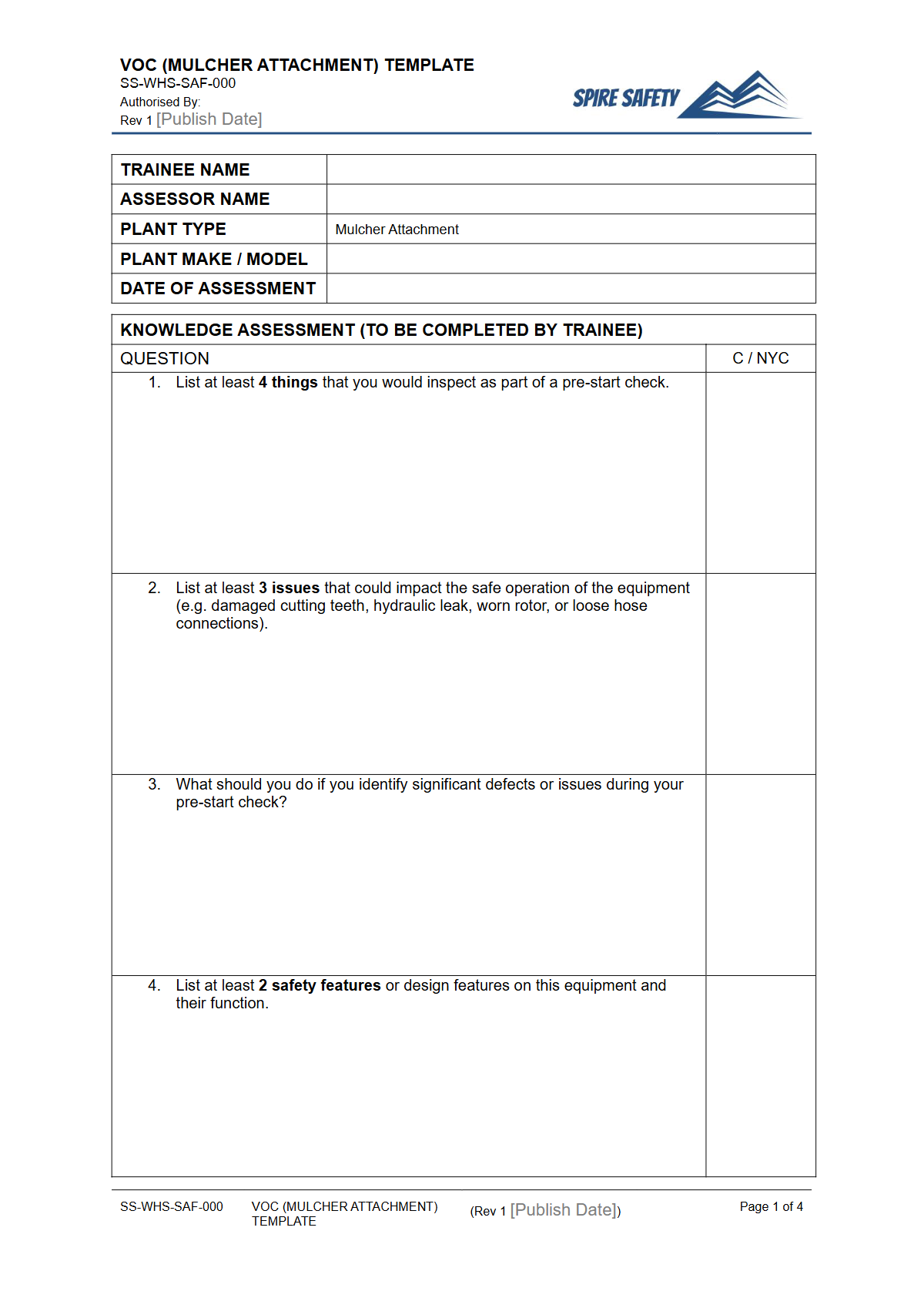
Assess operator skills for mulcher attachments with our free Verification of Competency (Mulcher Attachment) Template.
Free Verification of Competency (Mulcher Attachment) Template
DOCX • 140 KB + PDF
Updated Oct 2026
No signup required
Purpose of the Free Verification of Competency (Mulcher Attachment) Template
Ensuring workers can safely operate powerful machinery is a cornerstone of workplace safety. This free Verification of Competency (Mulcher Attachment) Template provides a structured framework for assessing an operator's skills, knowledge, and ability to handle mulcher attachments safely and effectively.
Using this template helps formalise the assessment process, providing tangible evidence that a worker has demonstrated the required level of competence for the task.
The primary purpose of this Verification of Competency template is to create a formal record of an individual's demonstrated ability to operate a mulcher attachment. It helps organisations meet their duty of care by identifying any gaps in knowledge or skill before an incident occurs.
This process is a critical component of robust WHS management systems, ensuring that only trained and competent personnel operate high-risk plant.
Video walkthrough
How to use the Free Verification of Competency (Mulcher Attachment) Template
This downloadable template offers a comprehensive starting point for conducting a VOC assessment. The process typically involves a combination of theoretical questions and practical observation.
First, download the template in your preferred format (DOCX or PDF). The DOCX version is fully editable, allowing for complete customisation.
Next, adapt the template to your specific needs. It is crucial to modify the criteria to reflect the exact make and model of the mulcher attachment in use, your unique site conditions, and your organisation's safe work procedures.
We have provided a comprehensive baseline, but you must add, remove, or modify criteria to suit your operational context.
Once customised, a competent person—someone with the requisite knowledge, skills, and experience with mulcher attachments—should conduct the assessment. This involves observing the operator performing tasks, from pre-start checks to operation and shutdown.
The assessor documents their findings on the form, signs off on the outcome, and identifies any necessary corrective actions, such as further training.
When to use it
A Verification of Competency for a mulcher attachment is not a one-time event. It should be used in various situations to confirm an operator's ongoing competence. Key times to conduct a VOC include:
- New Employees: As part of the induction process, even if they hold an existing licence or ticket.
- New Equipment: When an operator is required to use a new or different type of mulcher attachment.
- Post-Incident: Following any incident or near miss involving the equipment to identify and correct unsafe behaviours or knowledge gaps.
- Refresher Training: As part of a scheduled refresher training program, often annually or biennially.
- Observed Deficiencies: If a supervisor or manager observes an operator performing a task unsafely or incorrectly.
The principles of verifying competency apply across various types of high-risk plant. An operator might be competent on one machine but require a new assessment before using another, similar to how one might need a separate Verification of Competency (Trencher) for different equipment.
Who should use it
This resource is designed for any person or organisation responsible for ensuring the safe operation of plant and machinery in an Australian workplace. This includes:
- Safety Managers and WHS Advisors: To standardise the assessment process and maintain safety records.
- Supervisors and Team Leaders: To conduct on-the-ground assessments of their team members.
- PCBU (Person Conducting a Business or Undertaking): To fulfil their primary duty of care under WHS legislation.
- Training Coordinators: To identify training needs and verify the effectiveness of training programs.
For complex operations or organisations lacking in-house expertise with specific high-risk plant, engaging external WHS consulting services can provide an independent and thorough assessment. This ensures the VOC process is robust and defensible. You can explore our complete free WHS resources library for more templates to support your safety management activities.
Common mistakes
Common mistakes to avoid
- Using the template as a generic 'tick-and-flick' exercise without genuine observation.
- Failing to customise the assessment criteria for the specific mulcher attachment model and site conditions.
- Allowing an assessor who lacks deep experience with the specific equipment to conduct the VOC.
- Neglecting to document and file the completed VOC record as evidence of due diligence.
Legal references
Legal considerations
The following legal requirements may be relevant to this type of work.
- Work Health and Safety Act (Harmonised) — Provides the primary duties for protecting workers and other people from work health and safety risks.
- Work Health and Safety Regulations (Harmonised) — Sets out requirements supporting the management of workplace hazards and risks.
The following codes may be relevant to this type of work.
- Managing WHS Risks Code of Practice — Provides practical guidance on identifying hazards, assessing risks and applying effective controls.
- Work Health and Safety Consultation, Cooperation and Coordination Code of Practice — Provides practical guidance on consulting workers and coordinating with other duty holders.
- Managing the Work Environment and Facilities Code of Practice — Provides practical guidance on safe work environments, workplace facilities and related controls.
Did you know
Projectile Risk
Mulcher attachments can eject rocks, wood fragments, and other debris at extremely high speeds, creating a significant risk zone. A comprehensive pre-start inspection must include checking the integrity of all guarding and deflectors.
Duty of Care
Under Australia's model WHS Act, a PCBU has a primary duty of care to ensure the provision of any information, training, instruction, or supervision necessary to protect all persons from risks to their health and safety.
FAQ
Frequently asked questions
01What is the difference between a VOC and a licence for a mulcher attachment?
02Who is a 'competent person' to conduct a mulcher attachment VOC?
03How often should a VOC for a mulcher attachment be conducted?
04Does this VOC template cover all types of mulcher attachments?
Share this resource
Free Verification of Competency (Mulcher Attachment) Template
Browse Categories
How To Use It
- 1Download and open in Word or PDF.
- 2Replace the placeholders with your business details.
- 3Get it reviewed by a WHS specialist before rollout.
Need it customised?
Our WHS consultants can adapt this template to your site, run a gap analysis, or audit what you already have in place.
Book a Free Consultation WHS consulting servicesor call 1300 156 382
Related templates
- Free Verification of Competency (Order Picker) Template
- Free Verification of Competency (Parts Washer) Template
- Free Verification of Competency (Pedestal Grinder) Template
- Free Verification of Competency (Pick and Carry Crane) Template
- Free Verification of Competency (Pipe Bender) Template
- Free Verification of Competency (Plasma Cutter) Template