
ISO Certification for Small Business
Guide to ISO certification for small business covering costs, audit process, timeframes and how to get ISO 45001, 9001 and 14001 certified.
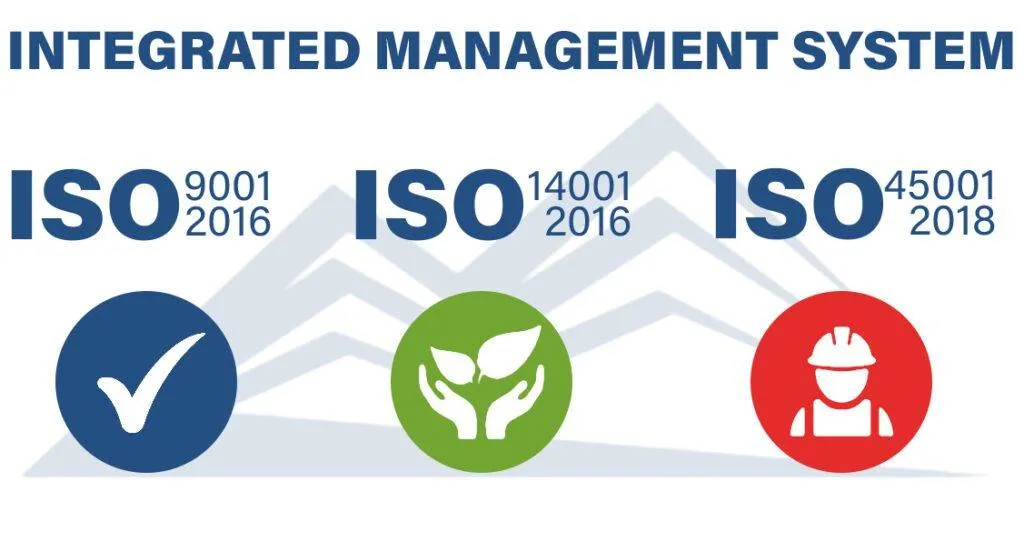
An infographic showing the core components of an integrated management system for ISO certification
Information to get ISO Certification for small business.
Video walkthrough
Benefits of ISO Certification for Small Businesses
Achieving ISO certification offers several key benefits for small businesses, extending beyond the ability to tender for larger contracts. Firstly, it provides a robust framework for improving operational efficiency. By standardising processes and procedures, businesses can reduce waste, minimise errors, and enhance productivity, leading to cost savings and improved profitability.
Spire Safety's ISO certification consultants work with small businesses across Australia, starting with a gap analysis.
Secondly, ISO certification significantly boosts credibility and reputation. It demonstrates a commitment to quality, safety, and environmental responsibility, which can be a strong differentiator in competitive markets. This can attract new clients, build trust with existing ones, and even improve relationships with suppliers.
Finally, the process of implementing an ISO management system fosters a culture of continuous improvement. Regular reviews and audits encourage ongoing evaluation and enhancement of business practices, ensuring the company remains agile and responsive to changing market conditions and regulatory requirements.
Key Takeaways:
Small businesses can get ISO certified with a small and easy to implement management system
The costs are generally $15,000+ (depending on business size and industry)
Your business will need to undergo a third-party audit
Contact us for a free consult
What is ISO certification?
ISO Certification (or accreditation) is a certification granted to organisations that can demonstrate they have management systems in place that align with the ISO standards. The most common of these are:
AS/NZS ISO 45001 OHS Management Systems
AS/NZS ISO 9001 Quality Management Systems
AS/NZS ISO 14001 Environmental Management Systems
A company can achieve certification in any or all of the above standards.
We have a detailed article on ISO certification here.
It's important to remember that "ISO Certification" is a slang term, and generally speaking the certification is issued by JASANZ. You can read about JASANZ here.
How do I get my small business certified?
The answer is: Contact us. We can organise the entire process, from the system build (or gap analysis), implementation and audit preparation all the way through to certification audit.
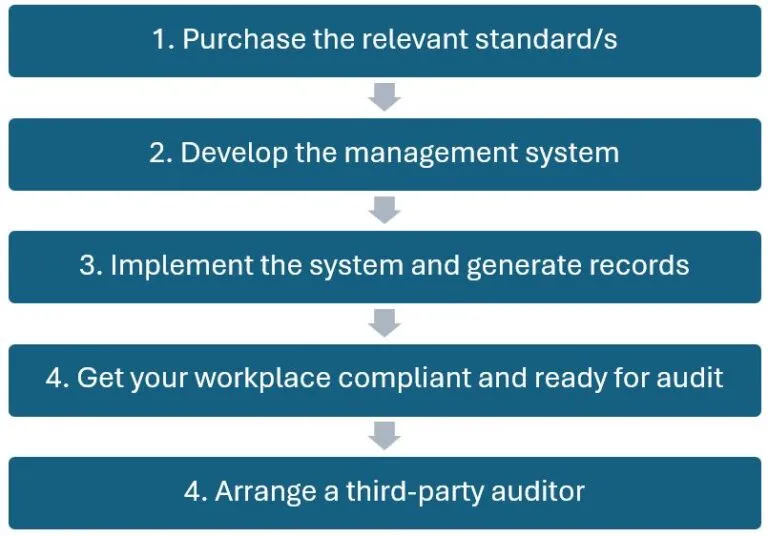
A visual guide illustrating steps for ISO certification specifically for small businesses
Even if you wish to manage the process on your own, we are happy to provide advice to help you get the ball rolling. If you did wish to do it yourself, the following are some good steps to start:
Purchase the relevant standard/s from Standards Australia:
Develop a management system that complies with the standard, including:
Policies
Procedures
Registers
Forms and Tools
Implement the system and generate records
Get your workplace legally compliant and ready for audit
Arrange a third-party auditor – we recommend Certify Hub.
What is a management system?
A management system is a set of documents which outline how something is managed within an organisation. Typically, these include:
Policies
Procedures
Plans
Forms, Tools and Registers
We have a detailed article on What is a WHS Management System.
We also supply Integrated Management Systems which comply with safety (45001), quality (9001) and environmental (14001) standards.
Can small businesses achieve ISO certification?
Absolutely! The good thing about the ISO standards is that the management system must be built taking into consideration the "organisational context". That is, smaller organisations can make use of smaller, easier to implement and more streamlined management systems.
We specialise in getting small and medium-sized businesses ISO certified!
How much does it cost?
The cost depends on a number of factors, including:
Which standards you want to be certified to (e.g. just 45001? Or 45001, 9001 and 14001?)
Size of the company, including:
Number of staff
Number of contractors
Number of operational sites
The industry (higher risk industries generally cost more to certify)
If you are a small business seeking 45001 certification only, a reasonable estimate is approx. $15,000. That cost includes:
Engaging a consultant to build the management system and help get you ready for audit, and
The audit and certification cost
What is the audit process?
To obtain ISO certification for small business, the audit process usually consists of 2 stages:
Stage 1 (Desktop / Offsite Audit) – This stage involves the auditor reviewing the documented system and ensuring that all requirements of the standard are met.
Stage 2 (Onsite Audit) – This stage will require the auditor to visit your site and ensure that the management system is implemented.
There are also ongoing audits required to maintain your certification. These are typically yearly surveillance audits and 3-yearly re-certification audits.
How long does ISO certification take?
The fastest we have ever completed an ISO certification (from system build, implementation and audit) is around 6-weeks. However, for most companies, 2 – 3 months minimum is a good timeframe.
Did You Know
One of the earliest recorded safety regulations dates back to the Code of Hammurabi in ancient Babylon (circa 1754 BC), which included laws to execute builders if their constructed houses collapsed and caused fatalities.
Fast forward to the Industrial Revolution in the 18th century, safety management began focusing on technological advancements to prevent accidents caused by machinery failures.
However, it wasn't until the late 20th century, after incidents like the Three Mile Island nuclear meltdown and the Challenger space shuttle disaster, that the human factor in safety management was recognised as crucial.
Need a hand?
Getting certified or staying certified is easier with support. Spire Safety provides ISO consulting for Australian businesses. Get in touch to talk it through.
FAQ
Frequently asked questions
01What are the benefits of getting ISO certified?
02Which ISO standards are most relevant for small businesses?
03What are the steps to achieve ISO certification for small business?
04How often does ISO certification need to be renewed?
05What is an ISO management system?
06What is the typical timeframe to achieve ISO certification?
Share this resource
Key Points
- •Small Business Friendly
- •From $15,000
- •6 Weeks Minimum
- •100% Success Rate
Need Help?
Our WHS consultants can help you implement this in your business. Book a free consultation today.
Book a Consultationor call 1300 156 382