
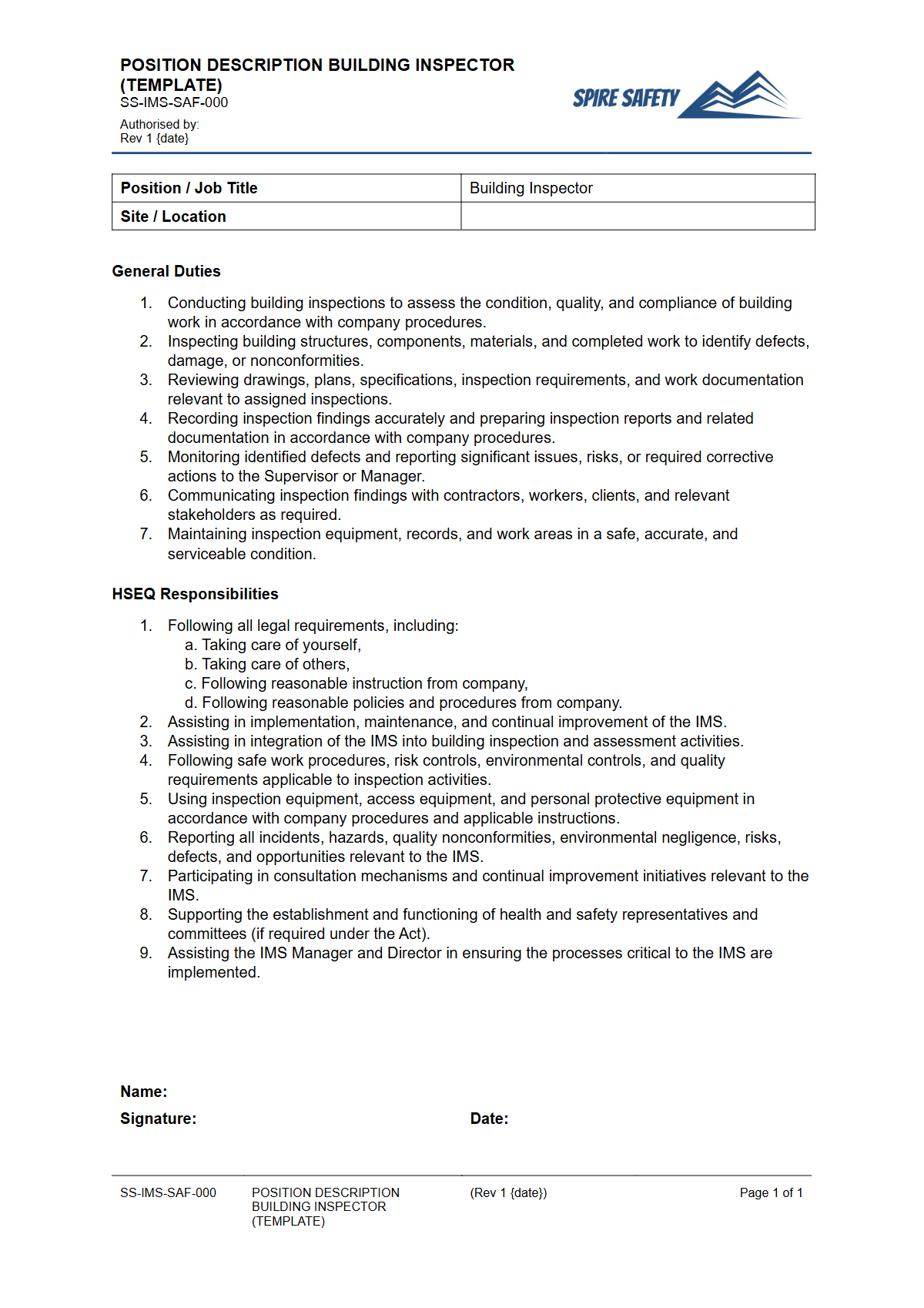
Free Position Description (Building Inspector) Template
Download our free Position Description (Building Inspector) template. This DOCX & PDF resource helps define roles, responsibilities, and WHS duties.
Free Position Description (Building Inspector) Template
DOCX • 139 KB + PDF
Updated Oct 2026
No signup required
Purpose of the Free Position Description (Building Inspector) Template
Clearly defining the role of a Building Inspector is fundamental to managing performance, ensuring compliance, and promoting a safe work environment. This Free Position Description (Building Inspector) Template provides a structured starting point for Australian businesses in the construction and property sectors.
It helps articulate the key duties, qualifications, and safety obligations essential for this critical role, ensuring clarity for both the employer and the employee from day one.
A comprehensive position description does more than just outline tasks; it integrates the role into your organisation's operational framework. For a Building Inspector, this means clearly defining their authority to assess compliance with the National Construction Code (NCC), identify building defects, and report on construction quality.
It also establishes their specific WHS responsibilities, forming a crucial component of your overall WHS management systems and helping to meet due diligence obligations.
How to use the Free Position Description (Building Inspector) Template
This template is provided in both DOCX and PDF formats for your convenience. The DOCX version is fully editable, allowing you to tailor the content to your specific business needs, project types, and state-based regulatory requirements.
A well-defined PD can also support pathways to certification, such as that required by organisations pursuing ISO 45001 consulting to demonstrate systematic management of OHS risks.
It is essential that you customise this document to reflect your unique operational context and legal obligations. We are not your legal or WHS advisors, and this template is a guide only.
Ensure you incorporate your company's specific policies, procedures, and the relevant codes of practice for your jurisdiction.
When to use it
A position description for a Building Inspector should be used at multiple points in the employment lifecycle. It is essential during recruitment to attract suitable candidates and provides a clear basis for interview questions.
It should be provided to the new employee during induction and used as a reference point for setting performance expectations and conducting regular reviews. The document is also invaluable during formal evaluations or when preparing for a WHS compliance auditing process, as it demonstrates how safety responsibilities are assigned throughout the organisation.
Who should use it
This resource is designed for managers and business owners within the Australian building and construction industry. This includes Construction Managers, Project Managers, HR Professionals, and Directors of building companies.
It provides the framework needed to ensure that all parties—from management to the inspector themselves—have a shared understanding of the role’s scope and its importance in delivering safe and compliant building projects.
Defining Core Competencies
Beyond technical skills, an effective Building Inspector requires specific behavioural competencies. These include exceptional attention to detail, objective judgement, and clear written and verbal communication skills for preparing reports and liaising with builders, clients, and certifiers.
The template includes sections to detail these soft skills, which are often as critical as technical knowledge for success in the role.
Integrating WHS Duties
The role of a Building Inspector has inherent WHS responsibilities, from identifying on-site hazards during inspections to managing their own personal safety. The PD must explicitly state these duties, such as conducting risk assessments before entering a site, using appropriate PPE, and reporting any observed safety breaches.
It also contributes to a positive safety culture, which extends to psychological safety and mental health first aid in the workplace, ensuring inspectors are supported in a high-pressure role.
Customisation for Your State
While building principles and the NCC are national, licensing and registration requirements for Building Inspectors can vary significantly between states and territories. When customising this template, ensure you reference the specific requirements of your local building authority (e.g., VBA in Victoria, QBCC in Queensland, NSW Fair Trading) regarding qualifications, experience, and classes of registration.
For businesses needing guidance on navigating these complex requirements, our WHS consulting services can provide tailored advice.
Using a structured template ensures all critical aspects of the Building Inspector role are considered. It creates clarity, supports compliance efforts, and sets a foundation for high performance. For more tools to support your safety management systems, explore our complete free WHS resources library.
Common mistakes
Common mistakes to avoid
- Using a generic job title without detailing the specific class of buildings (e.g., residential, commercial) the inspector will be working on.
- Failing to list essential WHS duties, such as conducting pre-inspection risk assessments or using required Personal Protective Equipment (PPE).
- Not reviewing and updating the position description regularly to reflect changes in legislation, company procedures, or the role itself.
- Omitting key behavioural competencies like conflict resolution, ethical conduct, and professional communication skills.
Legal references
Legal considerations
The following legal requirements may be relevant to this type of work.
- Work Health and Safety Act (Harmonised) — Provides the primary duties for protecting workers and other people from work health and safety risks.
- Work Health and Safety Regulations (Harmonised) — Sets out requirements supporting the management of workplace hazards and risks.
The following codes may be relevant to this type of work.
- Managing WHS Risks Code of Practice — Provides practical guidance on identifying hazards, assessing risks and applying effective controls.
- Work Health and Safety Consultation, Cooperation and Coordination Code of Practice — Provides practical guidance on consulting workers and coordinating with other duty holders.
- Managing the Work Environment and Facilities Code of Practice — Provides practical guidance on safe work environments, workplace facilities and related controls.
Did you know
The National Standard
The National Construction Code (NCC) is the primary technical document for building and plumbing standards in Australia, ensuring buildings are safe, accessible, and sustainable. Building Inspectors use it as their core reference.
Defect Dilemma
Studies have shown that a significant percentage of new apartment buildings in Australia have at least one type of defect, highlighting the critical importance of thorough and independent building inspections.
FAQ
Frequently asked questions
01What qualifications should a Building Inspector have in Australia?
02Does this template cover WHS responsibilities?
03Can I use this position description for performance reviews?
04Is a position description a legally binding document?
Share this resource
Free Position Description (Building Inspector) Template
Browse Categories
How To Use It
- 1Download and open in Word or PDF.
- 2Replace the placeholders with your business details.
- 3Get it reviewed by a WHS specialist before rollout.
Need it customised?
Our WHS consultants can adapt this template to your site, run a gap analysis, or audit what you already have in place.
Book a Free Consultation WHS consulting servicesor call 1300 156 382