
Free Position Description (Plasterer) Template
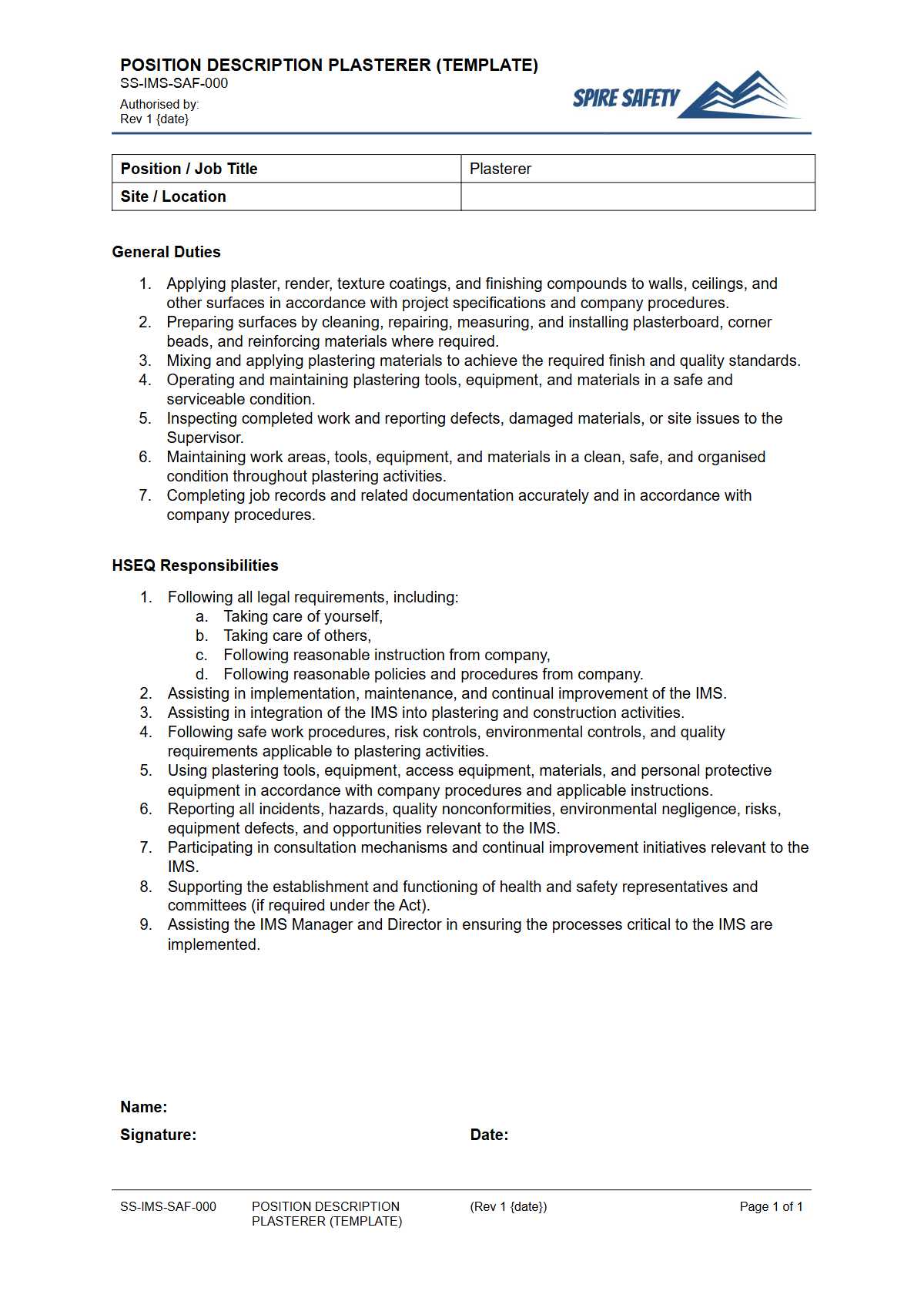
Clearly define roles, responsibilities, and WHS duties for plasterers with our structured template. Aligned with Australian safety standards.
Free Position Description (Plasterer) Template
DOCX • 135 KB + PDF
Updated Oct 2026
No signup required
Purpose of the Free Position Description (Plasterer) Template
A well-drafted position description is a foundational tool for any construction or trade-based business. It sets clear expectations for performance, safety, and conduct from day one.
Our Free Position Description (Plasterer) Template provides a structured starting point for defining the specific roles, responsibilities, and qualifications required for a plasterer in your organisation. Using this template helps ensure that key duties, including critical work health and safety (WHS) obligations, are clearly documented and communicated to workers, reducing ambiguity and promoting a safer work environment.
This document is more than just a hiring tool; it's a vital component of your overall safety framework. It helps to formally outline the physical demands of the job, the qualifications needed to perform tasks safely, and the specific safety protocols a worker must follow.
Integrating this PD into your operational processes supports the development of robust WHS management systems by clearly assigning safety responsibilities at the individual worker level.
Key Areas Covered in the Template
- Core duties and responsibilities (e.g., surface preparation, applying plaster, finishing).
- Essential qualifications and licences (e.g., White Card, Certificate III in Plastering).
- Key WHS obligations and safe work practices.
- Performance metrics and standards.
- Physical requirements and environmental conditions.
How to use the Free Position Description (Plasterer) Template
Our template is provided in both DOCX and PDF formats for your convenience. The DOCX version is fully editable, allowing you to tailor it precisely to your business needs.
To effectively use this resource, download the document and systematically work through each section, adding or removing details to align with the specific context of your worksite and organisational structure.
Note: This template is a guide, not a finished document. We strongly advise that you customise it to reflect the unique hazards, equipment, materials (e.g., specific plaster compounds, potential for silica exposure), and reporting lines of your workplace.
Consultation is key; involve your experienced plasterers and supervisors in the drafting process to ensure the position description is practical, accurate, and comprehensive. For expert assistance in adapting this or other documents to your specific operational needs, consider engaging professional WHS consulting services.
When to use it
A detailed position description for a plasterer should be used throughout the employment lifecycle. Its initial and most obvious use is during recruitment and hiring to attract suitable candidates and provide them with a clear understanding of the role.
Following this, it becomes an essential onboarding document, helping to induct new employees into their roles and responsibilities. It also serves as a benchmark for performance reviews, training needs analysis, and career development discussions.
In the unfortunate event of a workplace incident or a dispute, a clear PD can provide objective evidence of the expected duties and safety standards for the role.
Who should use it
This template is designed for anyone responsible for managing staff and ensuring safety in the construction and building trades. This includes:
- Business Owners and Directors: To establish clear and consistent roles within their company.
- HR Managers: For use in recruitment, onboarding, and performance management processes.
- Construction Managers and Site Supervisors: To manage daily work activities and enforce safety standards on site.
- WHS Advisors and Officers: To integrate role-specific safety duties into the broader WHS system and to support processes like WHS compliance auditing by providing a clear baseline of expected worker behaviour.
By defining the plasterer's role with precision, you create a foundation for accountability, safety, and quality workmanship. This not only protects your workers but also strengthens your business's operational integrity.
Explore our complete free WHS resources library for more templates and tools to support your safety management efforts.
Common mistakes
Common mistakes to avoid
- Using a generic template without customising it to the specific tasks, tools, and materials used on your site.
- Failing to clearly document critical WHS responsibilities, including hazard reporting and use of personal protective equipment (PPE).
- Forgetting to consult with experienced workers and supervisors when drafting the position description, leading to inaccuracies.
- Treating the document as 'set and forget' and not reviewing or updating it regularly as roles, tasks, or equipment change.
Legal references
Legal considerations
The following legal requirements may be relevant to this type of work.
- Work Health and Safety Act (Harmonised) — Provides the primary duties for protecting workers and other people from work health and safety risks.
- Work Health and Safety Regulations (Harmonised) — Sets out requirements supporting the management of workplace hazards and risks.
The following codes may be relevant to this type of work.
- Managing WHS Risks Code of Practice — Provides practical guidance on identifying hazards, assessing risks and applying effective controls.
- Work Health and Safety Consultation, Cooperation and Coordination Code of Practice — Provides practical guidance on consulting workers and coordinating with other duty holders.
- Managing the Work Environment and Facilities Code of Practice — Provides practical guidance on safe work environments, workplace facilities and related controls.
Did you know
Silica Dust Risk
Many plastering compounds, fillers, and fibre cement sheets contain crystalline silica. Inhaling silica dust generated from cutting, grinding, or sanding these materials can lead to serious lung diseases like silicosis, making dust control a critical WHS focus for plasterers.
Manual Handling Injuries
According to Safe Work Australia, injuries resulting from muscular stress while lifting or handling objects are a leading cause of serious workers' compensation claims in the construction industry, a significant risk in the plastering trade.
FAQ
Frequently asked questions
01What are the key WHS responsibilities for a plasterer?
02Does a plasterer need specific licences or qualifications in Australia?
03Why is it important to detail physical requirements in a plasterer's position description?
04How does a position description help with incident investigations?
Share this resource
Free Position Description (Plasterer) Template
Browse Categories
How To Use It
- 1Download and open in Word or PDF.
- 2Replace the placeholders with your business details.
- 3Get it reviewed by a WHS specialist before rollout.
Need it customised?
Our WHS consultants can adapt this template to your site, run a gap analysis, or audit what you already have in place.
Book a Free Consultation WHS consulting servicesor call 1300 156 382
Related templates
- Free Position Description (Plumber) Template
- Free Position Description (Procurement Officer) Template
- Free Position Description (Project Engineer) Template
- Free Position Description (Project Manager) Template
- Free Position Description (Quality Assurance Officer) Template
- Free Position Description (Quality Manager) Template