
Free Position Description (Plumber) Template
Define roles and safety duties with our free Position Description (Plumber) template. Aligned with Australian WHS standards for construction and trades.
Free Position Description (Plumber) Template
DOCX • 137 KB + PDF
Updated Oct 2026
No signup required
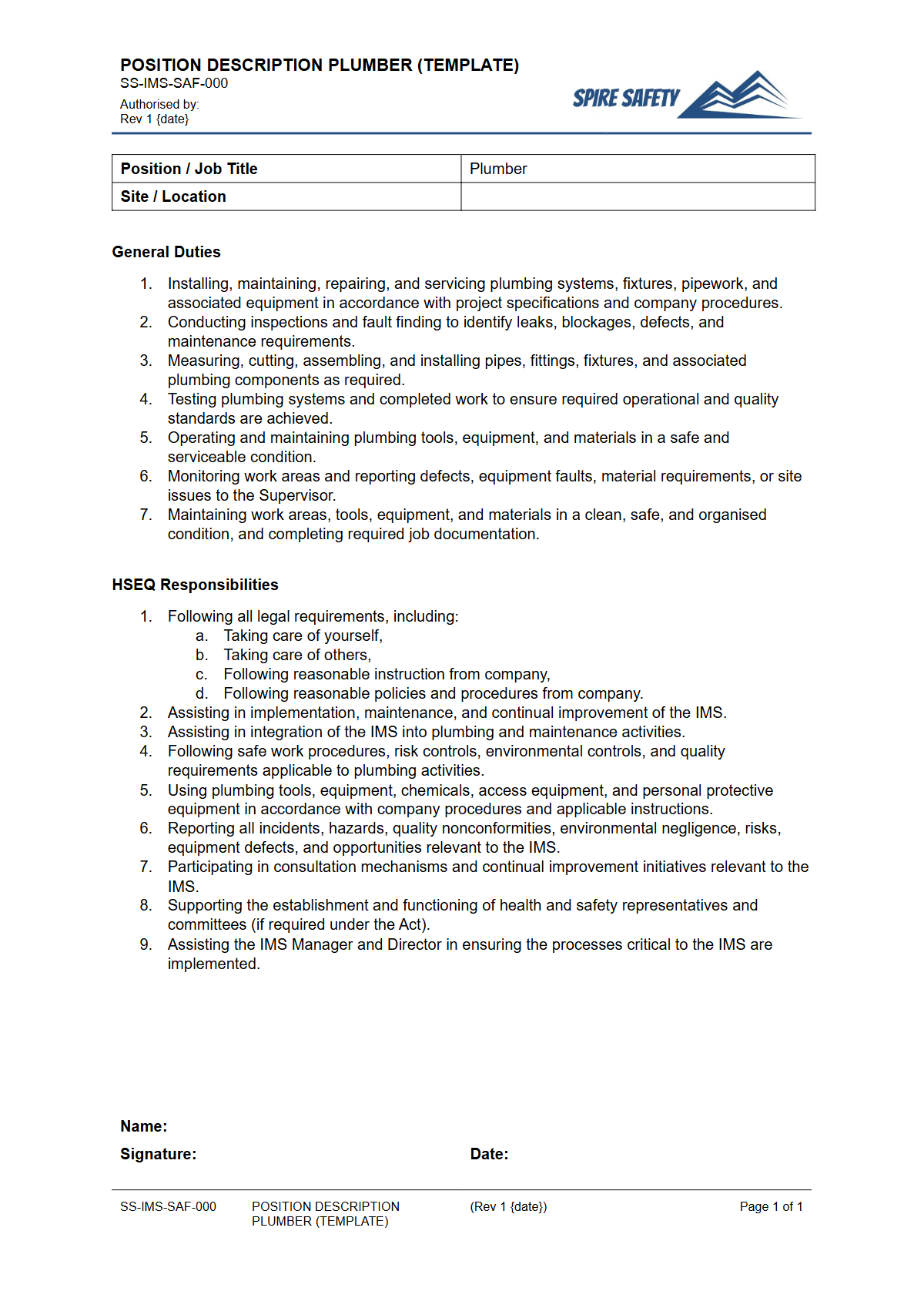
Purpose of the Free Position Description (Plumber) Template
A well-drafted Position Description is a cornerstone of effective workforce management and a critical component of your safety framework. This free Position Description (Plumber) template provides a clear, structured starting point for defining not just the technical duties of a plumber, but also their vital Work Health and Safety (WHS) responsibilities.
Using a detailed document helps set clear expectations from day one, supporting recruitment, onboarding, training management, and performance reviews. It formally outlines the skills, qualifications, and behaviours required for the role, ensuring alignment between the worker and the organisation’s operational and safety goals.
By clearly articulating safety-specific duties—such as conducting risk assessments, using personal protective equipment (PPE), and reporting hazards—the position description becomes a key piece of evidence in your safety management system. It demonstrates how you assign WHS responsibilities throughout your organisation, which is a fundamental requirement of workplace safety legislation.
Integrating this document helps build robust WHS management systems that embed safety into every role.
How to use the Free Position Description (Plumber) Template
This template is provided in both DOCX and PDF formats. Download the DOCX file to edit and adapt it to your specific business needs.
The PDF version is a useful reference for the original structure. The document is designed to be comprehensive but requires your input to become a functional tool for your workplace.
It includes sections for key responsibilities, qualifications and experience, behavioural competencies, and specific WHS duties.
You must customise this template to reflect the specific hazards, equipment, and procedures of your workplace. We've provided a structured framework based on common industry practice, but the final responsibility for its accuracy and suitability rests with you.
Key areas to tailor include the exact types of plumbing work (e.g., residential, commercial, industrial, gasfitting, drainage), specific tools and plant operated, site-specific hazards like confined spaces or asbestos, and your company's unique reporting structure and policies.
Ensuring the role's defined duties align with both legal obligations and internal standards is essential. This can be verified through processes like WHS compliance auditing, which helps identify any gaps between documented roles and on-the-ground practice.
When to use a Position Description
A Position Description for a plumber should be a living document, used and updated throughout the employment lifecycle. Its primary use is during the recruitment and selection process to create an accurate job advertisement and to brief candidates.
It then becomes a vital tool for onboarding new employees, ensuring they understand their role and responsibilities from the outset.
Beyond initial hiring, it serves as a benchmark for performance appraisals, providing a clear basis for discussing achievements and areas for development. The document should also be reviewed and updated whenever there is a significant change in the role, such as the introduction of new technology, new responsibilities, or a change in the work environment.
Following a workplace incident, reviewing the relevant Position Descriptions can help clarify if responsibilities were adequately defined and understood, and may require expert input from WHS consulting professionals to strengthen your processes.
Who should use this template
This resource is designed for anyone responsible for hiring or managing tradespeople in Australia. This includes small-to-medium business owners, HR managers, recruitment officers, and operations or site supervisors within the construction, maintenance, and facility management industries.
It is particularly useful for organisations that may not have a dedicated HR department and need a reliable starting point for formalising their employment documentation.
Whether you are hiring your first plumber or standardising documentation for a large team, this template provides a solid foundation. It is one of many documents available to help you build a safer, more organised workplace. For other checklists, forms, and templates, feel free to browse our complete free WHS resources library.
Common mistakes
Common mistakes to avoid
- Using a generic template without customising it for the specific tasks, tools, and risks of the job.
- Forgetting to explicitly list key WHS responsibilities, such as risk assessment and hazard reporting.
- Failing to review and update the position description when the role's duties or the work environment changes.
- Writing a simple task list instead of defining broader responsibilities, accountabilities, and performance expectations.
Legal references
Legal considerations
The following legal requirements may be relevant to this type of work.
- Work Health and Safety Act (Harmonised) — Provides the primary duties for protecting workers and other people from work health and safety risks.
- Work Health and Safety Regulations (Harmonised) — Sets out requirements supporting the management of workplace hazards and risks.
The following codes may be relevant to this type of work.
- Managing WHS Risks Code of Practice — Provides practical guidance on identifying hazards, assessing risks and applying effective controls.
- Work Health and Safety Consultation, Cooperation and Coordination Code of Practice — Provides practical guidance on consulting workers and coordinating with other duty holders.
- Managing the Work Environment and Facilities Code of Practice — Provides practical guidance on safe work environments, workplace facilities and related controls.
Did you know
State-Based Licensing
Plumbing is a licensed trade in all Australian states and territories, but the specific classes and requirements vary. A position description must specify the exact license and any endorsements (like gasfitting or drainage) required for the role in your state.
Musculoskeletal Risks
Trades occupations, including plumbing, have some of the highest rates of musculoskeletal injuries. A good position description should outline the physical demands of the job, helping to manage risks and inform pre-employment functional assessments.
FAQ
Frequently asked questions
01What should be included in a plumber's position description?
02How does a position description improve workplace safety?
03Is this template suitable for an apprentice plumber?
04Why is it so important to customise this template?
Share this resource
Free Position Description (Plumber) Template
Browse Categories
How To Use It
- 1Download and open in Word or PDF.
- 2Replace the placeholders with your business details.
- 3Get it reviewed by a WHS specialist before rollout.
Need it customised?
Our WHS consultants can adapt this template to your site, run a gap analysis, or audit what you already have in place.
Book a Free Consultation WHS consulting servicesor call 1300 156 382
Related templates
- Free Position Description (Procurement Officer) Template
- Free Position Description (Project Engineer) Template
- Free Position Description (Project Manager) Template
- Free Position Description (Quality Assurance Officer) Template
- Free Position Description (Quality Manager) Template
- Free Position Description (Quantity Surveyor) Template