
Free Position Description (Quality Assurance Officer) Template
Download our free, customisable Position Description template for a Quality Assurance Officer. Clearly define roles, responsibilities, and safety duties.
Free Position Description (Quality Assurance Officer) Template
DOCX • 138 KB + PDF
Updated Oct 2026
No signup required
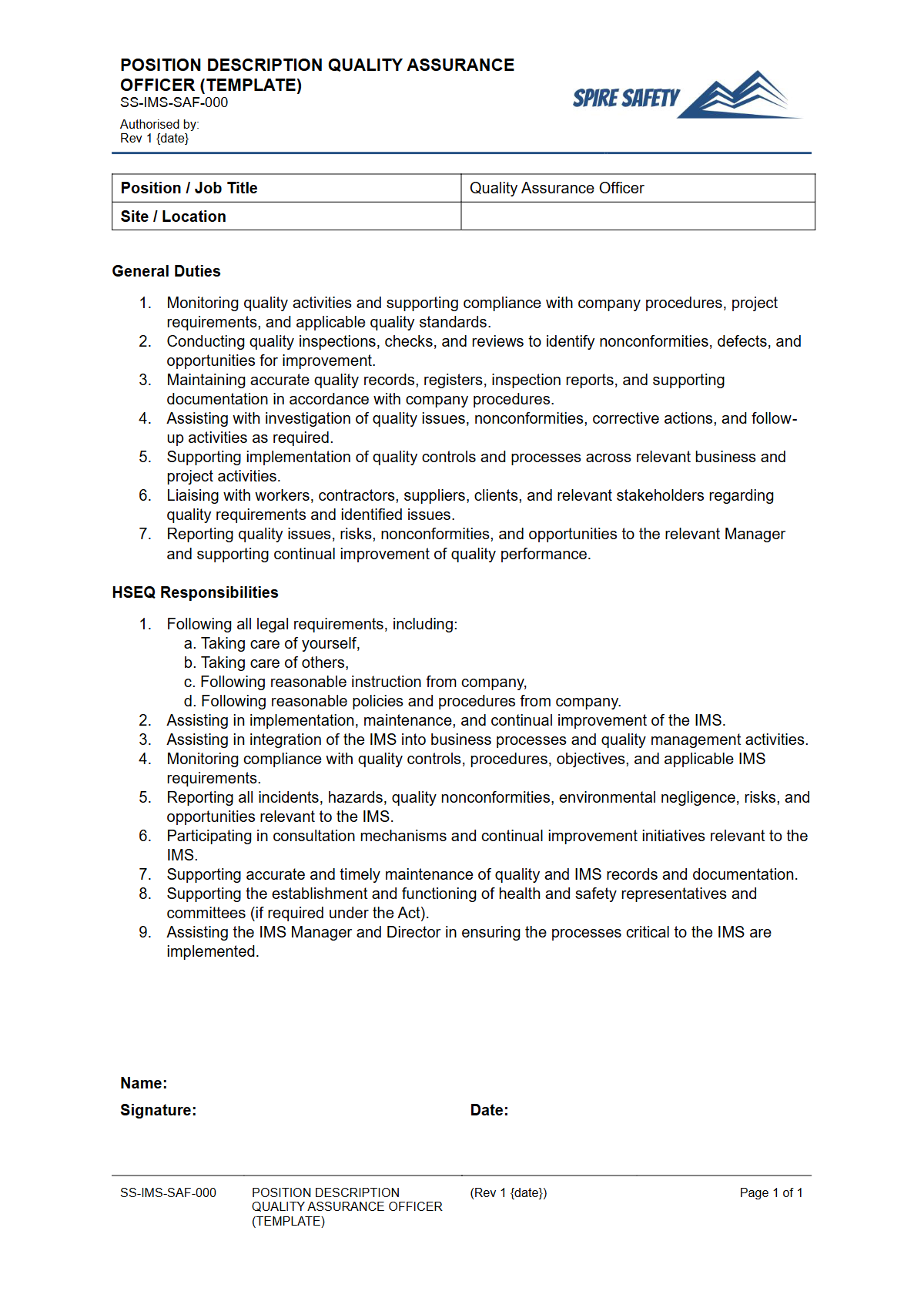
Purpose of the Free Position Description (Quality Assurance Officer) Template
A Quality Assurance (QA) Officer plays a pivotal role in maintaining product or service quality, which is intrinsically linked to workplace health and safety. This Free Position Description (Quality Assurance Officer) Template provides a structured starting point for organisations to define the scope, responsibilities, and qualifications for this critical role.
A well-drafted position description clarifies expectations, supports effective recruitment, and establishes a clear framework for performance management. It ensures that the QA Officer's duties are aligned not only with quality objectives but also with the organisation's safety protocols and legal WHS obligations.
Using this template helps integrate safety responsibilities directly into the quality function, reinforcing the idea that a safe process is a quality process. It forms a foundational document within broader WHS management systems, ensuring that accountability for identifying and controlling quality-related hazards is clearly assigned.
This clarity is essential for building a proactive safety and quality culture where every team member understands their contribution.
How to use the Free Position Description (Quality Assurance Officer) Template
This template is designed for ease of use. Simply download the document in your preferred format (DOCX for easy editing or PDF for straightforward printing) and begin tailoring it to your business.
The document is structured with key sections including position summary, key responsibilities, WHS duties, qualifications, and experience. Fill in the bracketed sections with information specific to your operational context, such as reporting lines, specific software systems used, and key performance indicators (KPIs).
Important: This is a template, not a finished document. It is essential that you customise it to reflect the specific requirements, risks, and organisational structure of your workplace.
We cannot guarantee its suitability for your specific circumstances. A thorough review of the role's actual functions and its interaction with workplace hazards is necessary before finalising the document.
When to use this Position Description
A detailed position description for a Quality Assurance Officer should be utilised in several key business processes. The most common use is during recruitment and hiring to attract suitable candidates and provide them with a clear understanding of the role's expectations from the outset.
It is also an invaluable tool during employee onboarding, helping to integrate the new QA Officer into the team and your quality frameworks.
Beyond recruitment, this document should be used for conducting regular performance reviews, setting goals, and identifying training needs. It can also be reviewed and updated during organisational restructuring or when implementing new quality standards, such as those required to achieve ISO 45001 certification. Having a current and accurate position description provides a stable reference point for both the employee and management, ensuring ongoing alignment.
Who should use this Position Description
This template is primarily intended for use by Hiring Managers, Human Resources (HR) professionals, and Department Heads responsible for quality control and assurance. They can adapt it to create a formal document that aligns with both operational needs and internal HR policies.
WHS Managers and Safety Officers will also find it useful for ensuring that crucial safety responsibilities are properly embedded within the role, rather than being treated as an afterthought.
For small to medium-sized enterprises (SMEs) without a dedicated HR or WHS department, business owners and senior managers can use this template to formalise roles and responsibilities within their team. Properly defining roles is a fundamental step in establishing clear lines of communication and accountability.
If you require assistance in defining complex roles or integrating safety duties effectively, seeking WHS consulting can provide expert guidance. You can also explore our extensive free WHS resources library for other useful templates and guides.
Common mistakes
Common mistakes to avoid
- Using the template without customising it to the specific workplace environment and risks.
- Neglecting to include specific, measurable WHS duties and responsibilities.
- Creating a simple list of tasks instead of defining the role's purpose, authority, and accountability.
- Failing to review and update the position description as the role or organisation evolves.
Legal references
Legal considerations
The following legal requirements may be relevant to this type of work.
- Work Health and Safety Act (Harmonised) — Provides the primary duties for protecting workers and other people from work health and safety risks.
- Work Health and Safety Regulations (Harmonised) — Sets out requirements supporting the management of workplace hazards and risks.
The following codes may be relevant to this type of work.
- Managing WHS Risks Code of Practice — Provides practical guidance on identifying hazards, assessing risks and applying effective controls.
- Work Health and Safety Consultation, Cooperation and Coordination Code of Practice — Provides practical guidance on consulting workers and coordinating with other duty holders.
- Managing the Work Environment and Facilities Code of Practice — Provides practical guidance on safe work environments, workplace facilities and related controls.
Did you know
Integrated Management Systems
Organisations often integrate their Quality Management System (ISO 9001) with their WHS Management System (ISO 45001). A QA Officer is a key figure in ensuring the smooth operation of such integrated systems, as quality and safety processes are often interconnected.
Clarity and Psychological Safety
A clear, well-defined position description does more than just outline tasks; it reduces role ambiguity and stress. This clarity is a recognised contributor to a psychologically healthy workplace.
FAQ
Frequently asked questions
01What is the role of a Quality Assurance Officer in WHS?
02Does this position description template cover all legal requirements?
03Can I use this template for a Quality Control (QC) Officer?
04How often should a position description be reviewed?
Share this resource
Free Position Description (Quality Assurance Officer) Template
Browse Categories
How To Use It
- 1Download and open in Word or PDF.
- 2Replace the placeholders with your business details.
- 3Get it reviewed by a WHS specialist before rollout.
Need it customised?
Our WHS consultants can adapt this template to your site, run a gap analysis, or audit what you already have in place.
Book a Free Consultation WHS consulting servicesor call 1300 156 382
Related templates
- Free Position Description (Quality Manager) Template
- Free Position Description (Quantity Surveyor) Template
- Free Position Description (Retail Store Manager) Template
- Free Position Description (Return to Work Coordinator) Template
- Free Position Description (Rigger or Dogman) Template
- Free Position Description (Roofer) Template