
Free Position Description (Rigger or Dogman) Template
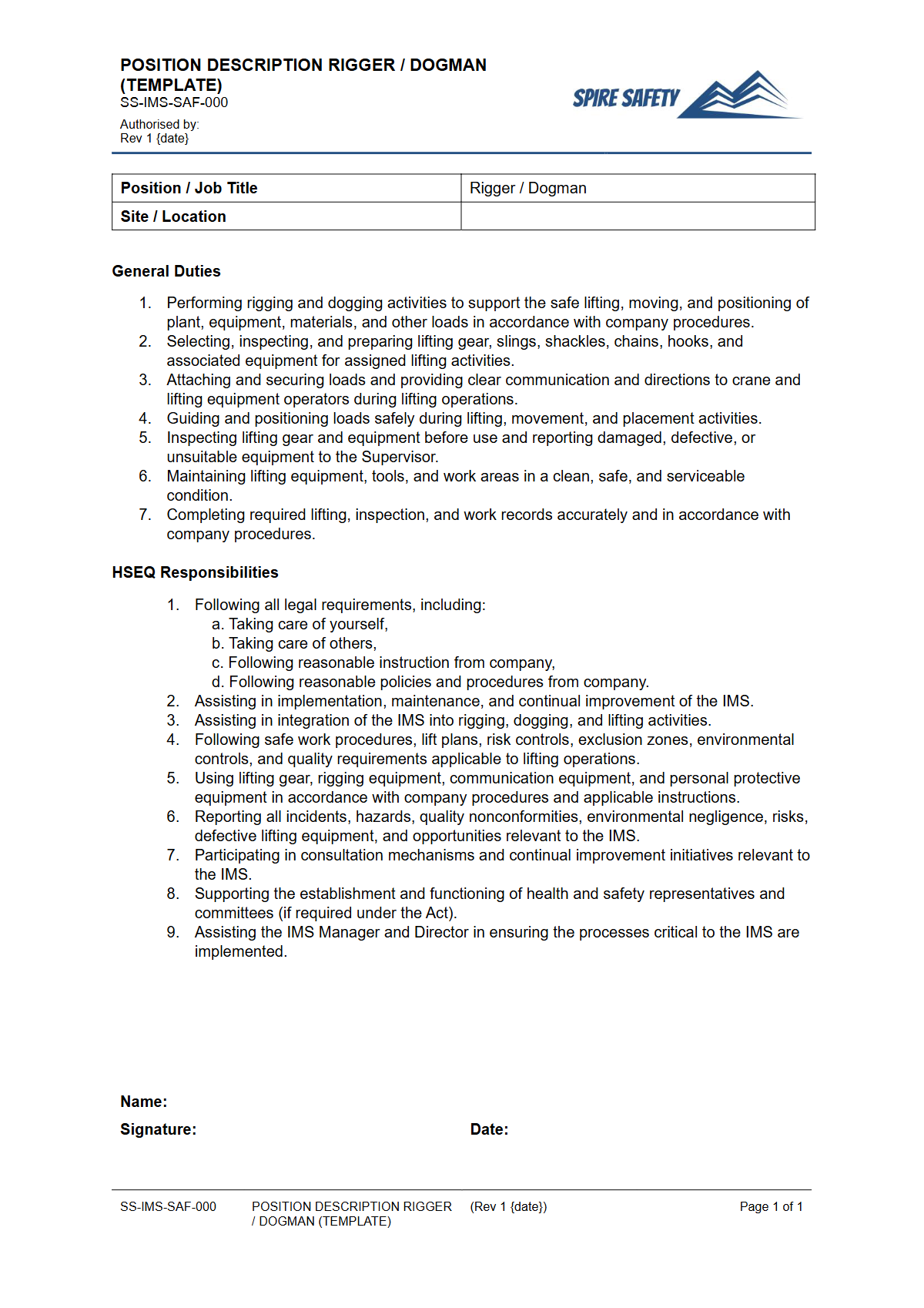
Clearly define roles, responsibilities, and safety duties for rigging and dogging personnel. Download our free Position Description (Rigger or Dogman) template.
Free Position Description (Rigger or Dogman) Template
DOCX • 135 KB + PDF
Updated Oct 2026
No signup required
Purpose of the Free Position Description (Rigger or Dogman) Template
In high-risk industries like construction, mining, and manufacturing, the roles of Rigger and Dogman are critical to operational safety. A well-drafted position description is essential for clearly defining responsibilities, qualifications, and safety accountabilities.
This Free Position Description (Rigger or Dogman) Template provides a structured starting point for organisations to articulate these crucial role requirements. Using a formal document helps ensure that candidates and employees understand the scope of their duties, the high-risk work licences they must hold, and their specific obligations under work health and safety legislation.
It formalises expectations and reduces ambiguity, which is vital when dealing with complex lifting operations.
A clear position description is a foundational element of a safe system of work. It integrates directly into your broader safety framework by ensuring that only competent and qualified individuals are assigned to safety-critical tasks.
This document helps support the development and maintenance of effective WHS management systems by creating a clear link between organisational safety policy and the responsibilities of individual workers. By outlining performance standards and WHS duties, it provides a benchmark for training, supervision, and performance management, contributing to a proactive safety culture.
How to use the Free Position Description (Rigger or Dogman) Template
This resource is available as a fully editable DOCX file and a print-ready PDF. To use it, simply download your preferred format and begin customising the content to suit your specific operational context.
It includes sections for primary purpose, key responsibilities, qualifications, experience, and behavioural competencies, all aligned with common Australian workplace practices.
IMPORTANT: This document is a template only. We have developed it to align with Australian WHS principles, but you must customise it to reflect the specific hazards, equipment (e.g., types of cranes, lifting gear), and procedures of your workplace.
Key areas for customisation include the specific High-Risk Work Licence classes required, site-specific safety rules, reporting lines, and details of the physical and environmental demands of the role. For complex operations, engaging professional advice can help ensure your documentation is robust and fit-for-purpose.
Our team of experts offers specialised WHS consulting to assist with tailoring documents to your unique needs.
When to use it
A formal Position Description for a Rigger or Dogman should be used throughout the employment lifecycle. Key moments to implement or review this document include:
- Recruitment and Selection: Use it as the foundation for job advertisements and interview questions to attract and identify suitable candidates.
- Onboarding and Induction: Provide it to new employees to clarify their role and responsibilities from day one.
- Performance Reviews: Refer to the position description to set performance goals and assess an employee’s contribution and adherence to safety standards.
- Organisational Change: Update the document when roles are restructured or new machinery and processes are introduced.
- Audits and Reviews: A comprehensive set of position descriptions is often a key piece of evidence reviewed during internal or external safety audits. Having them prepared is crucial when undergoing WHS compliance auditing activities.
Who should use it
This template is designed for use by individuals responsible for managing personnel and safety in industries that conduct lifting operations. This includes:
- Human Resources (HR) Managers
- Recruitment Consultants
- Hiring Managers and Department Heads
- Work Health and Safety (WHS) Managers and Advisors
- Construction Site Managers, Project Managers, and Supervisors
- Operations Managers in manufacturing, logistics, and resources sectors
By establishing clear roles and responsibilities, organisations demonstrate a commitment to safety that extends beyond basic compliance. This structured approach to role definition is a cornerstone of internationally recognised standards for occupational health and safety. Businesses seeking certification will find that well-defined position descriptions support the requirements of their management system, a process our experts can guide you through with ISO 45001 consulting.
This template is just one of many tools designed to help you build a safer workplace. You can explore our complete collection of checklists, forms, and policy templates in our free WHS resources library to find more documents that support your safety management system.
Common mistakes
Common mistakes to avoid
- Failing to specify the exact High-Risk Work Licence classes required (e.g., DG, RB, RI, RA).
- Using generic duties instead of detailing site-specific tasks and equipment.
- Neglecting to clearly outline the individual's WHS responsibilities and reporting duties.
- Forgetting to include the physical and psychological demands of the role, such as working at heights or in noisy environments.
Legal references
Legal considerations
The following legal requirements may be relevant to this type of work.
- Work Health and Safety Act (Harmonised) — Provides the primary duties for protecting workers and other people from work health and safety risks.
- Work Health and Safety Regulations (Harmonised) — Sets out requirements supporting the management of workplace hazards and risks.
The following codes may be relevant to this type of work.
- Managing WHS Risks Code of Practice — Provides practical guidance on identifying hazards, assessing risks and applying effective controls.
- Work Health and Safety Consultation, Cooperation and Coordination Code of Practice — Provides practical guidance on consulting workers and coordinating with other duty holders.
- Managing the Work Environment and Facilities Code of Practice — Provides practical guidance on safe work environments, workplace facilities and related controls.
Did you know
National Recognition
High-Risk Work Licences (HRWLs) issued in one Australian state or territory are recognised nationally, allowing licensed workers like Riggers and Dogmen to operate across the country.
Origin of "Dogman"
The term "Dogman" is believed to originate from the use of "dogs" – simple metal spikes with a connecting chain – which were hammered into logs for lifting.
FAQ
Frequently asked questions
01What is the difference between a Rigger and a Dogman in Australia?
02Are specific High-Risk Work Licences required for these roles?
03Why is a formal position description important for a Rigger or Dogman?
04Can this template be used for both Rigger and Dogman roles?
Share this resource
Free Position Description (Rigger or Dogman) Template
Browse Categories
How To Use It
- 1Download and open in Word or PDF.
- 2Replace the placeholders with your business details.
- 3Get it reviewed by a WHS specialist before rollout.
Need it customised?
Our WHS consultants can adapt this template to your site, run a gap analysis, or audit what you already have in place.
Book a Free Consultation WHS consulting servicesor call 1300 156 382
Related templates
- Free Position Description (Roofer) Template
- Free Position Description (Safety Officer - Site) Template
- Free Position Description (Scaffolder) Template
- Free Position Description (Scheduler or Planner) Template
- Free Position Description (School Groundskeeper) Template
- Free Position Description (Security Officer) Template