
Free Position Description (Safety Officer - Site) Template
Download our free Position Description (Safety Officer - Site) template for Australian businesses.
Free Position Description (Safety Officer - Site) Template
DOCX • 135 KB + PDF
Updated Oct 2026
No signup required
Purpose of the Free Position Description (Safety Officer - Site) Template
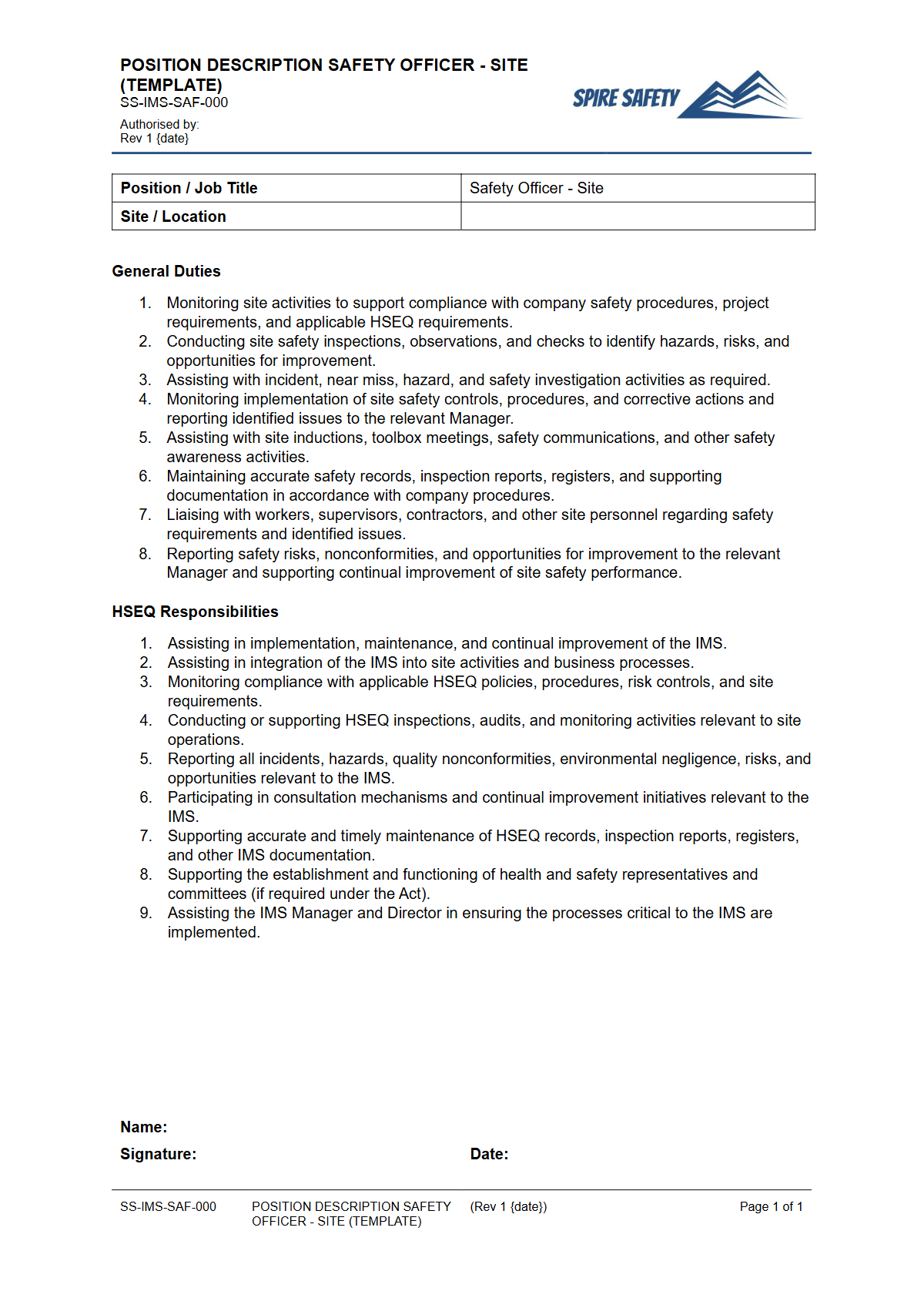
Defining roles and responsibilities is a cornerstone of a safe and efficient workplace. This Free Position Description (Safety Officer - Site) Template provides a structured starting point for organisations needing to recruit or formalise the duties of on-site safety personnel.
A well-written position description (PD) clarifies expectations, establishes reporting lines, and ensures that critical safety functions are assigned and understood. It serves as a vital tool not only for recruitment and onboarding but also for performance management and ongoing professional development.
Using a clear and comprehensive PD helps integrate the safety function directly into your operational structure. It ensures the Site Safety Officer understands their specific duties, from conducting inspections and risk assessments to delivering toolbox talks and participating in incident investigations.
This clarity is essential for building a proactive safety culture and a robust WHS management system that effectively manages risk across the project lifecycle.
How to use the Free Position Description (Safety Officer - Site) Template
This template is provided in both DOCX and PDF formats for your convenience. The DOCX file is fully editable, allowing you to tailor it to the unique demands of your worksite, company structure, and industry.
A generic PD is a weak control; its true value comes from specific customisation that reflects your operational reality. When adapting the document, consider the specific hazards, equipment, and procedures relevant to your site.
Important: We have drafted this template to be aligned with common Australian WHS practices, but it is not a substitute for professional advice. You must customise this document to suit your specific business operations, risk profile, and the legislative requirements of your state or territory.
Ensure you clearly outline the required qualifications, licences (e.g., construction induction white card), and experience needed for the role. It should also align with the key WHS requirements for construction site safety if that is your industry.
When to use it
A formal Position Description for a Site Safety Officer should be used in several key situations. The most obvious is during the recruitment process when advertising for a new hire.
It provides potential candidates with a clear understanding of the role and its expectations. It's also an essential document for internal promotions or when assigning safety responsibilities to an existing employee on a new project. Regularly reviewing and updating the PD is also critical, especially when project scopes change, new high-risk activities are introduced, or following a significant incident where roles and responsibilities may need to be re-evaluated to prevent a recurrence and avoid the severe consequences of system failures.
Who should use it
This resource is designed for anyone responsible for managing personnel and safety on a worksite. This includes Human Resources (HR) managers, hiring managers, Project Managers, Site Supervisors, and business owners (PCBUs) in sectors such as construction, civil engineering, mining, manufacturing, and logistics.
It provides the necessary framework to ensure the person you appoint has a clear mandate. A key part of the officer's role is to verify that all personnel have received proper WHS inductions and are competent for their assigned tasks, making this PD a critical link in your overall safety assurance process.
The Site Safety Officer is the on-the-ground champion for your safety procedures, so their responsibilities must be unambiguous. Their duties often involve day-to-day activities like monitoring compliance with SWMS, delivering safety briefings, and ensuring risk controls are implemented correctly. For example, they may be responsible for communicating site rules via targeted safety meetings, such as those covered in our Traffic Management Toolbox Talk template.
The position description also forms a basis for assessing the performance of your safety personnel. It can be used as a reference during performance reviews to identify areas of strength and opportunities for further training.
For organisations aiming for higher levels of safety maturity, the activities defined in this PD can be reviewed during independent WHS compliance audits to verify that safety roles are being fulfilled as intended.
By establishing a clear set of responsibilities, you empower your Site Safety Officer to act decisively in protecting the health and safety of all workers. This document is one of many tools available to help you build a safer workplace. For more templates, checklists, and guides, browse our complete free WHS resources library.
Common mistakes
Common mistakes to avoid
- Using the generic template without customising it for specific site hazards and company procedures.
- Creating a simple list of tasks instead of defining key responsibilities and performance measures.
- Failing to review and update the PD as the project, site risks, or legislation changes.
- Not clearly defining the Safety Officer's authority and responsibility to stop unsafe work.
Legal references
Legal considerations
The following legal requirements may be relevant to this type of work.
- Work Health and Safety Act (Harmonised) — Provides the primary duties for protecting workers and other people from work health and safety risks.
- Work Health and Safety Regulations (Harmonised) — Sets out requirements supporting the management of workplace hazards and risks.
The following codes may be relevant to this type of work.
- Managing WHS Risks Code of Practice — Provides practical guidance on identifying hazards, assessing risks and applying effective controls.
- Work Health and Safety Consultation, Cooperation and Coordination Code of Practice — Provides practical guidance on consulting workers and coordinating with other duty holders.
- Managing the Work Environment and Facilities Code of Practice — Provides practical guidance on safe work environments, workplace facilities and related controls.
Did you know
An Administrative Control
A clear position description is a key administrative control measure that helps ensure safety-critical tasks are formally assigned and not overlooked.
More Than Enforcement
Effective site safety officers don't just enforce rules; they act as coaches and mentors, helping to build a positive and proactive safety culture from the ground up.
FAQ
Frequently asked questions
01What is the difference between a Site Safety Officer and a WHS Manager?
02Does this template cover all legal duties for a Safety Officer role?
03Can I adapt this PD for a Safety Coordinator or Advisor role?
04Is a dedicated Safety Officer legally required on every Australian worksite?
Share this resource
Free Position Description (Safety Officer - Site) Template
Browse Categories
How To Use It
- 1Download and open in Word or PDF.
- 2Replace the placeholders with your business details.
- 3Get it reviewed by a WHS specialist before rollout.
Need it customised?
Our WHS consultants can adapt this template to your site, run a gap analysis, or audit what you already have in place.
Book a Free Consultation WHS consulting servicesor call 1300 156 382
Related templates
- Free Position Description (Scaffolder) Template
- Free Position Description (Scheduler or Planner) Template
- Free Position Description (School Groundskeeper) Template
- Free Position Description (Security Officer) Template
- Free Position Description (Site Manager) Template
- Free Position Description (Site Supervisor) Template