
Free Position Description (Site Supervisor) Template
Clearly define site supervisor roles with our free position description template. A structured starting point for Australian workplaces.
Free Position Description (Site Supervisor) Template
DOCX • 135 KB + PDF
Updated Oct 2026
No signup required
Purpose of the Free Position Description (Site Supervisor) Template
A clear and comprehensive position description is a cornerstone of effective safety management. This is especially true for the Site Supervisor role, which carries significant operational and Work Health and Safety (WHS) responsibilities.
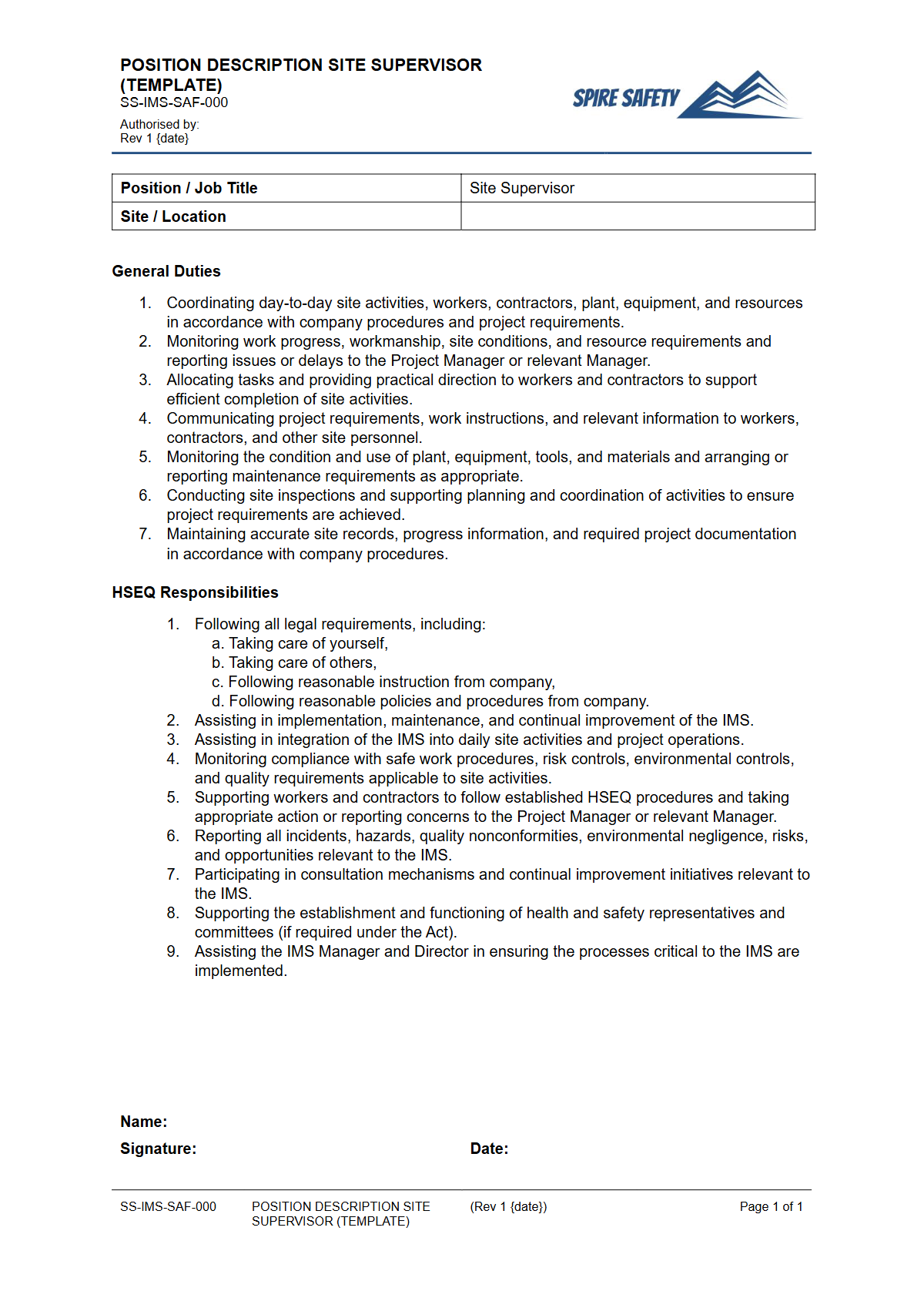
Our Free Position Description (Site Supervisor) Template provides a structured foundation for defining the authority, responsibilities, duties, and required competencies for this critical position. Using a detailed position description helps set clear expectations from day one, forming a basis for performance management, training needs analysis, and demonstrating due diligence.
The role of a Site Supervisor is pivotal in translating an organisation's safety policies into safe work practices on the ground. This template is designed to help you articulate these duties clearly, ensuring the candidate and the organisation have a shared understanding of the role's function.
It aligns with Australian WHS best practices by prompting you to detail responsibilities for hazard identification, risk assessment, incident reporting, and promoting a positive safety culture. A well-drafted PD is a key component in meeting the broader key WHS requirements for construction site safety.
How to Use the Free Position Description (Site Supervisor) Template
This template is provided as a DOCX file for easy editing and a PDF for reference. To use it, simply download the document and open it in your preferred word processor.
You will find sections covering the position's primary purpose, key responsibilities, reporting lines, qualifications, and experience. Each section includes placeholder text and prompts to guide you in adding information specific to your business and worksite.
Important: This is a template, not a finished document. You must customise it to reflect your organisation's specific structure, projects, culture, and risk profile.
We are not a law firm, and this document does not constitute legal advice. You must review the responsibilities outlined to ensure they align with your safety management system and relevant state or territory legislation. A properly customised position description is an invaluable tool in the onboarding process, complementing activities like The Importance of WHS Inductions for Employees.
When to Use It
A Site Supervisor position description should be used throughout the employment lifecycle. Its most obvious application is during recruitment and hiring to attract suitable candidates and provide clarity during interviews.
It is also a critical document for onboarding new supervisors, serving as a guide during their initial weeks. Beyond initial hiring, the position description should be a living document, referred to during performance reviews to assess achievement against key responsibilities and identify areas for professional development.
Furthermore, in the unfortunate event of a workplace incident, a well-defined position description can be essential. During an investigation, it helps clarify reporting lines and responsibilities, demonstrating that the organisation had structured processes in place for safety oversight.
As seen in a recent case study where an excavator killed a worker, a failure in supervision can have catastrophic consequences, highlighting the need for absolute clarity in this role.
Who Should Use It
This template is designed for use by anyone involved in managing personnel and WHS in sectors like construction, civil, mining, and manufacturing. This typically includes:
- Human Resources (HR) Managers: For creating consistent, role-appropriate documentation for recruitment and performance management.
- Project Managers and Construction Managers: To ensure their direct reports (Site Supervisors) have a clear and documented understanding of their operational and safety obligations.
- Company Directors and Senior Leaders: To establish clear lines of WHS accountability within their organisation's structure and as part of their broader due diligence obligations.
- Small Business Owners: For formalising roles and responsibilities within a growing team, ensuring safety leadership is clearly assigned.
Integrating this position description into your operational framework is a practical step towards building more robust WHS management systems. It helps ensure that accountability for safety is not just a policy statement but a defined and measurable part of a key individual's role. A supervisor's leadership in daily safety briefings is also critical; they are often responsible for delivering vital information, such as that found in our Traffic Management Toolbox Talk Template, to ensure site-specific risks are controlled.
Defining these responsibilities with precision is a complex task that must consider legal duties, operational needs, and human factors. If your organisation requires assistance in defining WHS roles or developing position descriptions that align with your specific risk profile, consider engaging professional WHS consulting services.
This document is just one of many tools available to help you build a safer workplace. Explore our complete free WHS resources library for more templates, checklists, and toolbox talks to support your safety management system.
Common mistakes
Common mistakes to avoid
- Using a generic template without customising it for site-specific hazards and company structure.
- Failing to clearly link WHS duties to measurable key performance indicators (KPIs).
- Not reviewing or updating the position description after an incident or a change in operations.
- Treating the document as a one-off recruitment tool instead of a live guide for performance management.
Legal references
Legal considerations
The following legal requirements may be relevant to this type of work.
- Work Health and Safety Act (Harmonised) — Provides the primary duties for protecting workers and other people from work health and safety risks.
- Work Health and Safety Regulations (Harmonised) — Sets out requirements supporting the management of workplace hazards and risks.
The following codes may be relevant to this type of work.
- Managing WHS Risks Code of Practice — Provides practical guidance on identifying hazards, assessing risks and applying effective controls.
- Work Health and Safety Consultation, Cooperation and Coordination Code of Practice — Provides practical guidance on consulting workers and coordinating with other duty holders.
- Managing the Work Environment and Facilities Code of Practice — Provides practical guidance on safe work environments, workplace facilities and related controls.
Did you know
Leadership Impact
Studies show that the visible safety leadership of frontline supervisors is one of the strongest predictors of worker safety behaviour and a positive safety culture on site.
PCBU and Officer Duties
Under model WHS law, a Site Supervisor acts as an agent of the PCBU (Person Conducting a Business or Undertaking) but may not necessarily be an 'Officer' with due diligence duties, depending on their level of influence over the business.
FAQ
Frequently asked questions
01What are the key WHS responsibilities of a Site Supervisor in Australia?
02Does this position description template cover all legal requirements?
03How often should a Site Supervisor's position description be reviewed?
04Can I use this template for a Leading Hand or Foreman role?
Share this resource
Free Position Description (Site Supervisor) Template
Browse Categories
How To Use It
- 1Download and open in Word or PDF.
- 2Replace the placeholders with your business details.
- 3Get it reviewed by a WHS specialist before rollout.
Need it customised?
Our WHS consultants can adapt this template to your site, run a gap analysis, or audit what you already have in place.
Book a Free Consultation WHS consulting servicesor call 1300 156 382
Related templates
- Free Position Description (Structural Engineer) Template
- Free Position Description (Tiler) Template
- Free Position Description (Training and Development Officer) Template
- Free Position Description (Truck Driver - Heavy Rigid) Template
- Free Position Description (Truck Driver - Multi-Combination) Template
- Free Position Description (Warehouse Manager) Template