
Free Position Description (Truck Driver - Heavy Rigid) Template
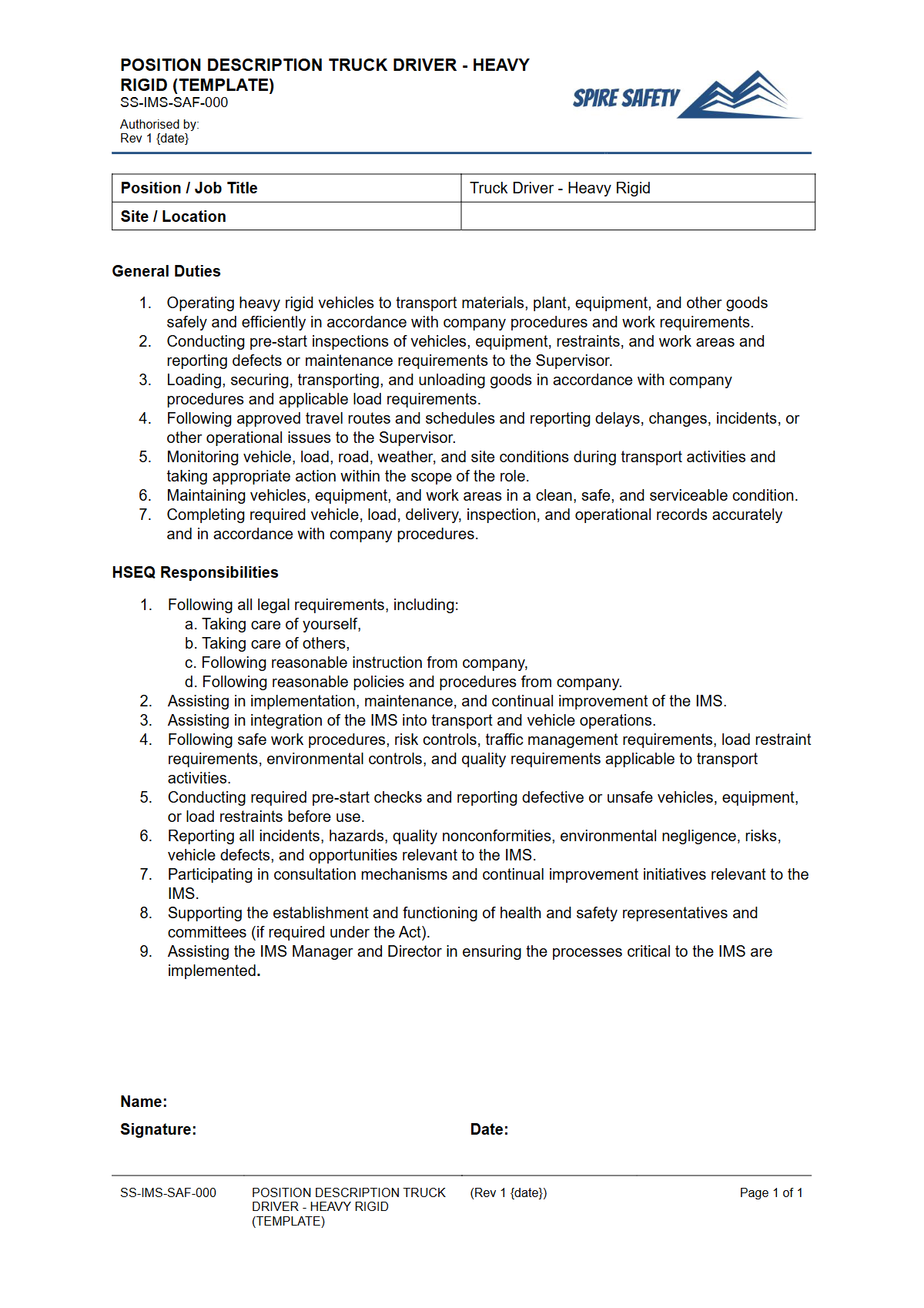
Clearly define the roles and safety responsibilities for your heavy vehicle operators with our Free Position Description (Truck Driver - Heavy Rigid) Template.
Free Position Description (Truck Driver - Heavy Rigid) Template
DOCX • 136 KB + PDF
Updated Oct 2026
No signup required
Purpose of the Free Position Description (Truck Driver - Heavy Rigid) Template
A well-drafted position description is a foundational tool for managing workplace safety and operational efficiency. This Free Position Description (Truck Driver - Heavy Rigid) Template provides a structured starting point for transport, logistics, and construction businesses to clearly define the responsibilities, qualifications, and safety duties for operators of heavy rigid vehicles.
Using a detailed position description helps ensure that drivers understand their specific obligations, including adherence to company policies, safe work procedures, and legislative requirements. It formalises expectations from recruitment through to day-to-day operations, forming a critical component of your safety framework.
Integrating this document into your operational procedures helps align driver activities with your broader risk management strategies. A clear Position Description is an essential document within comprehensive WHS management systems, linking individual roles to the organisation's overall safety objectives and compliance duties under the Heavy Vehicle National Law (HVNL).
How to use the Free Position Description (Truck Driver - Heavy Rigid) Template
This template is provided in both DOCX and PDF formats for your convenience. The DOCX version is fully editable, allowing you to tailor its content to the specific context of your organisation, worksites, and the types of heavy rigid trucks your team operates.
It is crucial that you customise this document to reflect your unique operational environment and safety requirements. We have provided a solid framework, but it is your responsibility to ensure the final document accurately represents the role within your business.
When customising, you should detail specific tasks, such as loading/unloading procedures, securing loads, coupling/decoupling trailers (if applicable), and communication protocols. You should also specify the exact qualifications needed beyond a Heavy Rigid (HR) licence, such as any required tickets or competencies.
This could include referencing a Vac Truck Verification of Competency (VOC) if the role involves operating such specialised equipment.
When to use a Position Description
A Position Description for a heavy rigid truck driver is a versatile document used throughout the employment lifecycle. Its primary use is during the recruitment and selection process to attract suitable candidates and provide a clear basis for interview questions.
Once an employee is hired, the document becomes a key part of their onboarding, helping to set clear expectations from day one. It also serves as a benchmark for performance reviews, training needs analysis, and career development discussions.
In the event of an incident, a clear PD can help clarify whether the worker was operating within the defined scope of their duties.
Who should use it
This template is designed for use by individuals responsible for managing human resources, operations, and safety within organisations that employ heavy vehicle drivers. This typically includes:
- Transport and Logistics Managers
- Fleet Supervisors
- Human Resources (HR) Professionals
- Work Health and Safety (WHS) Managers
- Business Owners of small to medium-sized transport or construction companies
These roles can leverage the template to standardise job requirements, streamline recruitment, and ensure that safety responsibilities are formally documented and communicated. For businesses needing support in adapting this template or developing broader safety protocols, seeking specialist WHS consulting can provide valuable guidance and ensure alignment with industry best practices.
Key Sections of the Position Description
Our template is structured to cover all critical aspects of the Truck Driver role. It includes sections for the position's primary purpose, key responsibilities (both operational and safety-related), reporting relationships, and required qualifications.
The WHS responsibilities section is particularly important, outlining duties such as conducting daily vehicle checks, reporting hazards, and complying with all safety procedures. For example, it establishes the expectation that drivers complete a dump truck pre-start checklist before each shift if applicable to their vehicle.
Documenting these duties helps to fulfil an employer's primary duty of care to provide necessary information and instruction. For high-risk activities often associated with heavy vehicles, a detailed PD should be used alongside a Safe Work Method Statement for tip truck operations or similar procedural documents to ensure all risks are controlled.
Common mistakes
Common mistakes to avoid
- Using a generic, non-customised position description that doesn't reflect specific site or vehicle risks.
- Failing to clearly list specific WHS responsibilities, such as fatigue management and vehicle pre-start checks.
- Neglecting to update the position description after changes in equipment, routes, or company procedures.
- Not using the position description as an active tool for performance reviews and identifying training needs.
Legal references
Legal considerations
The following legal requirements may be relevant to this type of work.
- Work Health and Safety Act (Harmonised) — Provides the primary duties for protecting workers and other people from work health and safety risks.
- Work Health and Safety Regulations (Harmonised) — Sets out requirements supporting the management of workplace hazards and risks.
The following codes may be relevant to this type of work.
- Managing WHS Risks Code of Practice — Provides practical guidance on identifying hazards, assessing risks and applying effective controls.
- Work Health and Safety Consultation, Cooperation and Coordination Code of Practice — Provides practical guidance on consulting workers and coordinating with other duty holders.
- Managing the Work Environment and Facilities Code of Practice — Provides practical guidance on safe work environments, workplace facilities and related controls.
Did you know
Fatigue is a Critical Risk
According to the National Transport Commission, driver fatigue is a factor in a significant percentage of heavy vehicle crashes in Australia. Managing fatigue through work scheduling, breaks, and driver education is a key WHS responsibility for transport operators.
FAQ
Frequently asked questions
01What is a Heavy Rigid (HR) licence in Australia?
02Does a position description for a truck driver need to include WHS duties?
03Can I use this template for other truck driver licence classes?
04How often should a position description be reviewed?
Share this resource
Free Position Description (Truck Driver - Heavy Rigid) Template
Browse Categories
How To Use It
- 1Download and open in Word or PDF.
- 2Replace the placeholders with your business details.
- 3Get it reviewed by a WHS specialist before rollout.
Need it customised?
Our WHS consultants can adapt this template to your site, run a gap analysis, or audit what you already have in place.
Book a Free Consultation WHS consulting servicesor call 1300 156 382
Related templates
- Free Position Description (Truck Driver - Multi-Combination) Template
- Free Position Description (Warehouse Manager) Template
- Free Position Description (Welder or Fabricator) Template
- Free Position Description (WHS Adviser or Officer) Template
- Free Position Description (WHS Coordinator) Template
- Free Position Description (Work Health and Safety Manager) Template