
Free Position Description (Welder or Fabricator) Template
Clearly define roles, responsibilities, and safety duties for welders and fabricators.
Free Position Description (Welder or Fabricator) Template
DOCX • 135 KB + PDF
Updated Oct 2026
No signup required
Purpose of the Free Position Description (Welder or Fabricator) Template
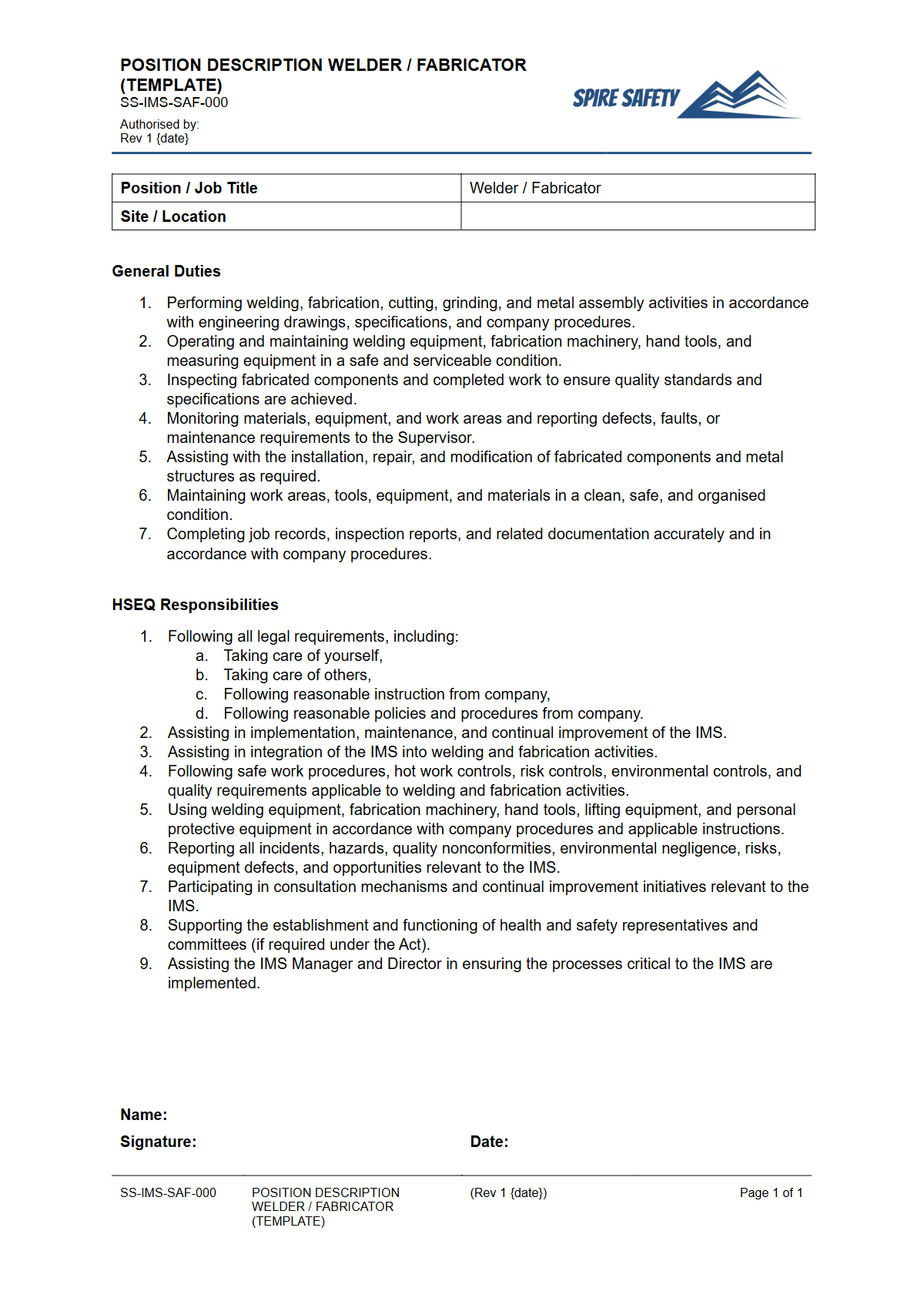
A well-drafted position description is more than just a recruitment tool; it’s a cornerstone of effective safety management. This Free Position Description (Welder or Fabricator) Template provides a structured framework for clearly defining the role, responsibilities, qualifications, and critical safety duties for welding and fabrication personnel.
It helps ensure that from the very beginning, applicants and employees understand the expectations, reporting lines, and their personal obligations to maintain a safe working environment. Using a detailed Position Description helps integrate safety into the role itself, rather than treating it as an afterthought.
How to use the Free Position Description (Welder or Fabricator) Template
To get started with the Free Position Description (Welder or Fabricator) Template, simply download your preferred format (DOCX for easy editing or PDF for reference). The template is pre-filled with common sections relevant to welders and fabricators in an Australian context, providing a solid foundation aligned with modern WHS practices.
Please note: We've provided this template as a structured starting point. You must review and customise it to reflect the specific hazards, equipment, processes, and reporting structures of your own workplace.
A generic document is not sufficient; it needs to be tailored to your site-specific conditions.
A robust Position Description should align with other key safety documents. For example, the duties outlined should be consistent with the steps detailed in your operational safety documents, such as a Safe Operating Procedure (SOP) template for TIG Welder operation. This creates a cohesive safety message across all documentation.
Key Components in the Template
- Position Summary: A brief overview of the role's purpose within the organisation.
- Key Responsibilities: Lists the primary tasks, such as interpreting blueprints, operating welding equipment (e.g., MIG, TIG, Stick), cutting and shaping metal, and performing quality checks.
- WHS Responsibilities: A dedicated section to outline safety-specific duties, including the correct use of PPE, adherence to SOPs and SWMS, participation in toolbox talks, and hazard reporting.
- Qualifications and Experience: Specifies necessary certifications (e.g., AS/NZS ISO 9606), tickets, and desired experience levels.
- Physical Demands: Details the physical requirements of the job, such as lifting, standing for long periods, working in confined or hot environments, and manual dexterity. This is crucial for managing manual handling risks.
When to use it
This Position Description is most valuable during key phases of the employment lifecycle. It is essential when recruiting new welders or fabricators to attract suitable candidates and set clear expectations.
It also serves as a foundational document for conducting performance reviews, identifying training needs, and managing employee development. Furthermore, incorporating detailed Position Descriptions is a fundamental part of building and maintaining effective WHS management systems, ensuring that roles and responsibilities are formally documented and understood throughout the business.
Who should use it
This template is designed for anyone involved in managing personnel in fabrication, manufacturing, construction, or maintenance environments. This includes:
- Human Resources (HR) Managers: For creating clear, consistent, and fair job advertisements and employment contracts.
- Workshop Managers and Supervisors: To clarify daily expectations, manage performance, and enforce safety standards on the floor.
- WHS/OHS Officers: To ensure that critical safety duties are formally assigned and integrated into every role.
- Business Owners: To establish a clear organisational structure and demonstrate due diligence in defining safety responsibilities.
Beyond the Position Description: Verifying Competency
A position description defines the requirements of a role, but it does not confirm a person's ability to perform tasks safely. After hiring, it is crucial to verify the operator's practical skills.
A Verification of Competency (VOC) is a formal process to confirm that an individual has the current skills and knowledge to operate equipment or perform tasks safely.
For roles involving specific welding types, using a targeted assessment is best practice. For example, you can use our free Verification of Competency (MIG Welder) Template to assess an operator's ability to safely handle MIG welding equipment and processes.
Similarly, for more precise work, a welder's skill with other methods should be checked. Our Verification of Competency (TIG Welder) template provides a structured checklist for assessing TIG welding proficiency and safety knowledge.
If you need help tailoring these documents or implementing a full competency framework as part of your safety system, our WHS consulting services can provide expert guidance.
Common mistakes
Common mistakes to avoid
- Using a generic description without tailoring it to site-specific equipment, hazards, and procedures.
- Failing to clearly specify the physical demands of the job, leading to potential musculoskeletal injuries.
- Omitting specific WHS responsibilities, treating them as implied rather than explicit duties of the role.
- Not reviewing and updating the position description when roles change or new equipment is introduced.
Legal references
Legal considerations
The following legal requirements may be relevant to this type of work.
- Work Health and Safety Act (Harmonised) — Provides the primary duties for protecting workers and other people from work health and safety risks.
- Work Health and Safety Regulations (Harmonised) — Sets out requirements supporting the management of workplace hazards and risks.
The following codes may be relevant to this type of work.
- Managing WHS Risks Code of Practice — Provides practical guidance on identifying hazards, assessing risks and applying effective controls.
- Work Health and Safety Consultation, Cooperation and Coordination Code of Practice — Provides practical guidance on consulting workers and coordinating with other duty holders.
- Managing the Work Environment and Facilities Code of Practice — Provides practical guidance on safe work environments, workplace facilities and related controls.
Did you know
Arc Eye is Sunburn
Welder's flash, or arc eye, is a painful condition caused by UV radiation from the welding arc. It is essentially a sunburn on the cornea of the eye and can cause significant pain and temporary vision loss.
Extreme Temperatures
The temperature of a welding arc can reach approximately 5,500 degrees Celsius, which is hotter than the surface of the sun. This extreme heat poses significant fire, explosion, and burn risks that must be carefully controlled.
FAQ
Frequently asked questions
01What WHS responsibilities should be included in a welder's position description?
02Is a position description a legal requirement in Australia?
03How does a position description differ from a Safe Work Method Statement (SWMS)?
04Can I use this template for both MIG and TIG welders?
Share this resource
Free Position Description (Welder or Fabricator) Template
Browse Categories
How To Use It
- 1Download and open in Word or PDF.
- 2Replace the placeholders with your business details.
- 3Get it reviewed by a WHS specialist before rollout.
Need it customised?
Our WHS consultants can adapt this template to your site, run a gap analysis, or audit what you already have in place.
Book a Free Consultation WHS consulting servicesor call 1300 156 382
Related templates
- Free Position Description (WHS Adviser or Officer) Template
- Free Position Description (WHS Coordinator) Template
- Free Position Description (Work Health and Safety Manager) Template
- Free Position Description Template
- Free Position Description (Accounts or Bookkeeper) Template
- Free Position Description (Administration Officer) Template