
Free Safe Operating Procedure (Welder - TIG Operation) Template
Download our free Safe Operating Procedure (SOP) template for TIG Welder operation.
Free Safe Operating Procedure (Welder - TIG Operation) Template
DOCX • 180 KB + PDF
Updated Oct 2026
No signup required
Purpose of the Free Safe Operating Procedure (Welder - TIG Operation) Template
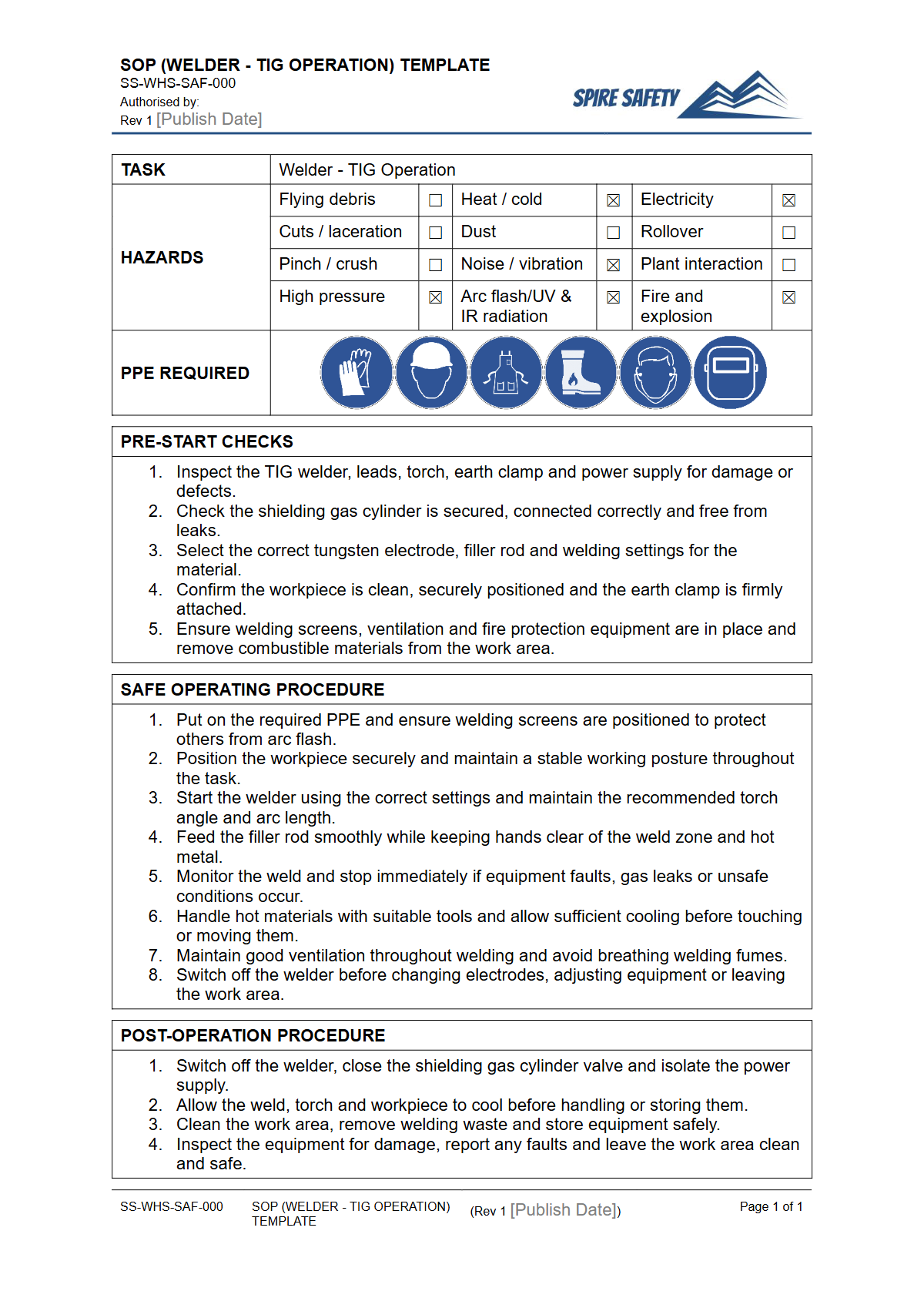
Operating a Tungsten Inert Gas (TIG) welder involves significant hazards, including intense ultraviolet (UV) radiation, electrical shock, exposure to welding fumes, and severe burns. This free Safe Operating Procedure (Welder - TIG Operation) Template provides a structured framework for documenting the controls required to manage these risks effectively.
By outlining a clear, step-by-step process for pre-operational checks, setup, operation, and shutdown, this SOP helps organisations ensure that TIG welding tasks are performed safely and consistently.
A documented Safe Operating Procedure is a fundamental component of a safe system of work. It serves as a vital training tool for new operators, a reference for experienced personnel, and evidence of your organisation's commitment to proactive risk management.
Implementing a robust SOP for high-risk equipment like a TIG welder is a key step in fulfilling your duties under Australian WHS legislation.
Key Risks Addressed by this Safe Operating Procedure:
- Electrical Hazards: Guidance on inspecting leads, connections, and grounding to prevent electric shock.
- Radiation Exposure: Controls for arc eye and skin burns from UV and infrared radiation.
- Fumes and Gases: Emphasis on ventilation and respiratory protection to manage hazardous airborne contaminants.
- Fire and Explosion: Procedures for clearing the work area of flammable materials and having appropriate fire suppression equipment ready.
- Burns: Steps for handling hot workpieces and equipment safely.
Video walkthrough
How to use the Free Safe Operating Procedure (Welder - TIG Operation) Template
This document is a template and must be customised to your specific workplace. Download the DOCX file and adapt it to reflect the actual TIG welding equipment, materials, and environment at your site.
Consult with the operators who perform the task—their direct experience is invaluable for creating a practical and effective procedure. It's crucial to ensure the final SOP is integrated into your broader WHS management systems, linking it to risk assessments, training records, and maintenance logs.
IMPORTANT NOTE: This template provides a starting point. We are not WHS consultants providing advice.
You must consult with your team and a qualified safety professional to ensure the final document is specific, relevant, and adequate for your workplace. The responsibility for creating a safe work environment and a document rests with the PCBU (Person Conducting a Business or Undertaking).
When to use a Safe Operating Procedure
A Safe Operating Procedure for TIG welding should be used in several key situations. It's essential during the induction and training of new employees or when an existing worker is being trained on TIG welding for the first time.
It should also be readily available at the work area as a constant reference for operators. Supervisors can use the SOP to conduct pre-start checks or observe work practices to ensure they align with the documented procedure.
Furthermore, the SOP is a critical document to review after any incident, near-miss, or when changes are made to equipment or processes.
For tasks that are part of a larger fabrication project, the SOP should be used alongside other procedural documents. For example, if metal requires surface preparation before welding, you might also consult a free Sand Blasting SOP to ensure all stages of the job are covered by a safe work method.
Who should use this Safe Operating Procedure
This SOP template is designed for a range of personnel within an organisation. WHS managers, supervisors, and team leaders will use it to establish and enforce safety standards.
They are responsible for customising the template, training workers, and ensuring the procedures are followed. Competent and authorised TIG welder operators are the primary end-users, relying on the SOP to guide their daily work practices and reinforce safe behaviour.
Maintenance personnel may also reference the SOP to understand the operational context before conducting service or repairs, especially regarding lockout/tagout procedures.
Regular review of your SOPs is a critical part of maintaining a safe workplace. An internal or external WHS compliance auditing process can help identify gaps and opportunities for improvement in your documented procedures and their practical application.
Many workshop environments contain a variety of equipment, each requiring its own procedure. For instance, tasks may involve using other machinery, and having a specific Brake Press SOP template or an Air Compressor Safe Operating Procedure ensures that all high-risk activities are managed systematically.
You can find these and more in our free WHS resources library to build a comprehensive set of safety documents for your workplace.
Common mistakes
Common mistakes to avoid
- Failing to ensure adequate ventilation, leading to the inhalation of hazardous fumes and shielding gases.
- Using an incorrect lens shade in the welding helmet, resulting in arc eye and long-term vision damage.
- Neglecting to secure a proper earth clamp connection, causing a poor-quality weld and increasing electrical risk.
- Handling hot, freshly welded material without appropriate gloves or tools, leading to severe burns.
Legal references
Legal considerations
The following legal requirements may be relevant to this type of work.
- Work Health and Safety Act (Harmonised) — Provides the primary duties for protecting workers and other people from work health and safety risks.
- Work Health and Safety Regulations (Harmonised) — Sets out requirements supporting the management of workplace hazards and risks.
The following codes may be relevant to this type of work.
- Managing WHS Risks Code of Practice — Provides practical guidance on identifying hazards, assessing risks and applying effective controls.
- Work Health and Safety Consultation, Cooperation and Coordination Code of Practice — Provides practical guidance on consulting workers and coordinating with other duty holders.
- Managing the Work Environment and Facilities Code of Practice — Provides practical guidance on safe work environments, workplace facilities and related controls.
Did you know
Intense Radiation
The electric arc in TIG welding produces intense ultraviolet (UV) radiation, which can cause severe 'arc eye' (photokeratitis) and skin burns similar to extreme sunburn in just minutes of unprotected exposure.
Inert Gas Shield
The 'IG' in TIG stands for 'Inert Gas'. Argon is commonly used to create a shield around the weld pool, protecting it from atmospheric oxygen and nitrogen to create a cleaner, higher-quality weld.
FAQ
Frequently asked questions
01What is the difference between an SOP and a SWMS for TIG welding?
02How often should a TIG welding SOP be reviewed?
03What personal protective equipment (PPE) is essential for TIG welding?
04Does this SOP cover specific filler metals or base materials?
Share this resource
Free Safe Operating Procedure (Welder - TIG Operation) Template
Browse Categories
How To Use It
- 1Download and open in Word or PDF.
- 2Replace the placeholders with your business details.
- 3Get it reviewed by a WHS specialist before rollout.
Need it customised?
Our WHS consultants can adapt this template to your site, run a gap analysis, or audit what you already have in place.
Book a Free Consultation WHS consulting servicesor call 1300 156 382
Related templates
- Free Safe Operating Procedure (Welding Fume Extractor) Template
- Free Safe Operating Procedure (Welding Positioner) Template
- Free Safe Operating Procedure (Welding Rotator) Template
- Free Safe Operating Procedure (Wet Floor Cleaning) Template
- Free Safe Operating Procedure (Wet Sanding) Template
- Free Safe Operating Procedure (Wet Vacuum) Template