
Free Safe Operating Procedure (Wet Sanding) Template
Download our free Safe Operating Procedure (Wet Sanding) Template to formalise safety controls for your workplace. Customise this DOCX to your needs.
Free Safe Operating Procedure (Wet Sanding) Template
DOCX • 126 KB + PDF
Updated Oct 2026
No signup required
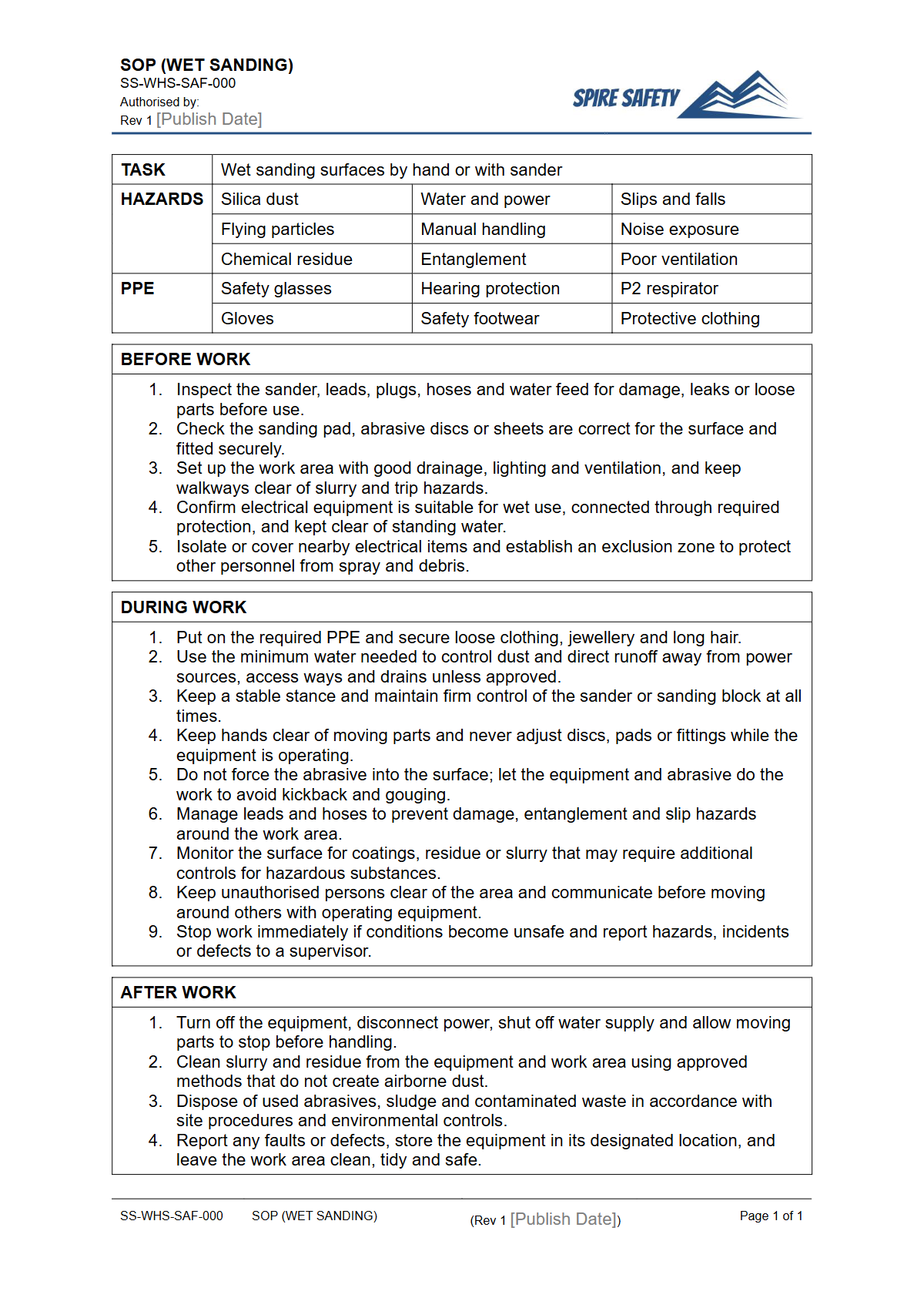
Purpose of the Free Safe Operating Procedure (Wet Sanding) Template
Wet sanding is a common finishing process used to reduce airborne dust, but it introduces other significant hazards, primarily electrical shock and slips. This Free Safe Operating Procedure (Wet Sanding) Template provides a structured framework for documenting the risks and control measures associated with the task.
Using a formal SOP helps ensure workers understand the required steps to perform the job safely, promoting a consistent and compliant approach to workplace health and safety.
A documented SOP is a key part of a safe system of work. It serves as an essential tool for training, supervision, and risk management, helping your organisation meet its duty of care under Australian WHS regulations.
Video walkthrough
How to use the Free Safe Operating Procedure (Wet Sanding) Template
This template is available as a fully editable DOCX file for easy customisation and a PDF for immediate use. It is designed as a starting point, outlining the common steps, hazards, and controls for wet sanding tasks.
To be effective, you must adapt the content to reflect your specific operational environment.
Important: This is a template, not a finished document. We strongly advise that you customise it by adding details specific to your workplace's equipment (brand and model), sanding materials, surfaces, and environment in consultation with your workers.
For assistance with developing and implementing site-specific procedures, consider engaging professional WHS consulting services.
When to use it
A Safe Operating Procedure for wet sanding should be a core part of your safety management system. It should be used during:
- Worker Training and Induction: To teach new and existing employees the correct, safe method for wet sanding.
- Pre-Task Planning: As a reference for workers and supervisors before starting a wet sanding job.
- Risk Assessments: As a baseline document when conducting a formal WHS compliance auditing process or risk assessment for the task.
- Incident Investigations: To compare the established procedure with how the task was actually performed if an incident occurs.
Who should use it
The responsibility for managing workplace safety is shared. This SOP should be used by:
- Persons Conducting a Business or Undertaking (PCBUs): To fulfil their primary duty of care by providing and maintaining a safe system of work.
- Managers and Supervisors: To train workers, enforce safety standards, and monitor compliance with the procedure.
- Workers: To understand and follow the approved safety steps required to protect themselves and others from harm.
Key Hazards in Wet Sanding
While wet sanding effectively suppresses dust, it introduces other risks that must be managed. The SOP prompts you to consider hazards such as:
- Electrical Hazards: The combination of water and electrical power tools creates a high risk of electric shock or electrocution if equipment is not suitable or maintained.
- Slips, Trips, and Falls: Water and slurry on the floor create extremely slippery surfaces.
- Hazardous Substances: The slurry created can contain hazardous particles from the sanded material (e.g., paints, fillers, resins) and may cause skin irritation or dermatitis.
- Ergonomic Hazards: Prolonged use of sanding equipment can lead to musculoskeletal injuries from vibration, repetition, and awkward postures.
Wet sanding often occurs in workshops where other equipment is in use. It is vital to manage risks from all powered plant.
For instance, if your sanders are pneumatic, a free Air Compressor SOP template is essential for managing the associated power source safely.
Essential Control Measures
An effective SOP details the specific controls needed to mitigate risks. This includes specifying the required Personal Protective Equipment (PPE) like waterproof gloves, non-slip enclosed footwear, and eye protection.
It also reinforces the mandatory use of a residual current device (RCD) for all portable electrical tools used near water. These documented controls are a vital part of your overall WHS management systems.
For workshops involved in broader fabrication or finishing tasks, consider SOPs for every stage of the process. If you are cutting materials before sanding, a FREE Circular Saw SOP Template will help ensure safety is maintained throughout the entire job workflow.
Review and Improvement
A Safe Operating Procedure is a dynamic document. It should be reviewed regularly—typically on an annual basis—or whenever there is a change in equipment, processes, or after a safety incident.
This commitment to review ensures the procedure remains relevant and effective. For more templates and safety resources to support your WHS program, browse our complete free WHS resources library.
Common mistakes
Common mistakes to avoid
- Using damaged or non-water-rated electrical equipment, or failing to use an RCD.
- Neglecting to clean up water and slurry promptly, creating a serious slip and fall hazard for everyone in the area.
- Failing to wear appropriate waterproof gloves, leading to skin irritation or chemical absorption.
- Using the generic template without customising it for the specific tools, chemicals, and risks in the workplace.
Legal references
Legal considerations
The following legal requirements may be relevant to this type of work.
- Work Health and Safety Act (Harmonised) — Provides the primary duties for protecting workers and other people from work health and safety risks.
- Work Health and Safety Regulations (Harmonised) — Sets out requirements supporting the management of workplace hazards and risks.
The following codes may be relevant to this type of work.
- Managing WHS Risks Code of Practice — Provides practical guidance on identifying hazards, assessing risks and applying effective controls.
- Work Health and Safety Consultation, Cooperation and Coordination Code of Practice — Provides practical guidance on consulting workers and coordinating with other duty holders.
- Managing the Work Environment and Facilities Code of Practice — Provides practical guidance on safe work environments, workplace facilities and related controls.
Did you know
Slurry Hazards
The slurry produced during wet sanding isn't just water. It can contain heavy metals, isocyanates from clear coats, and other chemicals that can be absorbed through the skin, making waterproof gloves a critical piece of PPE.
Electrical Sensitivity
A standard Residual Current Device (RCD) is designed to trip in less than 30 milliseconds when it detects a current imbalance of just 30 milliamperes (0.03 amps), which is far below the level that can cause a fatal electric shock.
FAQ
Frequently asked questions
01What is the main safety advantage of wet sanding over dry sanding?
02What PPE is essential for wet sanding?
03How do I manage electrical risk when wet sanding with a power tool?
04Is a Safe Operating Procedure a legal requirement for wet sanding?
Share this resource
Free Safe Operating Procedure (Wet Sanding) Template
Browse Categories
How To Use It
- 1Download and open in Word or PDF.
- 2Replace the placeholders with your business details.
- 3Get it reviewed by a WHS specialist before rollout.
Need it customised?
Our WHS consultants can adapt this template to your site, run a gap analysis, or audit what you already have in place.
Book a Free Consultation WHS consulting servicesor call 1300 156 382
Related templates
- Free Safe Operating Procedure (Wet Vacuum) Template
- Free Safe Operating Procedure (Wetland Cleanup) Template
- Free Safe Operating Procedure (Wheel Balancer) Template
- Free Safe Operating Procedure (Wheel Nut Torquing) Template
- Free Safe Operating Procedure (Wheel Removal) Template
- Free Safe Operating Procedure (Wheel Stud Replacement) Template