
Free Safe Operating Procedure (Wheel Removal) Template
Download our free Safe Operating Procedure (Wheel Removal) template to document the step-by-step process for this hazardous task. Get your DOCX and PDF now.
Free Safe Operating Procedure (Wheel Removal) Template
DOCX • 126 KB + PDF
Updated Oct 2026
No signup required
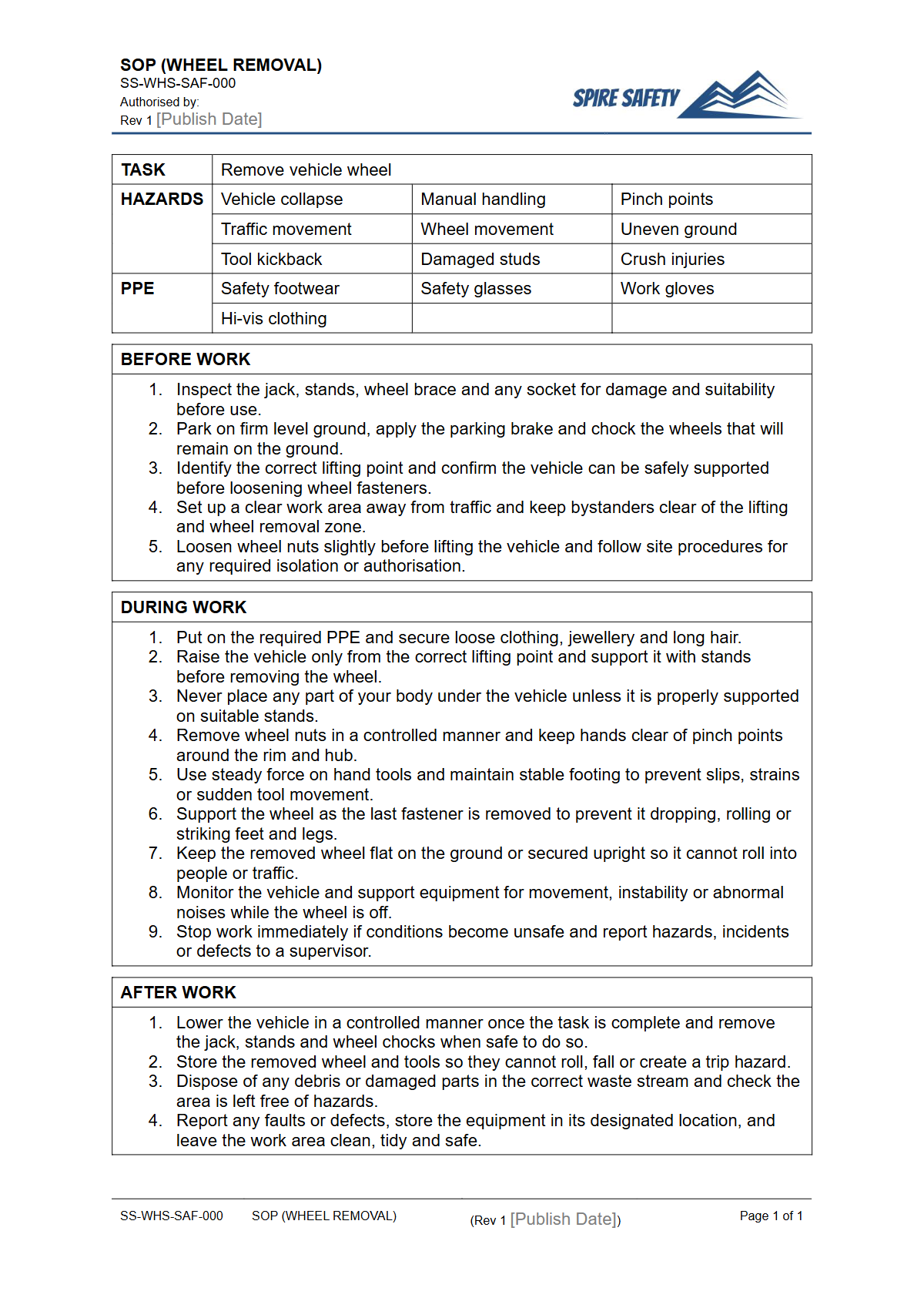
Purpose of the Free Safe Operating Procedure (Wheel Removal) Template
Effectively managing workplace hazards is crucial, and the task of wheel removal presents significant risks if not controlled. Our Free Safe Operating Procedure (Wheel Removal) Template provides a structured framework for documenting the required safety controls for this common but hazardous maintenance activity.
This customisable document helps organisations outline the step-by-step process, identify potential hazards, and specify the personal protective equipment (PPE) needed to ensure worker safety.
A documented SOP is a key element of any effective WHS management system, demonstrating a commitment to proactive risk management. It serves as a vital training tool for new workers and a reference for experienced personnel, helping to standardise safe work practices across your entire operation and providing clear instructions to follow in both routine and emergency situations.
Video walkthrough
How to use the Free Safe Operating Procedure (Wheel Removal) Template
This Safe Operating Procedure is provided as a starting point. It is available in both DOCX and PDF formats, with the DOCX file being fully editable.
You must adapt the content to the specific types of vehicles, equipment, and environmental conditions at your worksite. A generic procedure is not sufficient to ensure safety, and compliance depends on the quality of your site-specific customisation.
Key Customisation Steps
- Plant and Equipment: List the specific makes and models of jacks, axle stands, wheel chocks, and torque wrenches used.
- Task-Specific Hazards: Identify unique risks at your site, such as uneven ground, poor lighting, or proximity to traffic.
- Control Measures: Detail your exact control measures, including lifting points, jack stand placement, and nut tightening sequences and torque values.
- Emergency Procedures: Include site-specific emergency contacts and procedures for incidents like jack failure or injury.
Remember to integrate procedures for associated equipment. For example, if pneumatic tools are used, the process should align with the controls outlined in your workshop's free Air Compressor SOP template.
When to use this Safe Operating Procedure
This Safe Operating Procedure should be referenced every time a wheel removal task is performed, especially on heavy vehicles, mobile plant, or in a commercial workshop setting. It applies to any maintenance or repair work that requires a wheel to be taken off, such as brake inspections, bearing replacements, or suspension work, not just tyre changes.
Using the SOP consistently helps reinforce safe behaviour and ensures no critical safety steps are missed, particularly when workers are under pressure or performing the task infrequently.
For tasks involving associated high-risk activities like heating seized components, the SOP must integrate with other procedures, such as those in a specific Oxy Acetylene SOP template, to manage the combined hazards effectively. The document should form a key piece of evidence during safety assessments and can be used to demonstrate procedural controls.
Who is Responsible for the SOP?
Under Australian WHS law, the Person Conducting a Business or Undertaking (PCBU) has the primary duty of care to ensure workplace safety. This includes developing and implementing safe systems of work, like SOPs.
Managers and supervisors are responsible for ensuring the wheel removal SOP is implemented, understood, and followed by their teams. Their role includes providing adequate training, resources, and supervision.
Supervisors should also conduct regular checks to verify that the work is being performed according to the SOP. This procedural confirmation can be part of routine inspections or a more formal process like scheduled WHS compliance auditing to ensure the system remains effective over time.
Competency and Training
Workers tasked with removing wheels must be competent to do so safely. Competency is a combination of training, knowledge, and experience.
This SOP is a critical tool for training, but it does not replace hands-on instruction and assessment. Workers must be trained on the specific procedure, understand the hazards involved, and demonstrate their ability to perform the task safely before being authorised to work unsupervised.
Training records should be kept for all workers who perform this task. For operators of specific machinery where wheel maintenance is part of their role, this SOP can supplement equipment-specific training guides.
For instance, it can be used alongside a FREE Telehandler SOP Template to cover all aspects of that machine's safe use and maintenance.
Common mistakes
Common mistakes to avoid
- Using incorrect or damaged lifting equipment, such as bottle jacks without a base plate on soft ground.
- Working under a vehicle that is only supported by a hydraulic or pneumatic jack, without certified axle stands.
- Failing to correctly torque wheel nuts in the specified sequence and to the manufacturer's specifications.
- Neglecting to fully deflate tyres before starting any work on multi-piece or split-rim assemblies.
Legal references
Legal considerations
The following legal requirements may be relevant to this type of work.
- Work Health and Safety Act (Harmonised) — Provides the primary duties for protecting workers and other people from work health and safety risks.
- Work Health and Safety Regulations (Harmonised) — Sets out requirements supporting the management of workplace hazards and risks.
The following codes may be relevant to this type of work.
- Managing WHS Risks Code of Practice — Provides practical guidance on identifying hazards, assessing risks and applying effective controls.
- Work Health and Safety Consultation, Cooperation and Coordination Code of Practice — Provides practical guidance on consulting workers and coordinating with other duty holders.
- Managing the Work Environment and Facilities Code of Practice — Provides practical guidance on safe work environments, workplace facilities and related controls.
Did you know
Wheel-Off Incidents
Incorrect torqueing procedures are a leading cause of wheel-off incidents on heavy vehicles. National studies have highlighted that improper fastening, often due to a lack of a clear procedure or using the wrong tools, can lead to catastrophic accidents.
Stored Energy
A heavy vehicle tyre can contain immense stored energy. An uncontrolled release during a tyre explosion, particularly with multi-piece rims, can be fatal to anyone in the immediate vicinity, releasing forces equivalent to several kilograms of explosives.
FAQ
Frequently asked questions
01What should be included in a Safe Operating Procedure for wheel removal?
02Why is a specific SOP needed for changing a tyre or wheel?
03Who is responsible for writing a Safe Operating Procedure for wheel removal?
04How often should a wheel removal SOP be reviewed?
Share this resource
Free Safe Operating Procedure (Wheel Removal) Template
Browse Categories
How To Use It
- 1Download and open in Word or PDF.
- 2Replace the placeholders with your business details.
- 3Get it reviewed by a WHS specialist before rollout.
Need it customised?
Our WHS consultants can adapt this template to your site, run a gap analysis, or audit what you already have in place.
Book a Free Consultation WHS consulting servicesor call 1300 156 382
Related templates
- Free Safe Operating Procedure (Wheel Stud Replacement) Template
- Free Safe Operating Procedure (Wheelchair Brake Check) Template
- Free Safe Operating Procedure (Wheelchair Charging) Template
- Free Safe Operating Procedure (Wheelchair Cushion Clean) Template
- Free Safe Operating Procedure (Wheelchair Footrest) Template
- Free Safe Operating Procedure (Wheelchair Handling) Template